When engineers specify HDPE pipes for water supply, drainage, or cable protection projects, one claim appears consistently across technical datasheets: a 50-year design life. Project owners and procurement managers sometimes question this figure. Is it a genuine engineering calculation or a marketing number?
It is a genuine engineering calculation — and the real number is actually higher. This post explains the science behind HDPE pipe lifespan, what the 50-year figure means, what actual service data shows, and what determines how long your specific installation will last.
The 50-Year Design Life: What It Actually Means
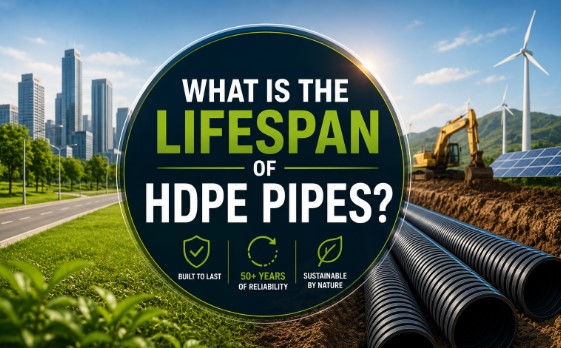
The 50-year service life is not an estimate or a sales claim. It is a minimum requirement established by India’s IS 4984:2016 standard and the international standards ISO 9080 and ISO 12162, verified through a precise testing and extrapolation methodology called Long-Term Hydrostatic Strength (LTHS) testing.
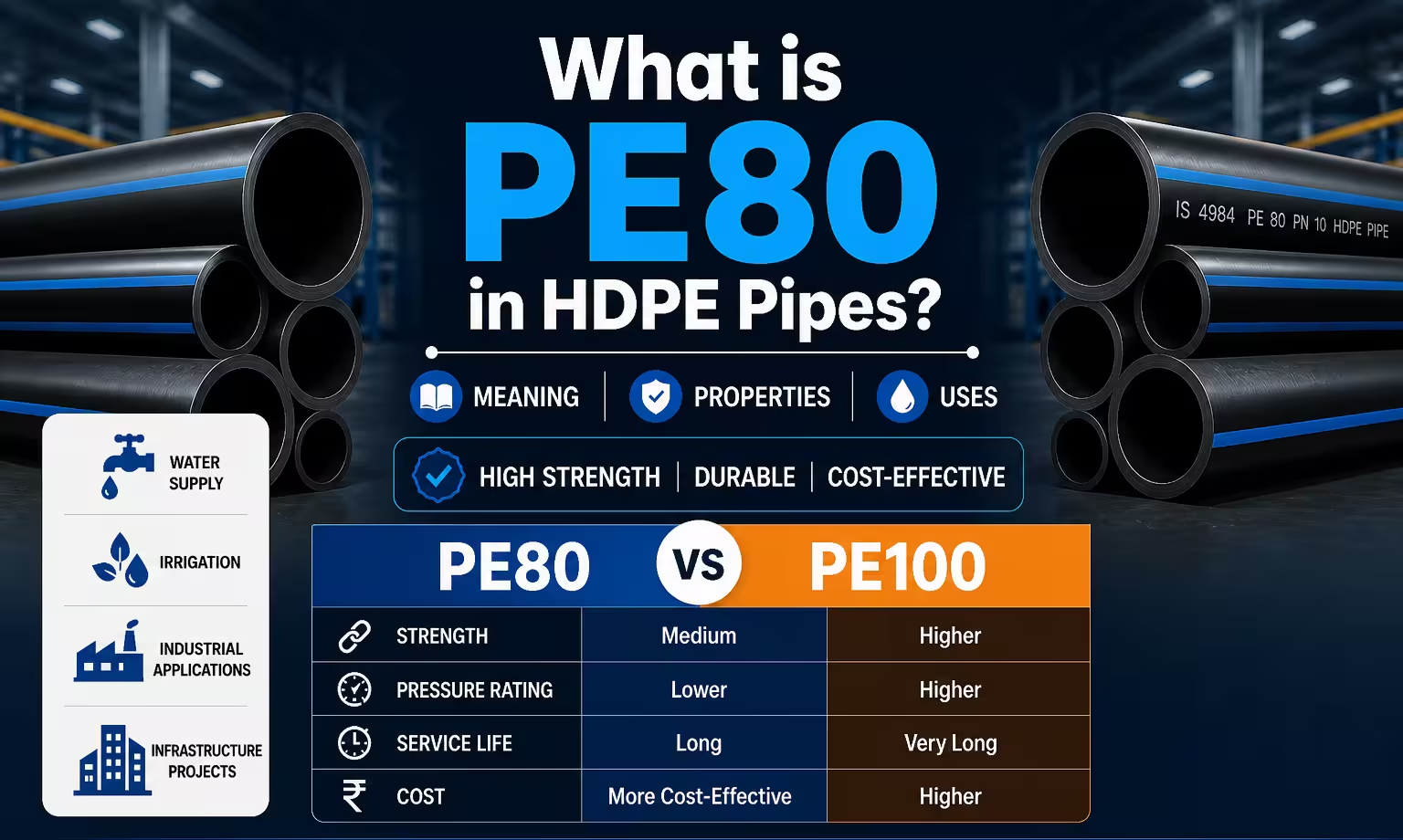
The process works as follows. HDPE pipe samples are subjected to sustained internal pressure at three temperatures — 20°C, 60°C, and 80°C — across test durations from one hour to more than 10,000 hours (approximately 14 months). The resulting failure data is subjected to regression analysis per ISO 9080:2012 to extrapolate the 97.5% lower prediction limit of the stress the pipe can sustain at 20°C for 50 years. This extrapolated value — the Minimum Required Strength (MRS) — becomes the material grade classification. PE100 has an MRS of 10.0 MPa; PE80 has an MRS of 8.0 MPa.
The critical point is what “design life” means in this context. The 50-year figure is the minimum certified performance threshold — it is the lower boundary of what the pipe is guaranteed to achieve. In practice, real systems operate at pressures well below the maximum rated pressure, at temperatures below 20°C in buried conditions, and with material properties that consistently exceed the MRS minimum. All of these factors push actual service life well beyond 50 years.
What Real-World Data Shows: 100 Years and Beyond
The most compelling evidence for HDPE pipe longevity comes from dig-up studies — investigations of HDPE pipes removed from actual service after decades of operation.
A landmark study examined HDPE pipes installed in Frankfurt in 1961 and removed from service in 2002 — 41 years of underground service carrying water at 4.5 bar. Laboratory testing on the removed pipes found no evidence of thermal aging. Hydrostatic pressure tests confirmed a predicted remaining service life of 124 years at operating pressure. Total projected lifetime: well over 100 years.
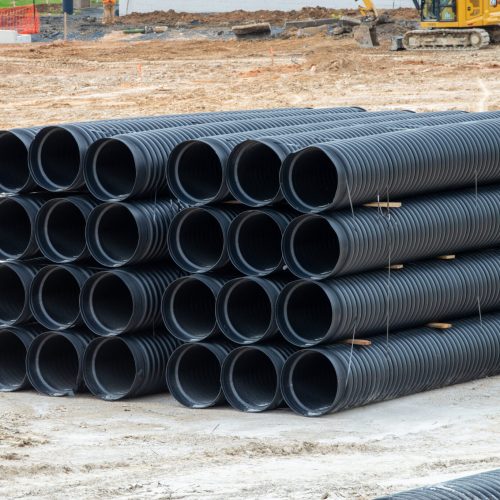
Research published jointly by TEPPFA (The European Plastic Pipes and Fittings Association) and the PE100+ Association concluded that dig-up studies of in-service PE80 and PE100 pipes consistently show minimal degradation, confirming expected service life in excess of 100 years for both grades. For corrugated HDPE drainage pipes specifically, independent research presented at Plastics Pipes XIII found service life to be well in excess of 100 years, even at deflections above 5%.
The design life of 50 years and the actual service life of 100+ years are not contradictory — they represent two different things. Design life is the conservative, certified minimum used for engineering calculations. Actual service life is what the material delivers in practice, based on decades of field evidence. Understanding this distinction matters for lifecycle cost calculations and infrastructure investment decisions.
What Determines the Actual Lifespan of Your HDPE Pipe
While the material science consistently supports 100+ year performance, the actual lifespan of a specific installation depends on four factors:
Material grade and virgin compound. PE100 HDPE pipe manufactured from virgin-grade compound will always outperform PE80, and both will far outlast pipe made from recycled or off-spec resin. IS 4984:2016 BIS/ISI mark certification guarantees virgin compound — verify the mark before procurement. Gark Polyplast uses virgin-grade PE80 and PE100 exclusively across all product lines.
Operating pressure relative to rated pressure. The Frankfurt pipes achieved 100+ year projected life while operating at 4.5 bar — well below their rated PN10 capacity. Real-world systems typically operate at 60–80% of rated pressure, which extends service life substantially beyond the design point. For guidance on matching SDR to operating pressure correctly, our technical guide What is SDR in HDPE Pipes? covers the full specification.
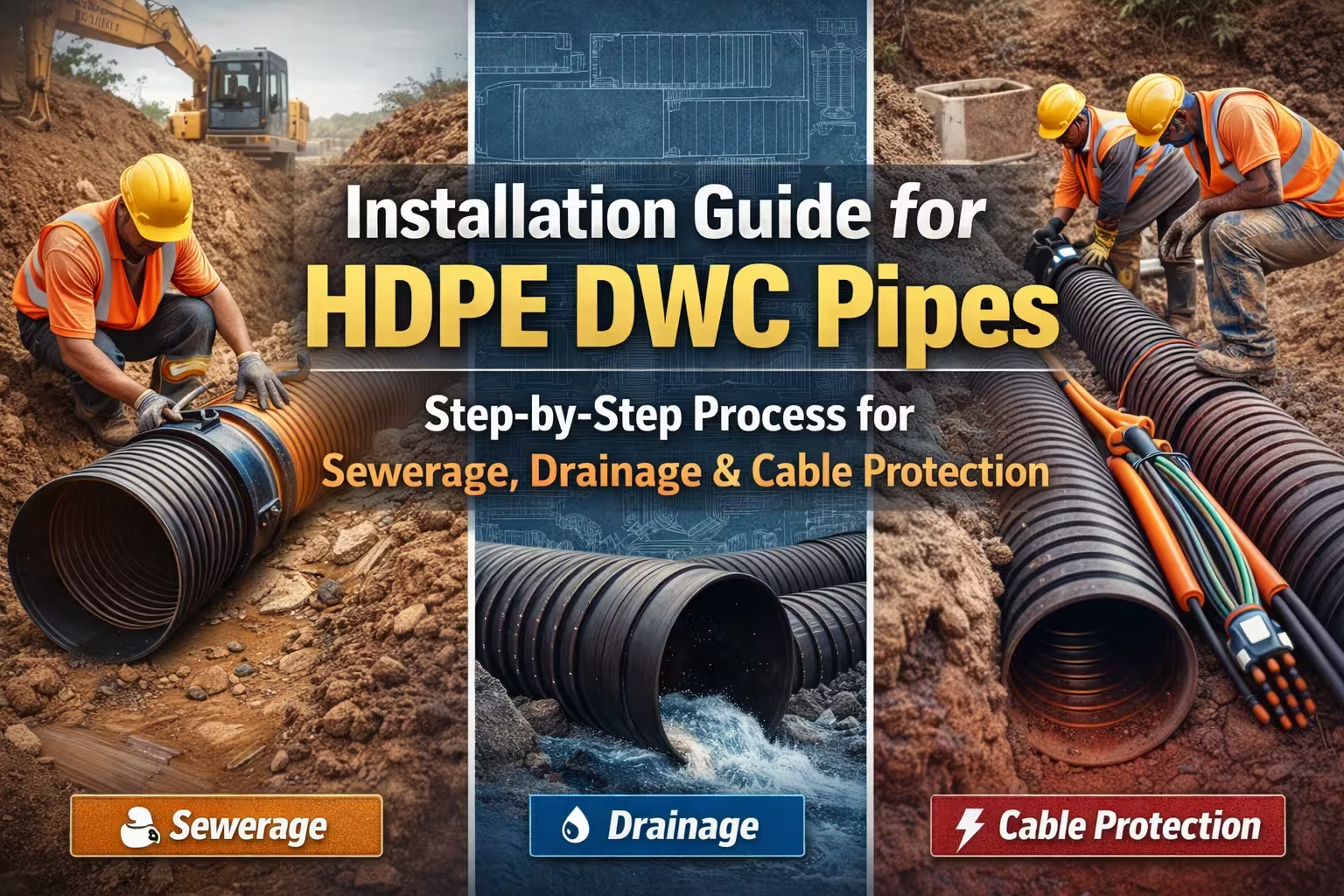
Installation quality. Correct bedding, haunching, and backfill are essential for HDPE DWC pipes and buried pressure pipes. Point loading from stones or debris, inadequate support at haunches, or excessive deflection beyond IS 16098’s 5% limit will reduce service life — not because of material failure, but because of installation-induced mechanical stress. Our HDPE DWC Pipe Installation Guide covers every installation stage that affects long-term performance.
Temperature. The 50-year IS 4984 design life is rated at 20°C. In buried underground conditions, most Indian installations operate below this temperature — extending service life. For above-ground sections in high solar exposure zones (Gujarat, Rajasthan), UV-stabilised black HDPE is essential, and pressure should be derated for elevated operating temperatures.
HDPE vs GI vs Concrete: A Lifespan Comparison
Understanding HDPE’s lifespan is most useful in comparison to the alternatives it replaces.
GI (Galvanised Iron) pipe has an average service life of 20–25 years in Indian soil and water conditions before corrosion requires replacement. In aggressive soils — acidic, saline, or high-chloride — this can fall to 15 years. Each replacement cycle means excavation, spoil disposal, new material, and community disruption. HDPE pressure pipes at 50+ year design life eliminate two to three of these cycles.
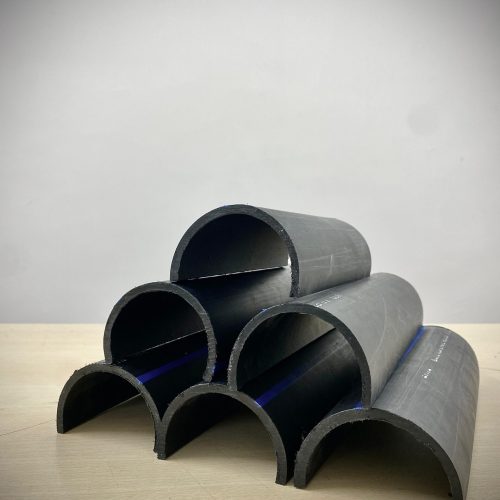
RCC (Reinforced Cement Concrete) pipes are subject to carbonation of the concrete matrix — a slow but irreversible process that removes the alkaline protection for the steel reinforcement, initiating corrosion. In tropical and coastal Indian environments, carbonation proceeds faster. HDPE Half Round Pipes replacing RCC cable covers and HDPE DWC Pipes replacing RCC drainage never carbonise, never rust, and do not degrade progressively.
PVC pipe has a shorter service life than HDPE — rubber ring joints deteriorate over time, brittle cracking can occur at low temperatures or under impact, and UV degradation affects exposed sections. HDPE’s flexibility and UV-stabilisation through carbon black compound give it a material durability advantage over PVC for long-buried infrastructure.

 +91 9081300225 | +91 9081300226
 Sales@garkgroup.com | garkpolyplast@gmail.com
 www.garkgroup.com
 Gark Industrial Park, Kotda-Pirojpura Road, Palanpur, Gujarat 385010