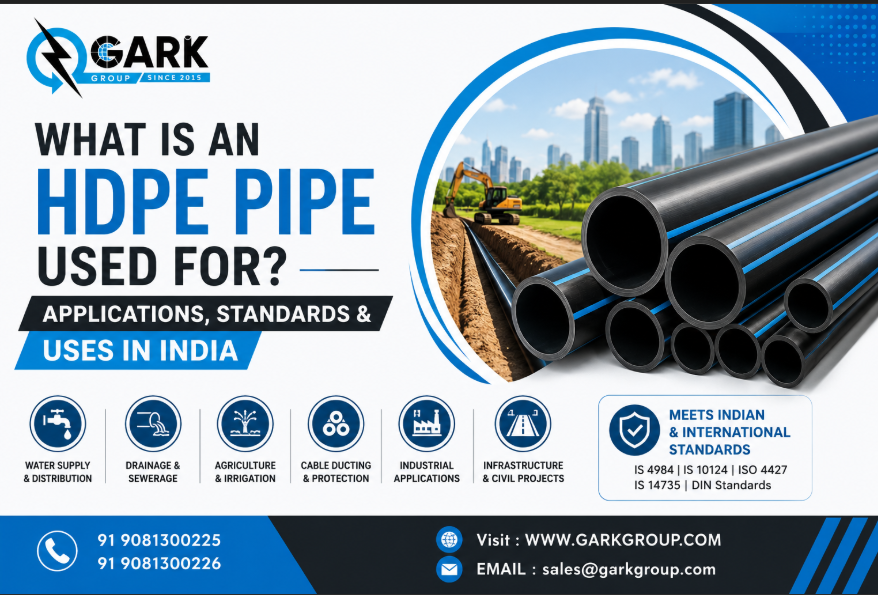
India is building infrastructure at a scale and pace unprecedented in its history — water supply networks under Jal Jeevan Mission, underground power and telecom cables under RDSS and BharatNet, sewerage systems under AMRUT 2.0, and irrigation networks under PMKSY. The material choices made at this moment will determine the environmental and economic cost of India’s infrastructure for the next 50 years.
HDPE pipes are not just the technically superior choice for these projects — they are the sustainable choice. This post explains why, across six distinct environmental dimensions.
1. Longest Service Life — Less Replacement, Less Waste
The most underappreciated environmental attribute of IS 4984:2016 certified HDPE pressure pipes is their service life. PE100 HDPE pipe has a certified 50-year design life under IS 4984, with conservative long-term hydrostatic strength projections indicating 60+ years in normal underground service. A GI pipe network may require full replacement within 20–25 years in aggressive soil environments. A concrete pipe system in acidic or saline soils may degrade significantly within 15–20 years.
Every pipe replacement cycle consumes energy, generates construction waste, emits transport carbon, and disrupts the community above the trench. Eliminating two to three replacement cycles over a 50-year period is a massive reduction in embedded carbon and material waste. Infrastructure that lasts is inherently sustainable infrastructure.
2. Zero Corrosion — No Metallic Contamination or Pipe Loss
HDPE does not corrode. This single property has two sustainability consequences.
First, there is no progressive material loss from the pipe wall over time — unlike GI pipe, which corrodes internally and externally, losing structural mass year by year and eventually requiring excavation and replacement. The HDPE pipe installed today has the same wall thickness and structural integrity in year 50.
Second, corrosion-free HDPE delivers water quality at the tap that is unchanged from the treatment plant. India loses an estimated 40–50% of treated water to leakage and contamination in distribution systems — much of it through corroded and jointed legacy GI networks. HDPE pipes joined by heat fusion form monolithic, leak-free joints that eliminate this distribution loss. Reducing water loss is one of the highest-leverage sustainability actions available to India’s water sector — every litre saved is a litre that did not require energy to pump, treat, and distribute.
3. Lower Carbon Footprint in Manufacturing and Transport
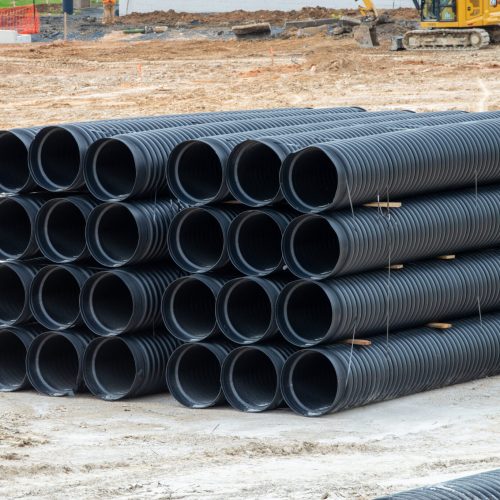
Life cycle analysis comparing HDPE to concrete drainage pipe shows that corrugated HDPE has approximately 59% lower global warming potential than reinforced concrete over its full service life. HDPE’s lower melting point compared to steel or ductile iron reduces energy consumption in manufacturing. Its lightweight nature — HDPE pipes weigh 70–80% less than equivalent concrete or metal sections — dramatically reduces fuel consumption in transport. More pipe per truck, fewer truck movements per project, lower freight carbon per installed metre.
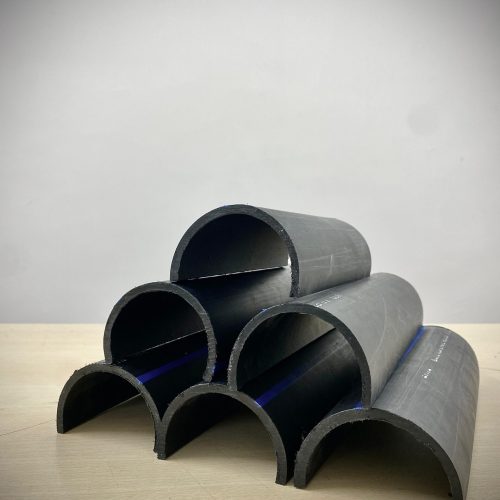
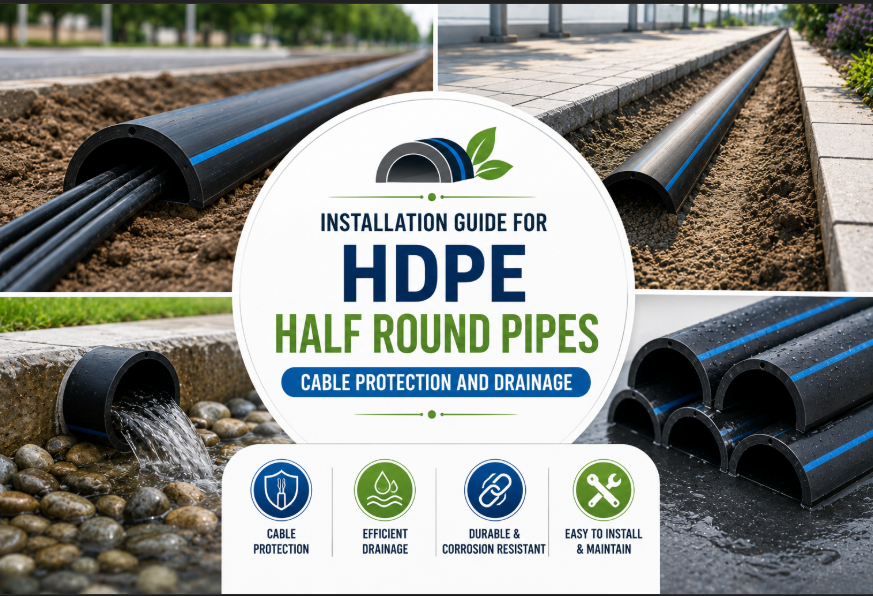
For HDPE DWC pipes replacing RCC drainage, HDPE Half Round Pipes replacing RCC cable cover channels, and HDPE pressure pipes replacing GI water mains — the carbon saving at the transport and installation stage alone is material.
4. 100% Recyclable — Circular Economy Compatible
HDPE is one of the most recyclable plastics in existence — designated Resin Identification Code 2. At the end of its 50+ year service life, HDPE pipe can be ground and reprocessed into non-potable applications: drainage pipes, agricultural conduits, construction materials. It does not require landfill disposal or incineration.
This recyclability makes HDPE pipe fully compatible with India’s circular economy agenda and the Extended Producer Responsibility (EPR) framework now being applied to plastics in India. A material that enters the infrastructure ecosystem and re-enters the materials economy at end of life is a fundamentally different environmental proposition from concrete rubble or corroded steel.
5. Water Conservation Through Hydraulic Efficiency
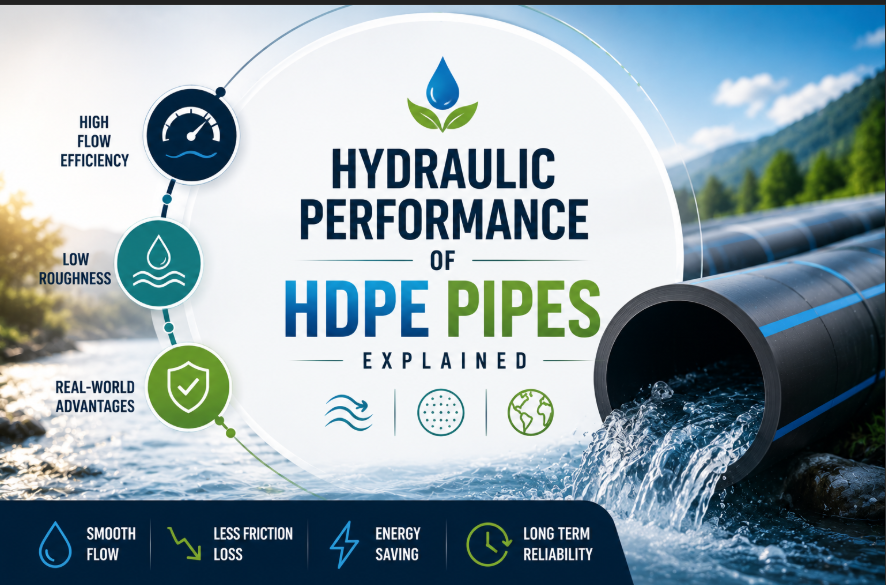
HDPE’s smooth bore — Manning’s roughness coefficient n = 0.009 versus n = 0.013 for concrete — delivers 30% more hydraulic flow capacity at the same pipe diameter and gradient. In practical terms, a smaller HDPE pipe achieves the same drainage or distribution flow as a larger concrete pipe. Smaller pipe means less excavation, less material, less spoil to dispose of — and a water distribution system that operates at lower pump pressure, consuming less energy over its operational lifetime.
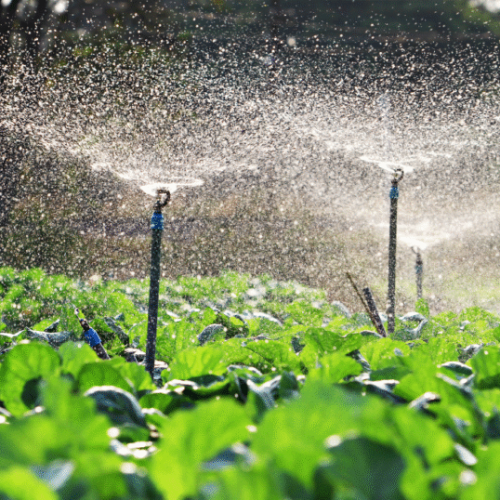
For agricultural irrigation networks under PMKSY, HDPE Sprinkler Pipes deliver water to fields with minimal distribution loss — conserving the freshwater that accounts for 70% of India’s total consumption and reducing the energy cost of pumping per irrigated hectare.
6. No Hazardous Substances — Safe for Soil and Water Ecosystems
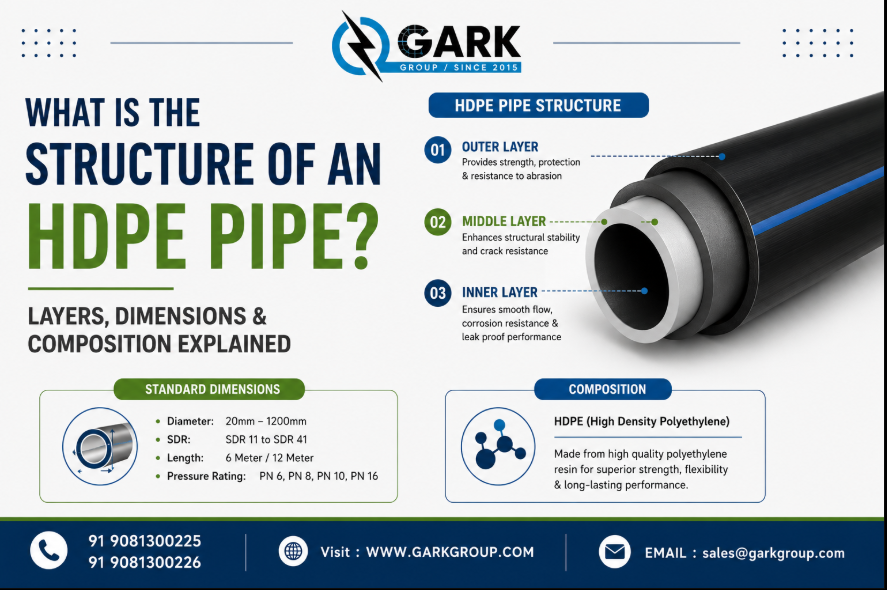
IS 4984:2016 certified HDPE pipe is manufactured from virgin-grade PE compound containing no heavy metals, no lead stabilisers, no phthalate plasticisers, and no BPA. Over its 50-year service life underground, it leaches no hazardous substances into surrounding soil or groundwater. The pipe that protects India’s drinking water supply under Jal Jeevan Mission is certified safe for potable water — and equally safe for the ecosystems it passes through.
This is in contrast to older pipe materials: lead-jointed cast iron, corroding GI releasing iron and zinc, cement-lined pipes releasing alkaline compounds into adjacent soil. HDPE’s chemical inertness across pH 2 to 13 makes it the cleanest infrastructure pipe material available.
Gark Polyplast: Sustainable Manufacturing, Certified Quality
Gark Polyplast Pvt. Ltd. holds ISO 14001:2015 — the internationally recognised Environmental Management System certification — alongside ISO 9001:2015 and ISO 45001:2018, at its Palanpur, Gujarat manufacturing facility. ISO 14001 is not a label: it requires documented environmental objectives, controlled manufacturing waste, monitored energy use, and continuous improvement in environmental performance.
Every pipe that leaves Gark Polyplast’s facility is manufactured from virgin-grade HDPE compound — no recycled or off-spec resin — ensuring material performance that delivers the full 50-year service life that makes HDPE sustainable in practice, not just in theory.
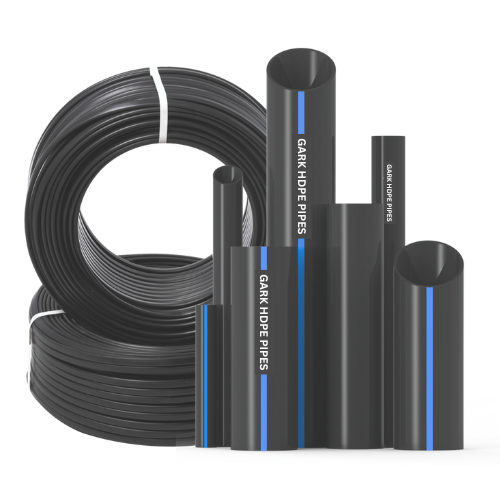
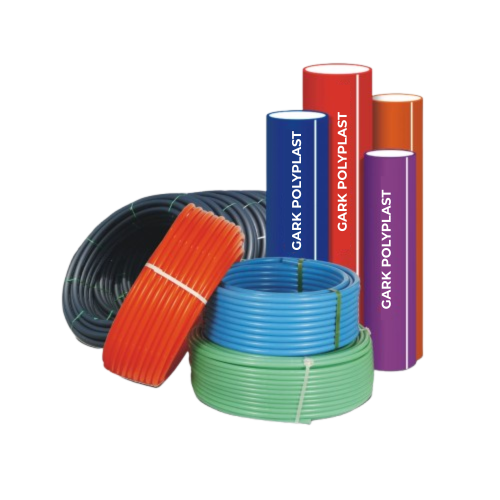
Our full product range — HDPE Pressure Pipes (IS 4984), HDPE DWC Pipes (IS 16098), HDPE Half Round Pipes, DWC Half Round Pipes, PLB Duct Pipes, and HDPE Sprinkler Pipes (IS 17425) — provides every pipe type needed for India’s sustainable infrastructure buildout from a single BIS-certified, ISO 14001-certified source.
The India HDPE pipes market, valued at USD 718.0 million in 2025 and projected to reach USD 1,029.1 million by 2034, reflects the engineering and policy consensus that HDPE is India’s infrastructure pipe material of the future. The sustainability case is inseparable from the technical case — which is why every major government programme specifying best-practice infrastructure materials specifies HDPE.
Download our product catalogue · Contact us for project requirements · Become a distribution partner
Partner with Gark Polyplast for Your DWC Pipe Requirements
Gark Polyplast Pvt. Ltd. is an ISI certified, BIS-marked manufacturer of HDPE DWC Pipes, HDPE Pipes, and PLB Ducts — operating from our state-of-the-art facility in Palanpur, Gujarat, since 2015.
 +91 9081300225 | +91 9081300226
 Sales@garkgroup.com | garkpolyplast@gmail.com
 www.garkgroup.com
 Gark Industrial Park, Kotda-Pirojpura Road, Palanpur, Gujarat 385010