Pick up any HDPE pipe and look at it. From the outside, it appears to be a simple hollow cylinder — black, smooth on the inside, slightly waxy to the touch. But what appears structurally simple contains a precisely engineered composition that determines everything the pipe will do: the pressure it carries, the fluids it handles safely, the service life it delivers, and how it connects to fittings and other pipes.
This guide breaks down the structure of an HDPE pipe completely — its physical dimensions, material composition, wall structure, and surface marking — so engineers, contractors, and procurement teams understand exactly what they are specifying and receiving.
The Three Controlling Dimensions
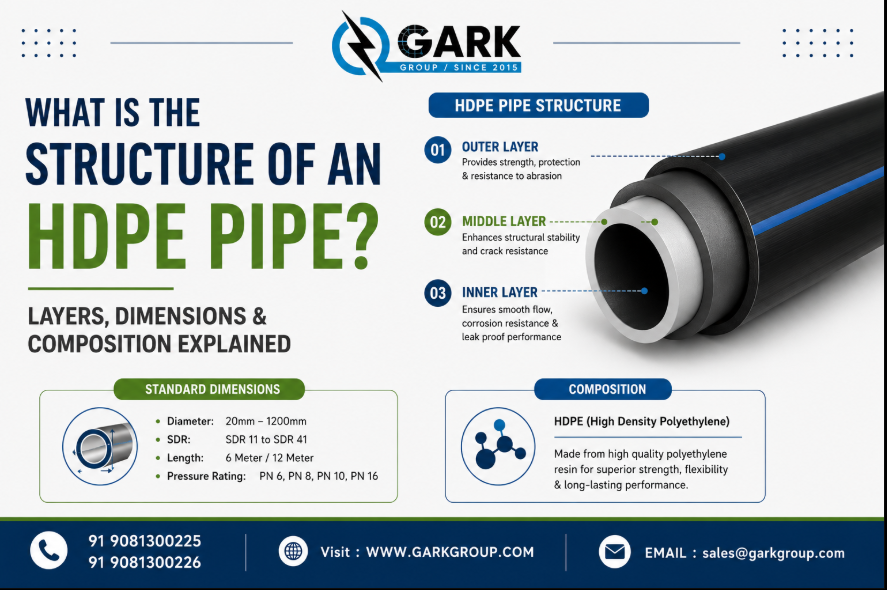
An HDPE pressure pipe has three key dimensional parameters. Understanding which one is the controlling measurement and why matters for both specification and installation.
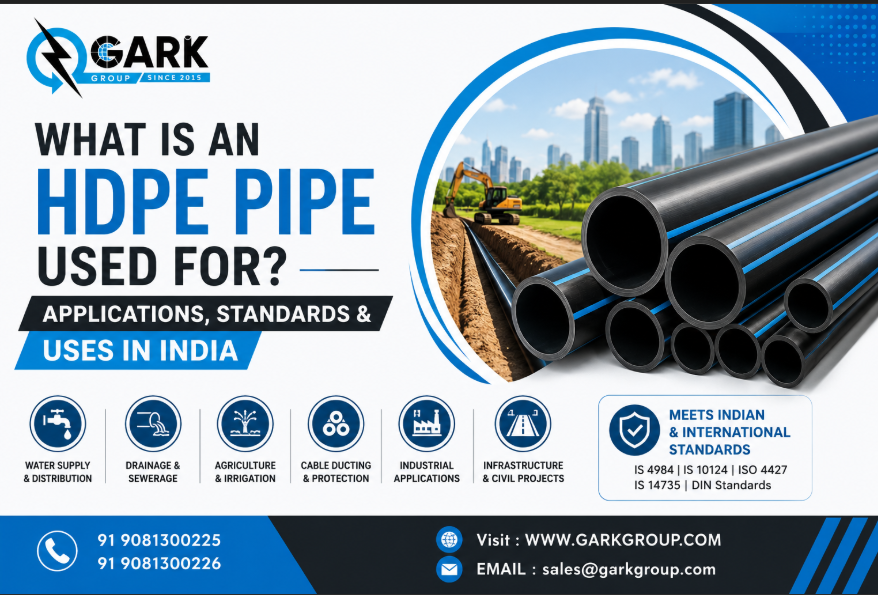
Outer Diameter (OD) is the controlling dimension in IS 4984:2016 and in all HDPE pipe standards globally. Unlike steel pipe — where nominal bore (NB) is the reference — HDPE pipe is specified, manufactured, and fitted by its outer diameter. This is because all butt fusion and electrofusion fittings are manufactured to match the pipe’s OD. The OD is the dimension that must be precisely maintained to ensure fusion equipment alignment and fitting compatibility.
Under IS 4984:2016, Gark Polyplast manufactures HDPE pressure pipes in OD sizes from 16mm to 315mm, with each OD held to tight manufacturing tolerance to ensure consistent fitting compatibility.
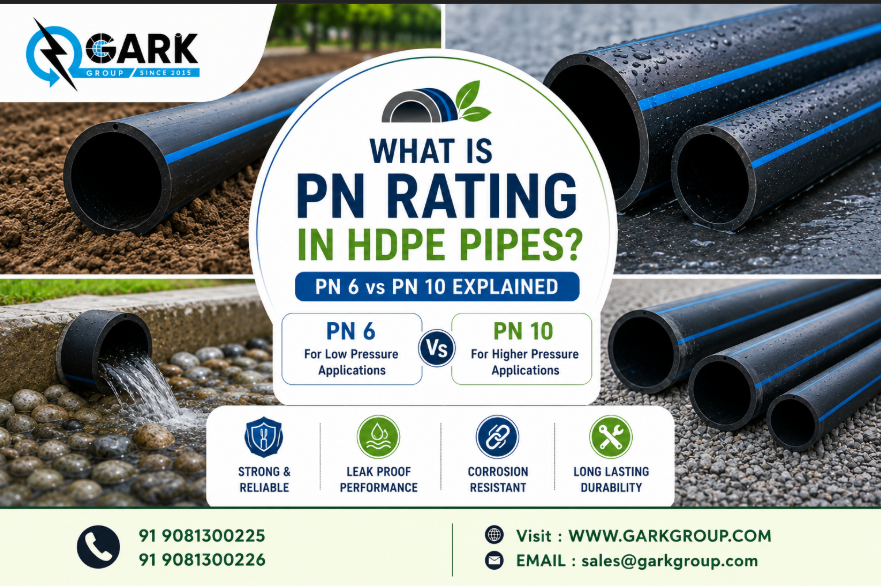
Wall Thickness (WT) is determined by the pipe’s SDR (Standard Dimension Ratio): WT = OD ÷ SDR. A 110mm OD pipe with SDR 17 has a wall thickness of 110 ÷ 17 = 6.47mm. A 110mm OD pipe with SDR 11 has a wall of 110 ÷ 11 = 10mm. The wall thickness is the parameter that determines the pipe’s pressure rating — thicker wall = higher PN. Our technical guide What is SDR in HDPE Pipes? explains this relationship in full.
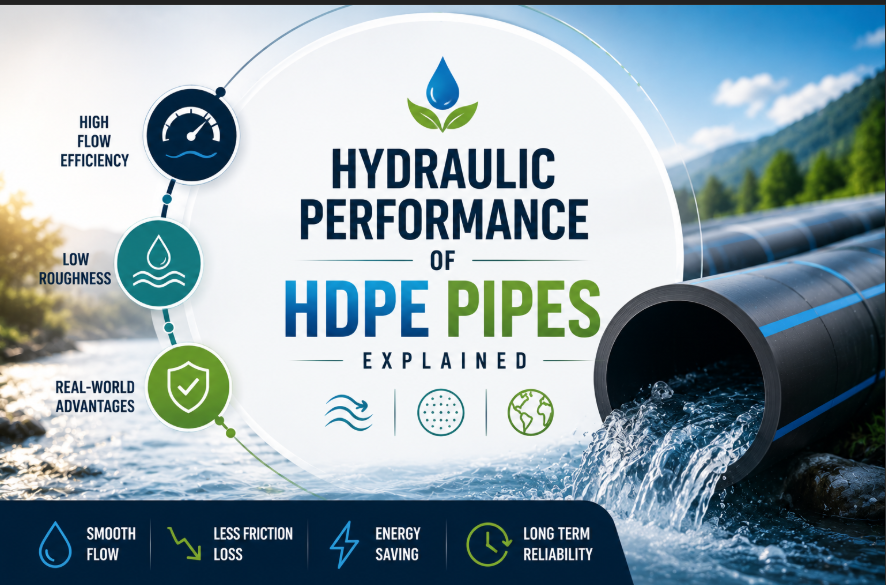
Inner Bore (ID) is derived from the OD and wall thickness: ID = OD − (2 × WT). For a 110mm SDR 17 pipe: ID = 110 − (2 × 6.47) = 97.1mm. The bore is the flow-carrying channel. It is not used as the reference dimension for specification because it varies with SDR — two 110mm OD pipes of different SDR classes have different bores. The bore’s smooth HDPE surface achieves an absolute roughness of approximately 0.0000015 metres — placing it in the hydraulically smooth category with Manning’s n = 0.009. This hydraulic performance is covered in full in our guide on Hydraulic Performance of HDPE Pipes.
The Material Composition of the Pipe Wall
The wall of an IS 4984:2016 certified HDPE pipe is not a simple layer of plastic. It is a precisely formulated composite of three components, all compounded together and extruded simultaneously to form an inseparable, homogeneous wall:
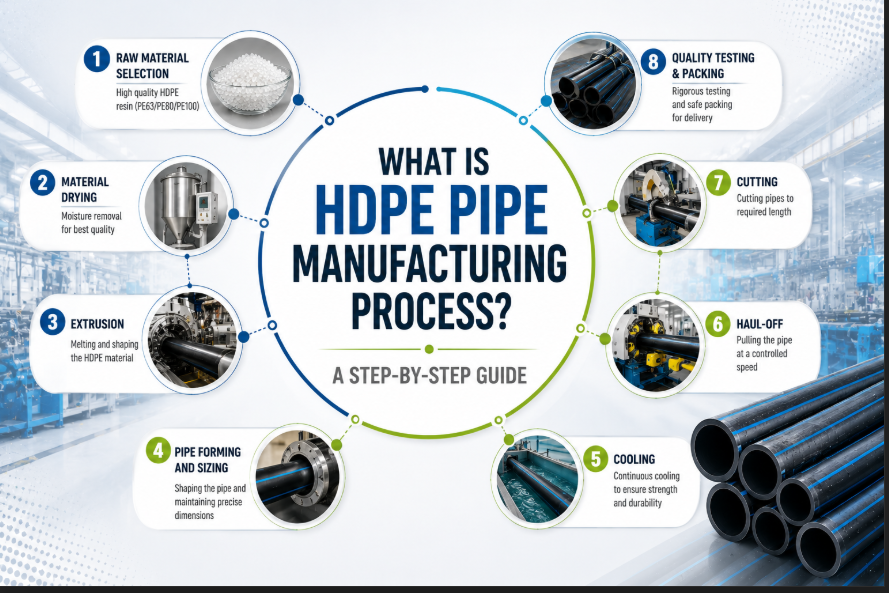
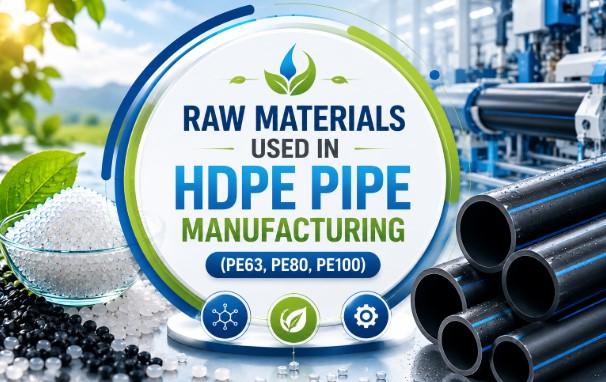
Base Polymer — PE63, PE80, or PE100 virgin resin. This is the structural core of the pipe — the polyethylene chains whose molecular architecture determines MRS, long-term hydrostatic strength, slow crack growth resistance, and service life. PE100 (MRS 10.0 MPa) is the highest-performance grade, used in municipal water supply and industrial pressure applications. PE80 (MRS 8.0 MPa) serves medium-pressure water distribution and gas distribution. All must be virgin-grade — never recycled or off-spec — per IS 4984 requirements.
Carbon Black Masterbatch — 2.0 to 2.5% per IS 4984. Carbon black is not a coating on the outer surface — it is uniformly compounded throughout the full wall thickness. This is the critical distinction between correctly manufactured HDPE pipe and poor-quality product where carbon black is only surface-applied. Compounded carbon black provides permanent UV protection through the entire service life; a surface coating would peel or erode within years. The carbon black absorbs UV radiation and acts as a radical scavenger, preventing photo-oxidative polymer chain degradation.
Antioxidant System — hindered phenolic primaries and phosphite secondaries. These protect the polymer chains from thermal oxidative degradation during the extrusion process at 210–260°C, and from long-term oxidative aging over the pipe’s 50-year service life underground. IS 4984 mandates OIT (Oxidative Induction Time) testing as a batch quality verification. Our complete guide on Raw Materials Used in HDPE Pipe Manufacturing covers each component in depth.
The Pipe Marking — What’s Printed on the Outer Surface
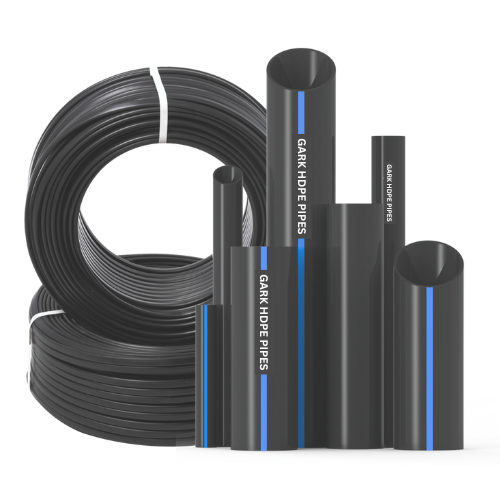
IS 4984:2016 mandates specific continuous inkjet marking on the outer surface of every certified pipe. This marking is not optional and is a legal requirement for BIS licence holders. A correctly marked Gark Polyplast pipe reads:
GARK POLYPLAST — PE100 — SDR 17 — PN 10 — DN 110mm — IS 4984:2016 — BIS [licence number] — [date/batch]
Each element is traceable and verifiable: manufacturer identity (BIS licence database), material grade (PE100 = MRS 10.0 MPa), pressure specification (SDR 17 PN 10), standard compliance (IS 4984:2016), and batch traceability (date/production lot). A pipe without all of these marking elements does not comply with IS 4984:2016 — regardless of what the supplier claims.
How the HDPE DWC Pipe Structure Differs
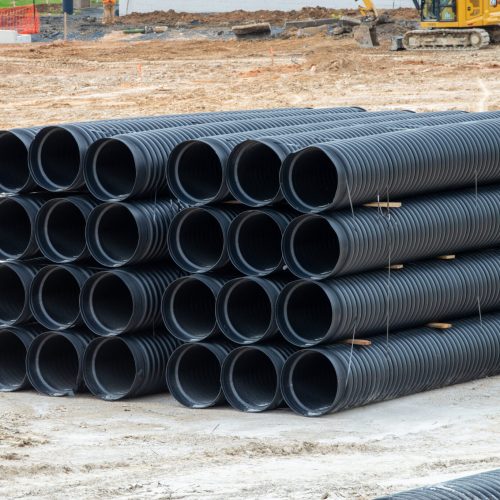
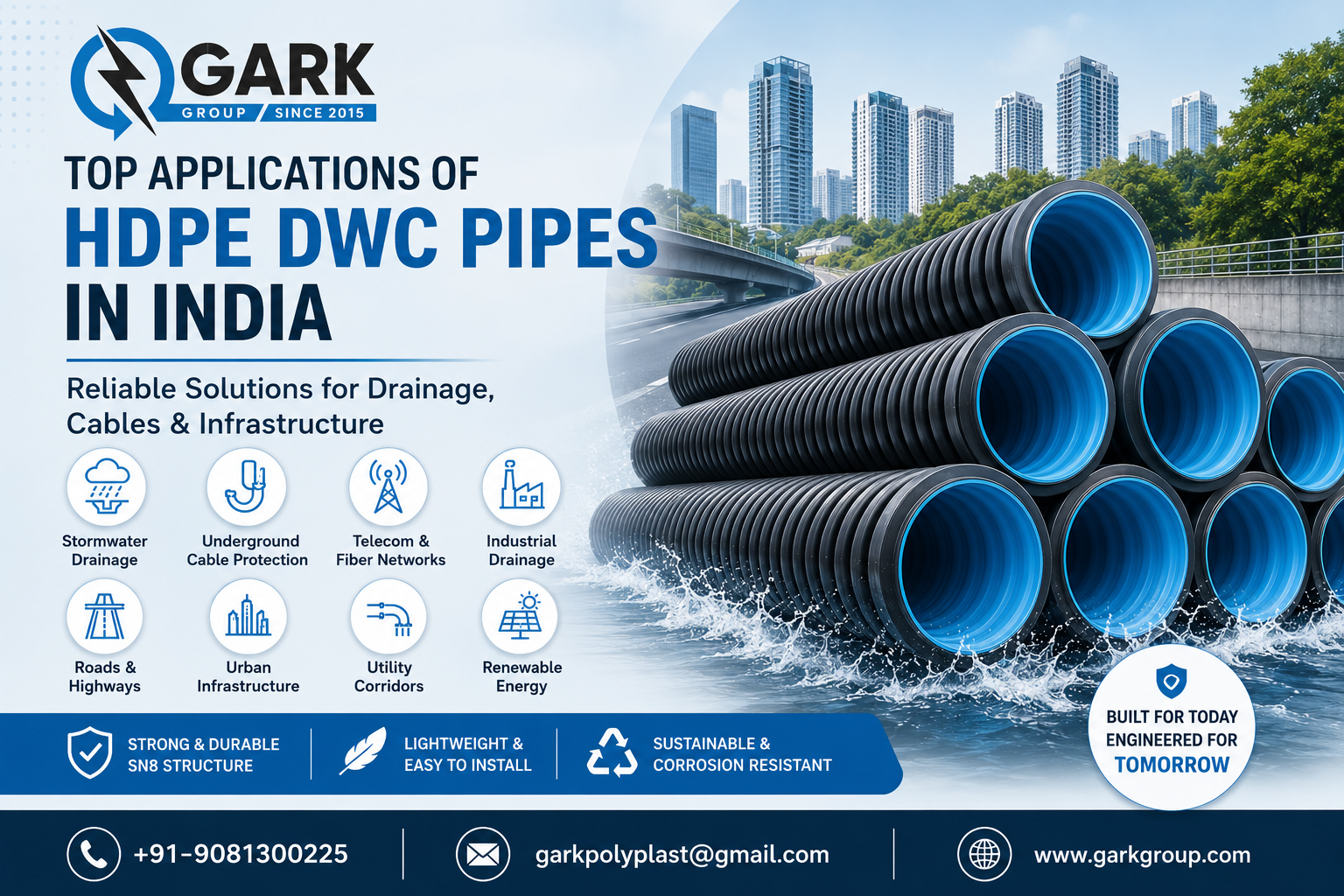
For drainage and cable conduit applications, HDPE DWC (Double Wall Corrugated) pipes have a fundamentally different structure from solid-wall pressure pipes. The outer wall is corrugated — a series of ribs that distribute external soil and traffic loads structurally around the pipe circumference, providing ring stiffness (SN4 or SN8 class) for burial under roads and highways. The inner wall is smooth — co-extruded with the outer wall as a single inseparable unit — providing the low-roughness hydraulic bore needed for drainage flow efficiency.
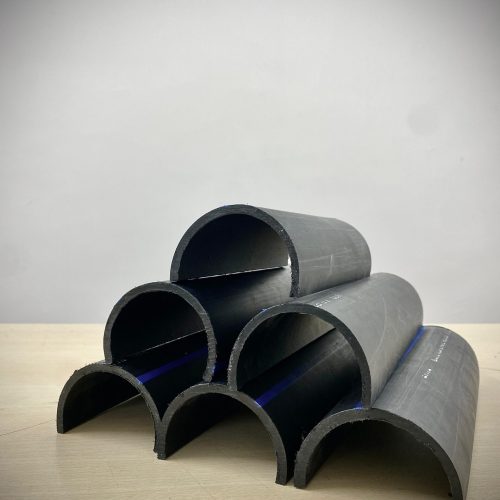
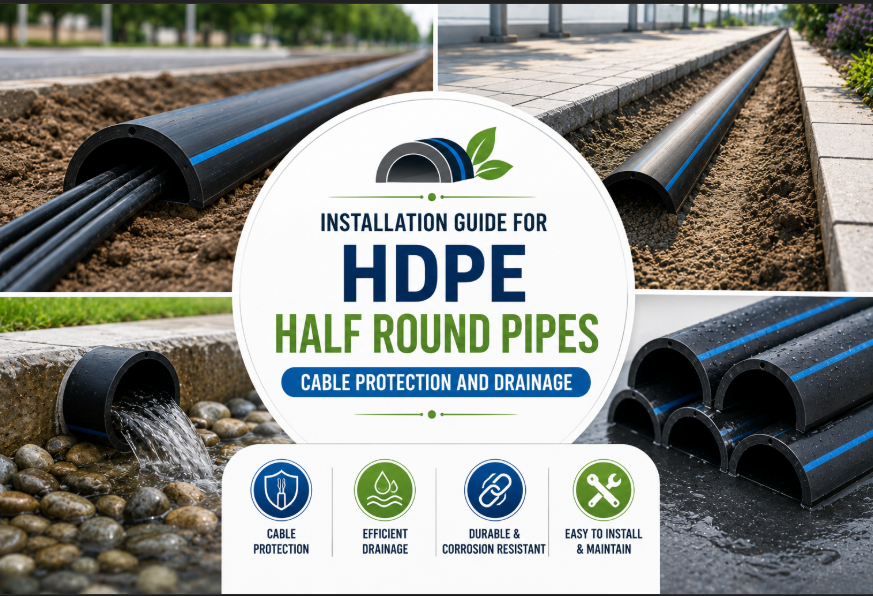
This dual-wall architecture is what makes DWC pipe both structurally competent under burial loads and hydraulically efficient as a gravity drain. HDPE Half Round Pipes share the same wall composition as solid-wall HDPE pipe — PE80 or PE100 with carbon black and antioxidant system — but are profiled as a 180° semi-circle rather than a full-bore cylinder.
Frequently Asked Questions
What is the structure of an HDPE pipe?
An HDPE pressure pipe (IS 4984:2016) consists of three physical dimensions — outer diameter (OD, the controlling reference), wall thickness (OD ÷ SDR), and inner bore (OD minus twice the wall thickness) — and three compounded wall materials: virgin PE base resin (PE63, PE80, or PE100), carbon black masterbatch at 2.0–2.5% for UV protection, and an antioxidant system for long-term oxidative resistance. The outer surface carries mandatory IS 4984 marking including manufacturer, PE grade, SDR, PN class, IS standard reference, BIS licence number, and batch date.
Why is OD (not bore) the reference dimension for HDPE pipe?
All HDPE pipe fittings, butt fusion machines, and electrofusion couplers are manufactured and calibrated to match the pipe’s outer diameter. The OD is held to precise manufacturing tolerance, enabling consistent fusion joint integrity regardless of wall thickness or SDR class. In contrast, the inner bore varies with SDR — two pipes of the same nominal OD but different SDR have different bores.
Is carbon black a coating or part of the HDPE pipe wall?
Carbon black is compounded uniformly throughout the entire wall thickness — not applied as a surface coating. IS 4984:2016 requires 2.0–2.5% carbon black content in the finished pipe, verified by carbon black content and dispersion testing. This compounded UV protection is permanent across the pipe’s full 50-year service life; surface coatings would degrade and fail over time.
Partner with Gark Polyplast for Your Pipe Requirements
Gark Polyplast Pvt. Ltd. is an ISI certified, BIS-marked manufacturer of HDPE DWC Pipes, HDPE Pipes, and PLB Ducts — operating from our state-of-the-art facility in Palanpur, Gujarat, since 2015.
 +91 9081300225 | +91 9081300226
 Sales@garkgroup.com | garkpolyplast@gmail.com
 www.garkgroup.com
 Gark Industrial Park, Kotda-Pirojpura Road, Palanpur, Gujarat 385010