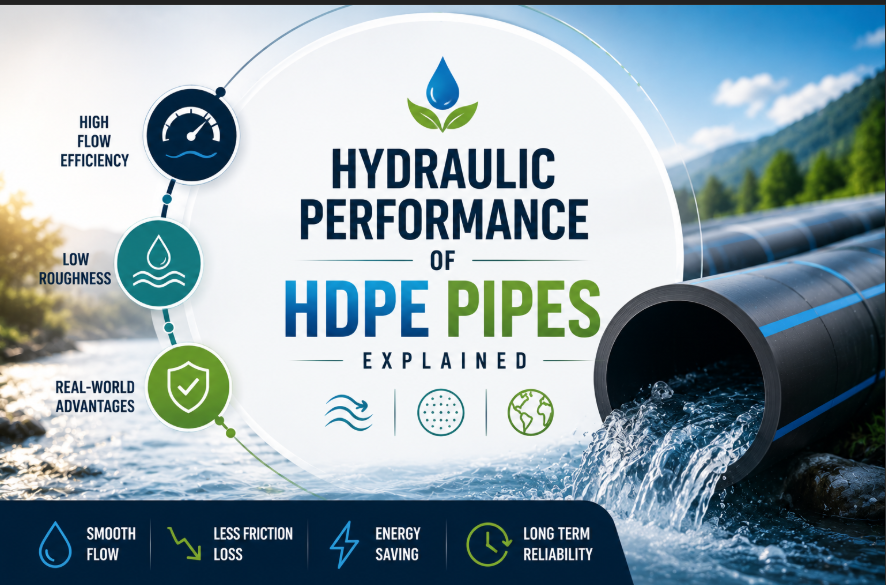
When an engineer designs a water distribution network, a drainage system, or an irrigation main, the pipe material is not just a structural decision — it is a hydraulic decision. The pipe’s internal surface determines how much energy is lost to friction as water flows through it, how much the flow capacity degrades over time, and how well the system handles surge events. On all three counts, HDPE pipes outperform every legacy material they replace — and the margin grows larger every year the system is in service.
This guide explains the hydraulic performance of HDPE pipes precisely: the coefficients, the formulas, the comparison with GI and concrete, and what the numbers mean for real infrastructure projects in India.
What Is Hydraulic Performance in a Pipe?
Hydraulic performance refers to a pipe’s ability to convey fluid with minimum energy loss due to friction between the flowing water and the pipe wall. The smoother the internal wall, the lower the friction, and the more efficiently the pipe carries flow.
Three parameters quantify hydraulic performance in engineering practice:
Manning’s roughness coefficient (n) — used primarily for gravity drainage and open-channel flow calculations. Lower values indicate a smoother, more hydraulically efficient surface.
Hazen-Williams coefficient (C) — used for pressurised water supply pipe networks. Higher values indicate less resistance and better flow capacity.
Absolute roughness (ε) — the physical microscopic roughness of the pipe inner wall surface, used in the Darcy-Weisbach equation for precise friction factor calculations.
HDPE pipe has an absolute roughness (ε) of approximately 0.0000015 metres — placing it firmly in the “hydraulically smooth” pipe category. This near-zero roughness is not a manufacturing claim; it is a direct consequence of the thermoplastic extrusion process that produces a chemically inert, homogeneous polymer surface without the grain boundaries, crystalline deposits, or microporosity that create roughness in metal and concrete pipes.
HDPE Hydraulic Coefficients: The Numbers
For IS 4984:2016 certified HDPE pressure pipes, the standard hydraulic design values are:
Manning’s n = 0.009 for HDPE smooth-bore pressure pipes Hazen-Williams C = 140 for polyethylene pipes Absolute roughness ε ≈ 0.0000015 m
Compare these against the materials HDPE replaces:
| Pipe Material | Manning’s n | Hazen-Williams C |
|---|
| HDPE (new and aged) | 0.009 | 140 |
| PVC (new) | 0.009–0.010 | 150 |
| GI pipe (new) | 0.012 | 120 |
| GI pipe (10 years) | 0.014 | ~100 |
| GI pipe (20 years) | 0.016 | 89–100 |
| GI pipe (40 years) | 0.020+ | 64–83 |
| Concrete pipe (new) | 0.013 | 100–140 |
| RCC drainage (aged) | 0.015+ | 100–110 |
The critical insight in this table is not just the starting values — it is the trajectory over time. GI pipe starts at Hazen-Williams C = 120 and deteriorates to C = 64–83 after 40 years of service as corrosion and mineral scale progressively roughen the internal surface. HDPE starts at C = 140 and remains at C = 140 in year 50, because the chemically inert polyethylene surface neither corrodes nor accumulates mineral scale adhesion.
This permanence of hydraulic performance is one of HDPE’s most significant — and most frequently overlooked — engineering advantages.
Practical Meaning: Flow Capacity and Pipe Sizing
The difference in Manning’s n between HDPE (0.009) and concrete (0.013) translates directly to flow capacity. Using Manning’s equation for gravity drainage:
Q = (1/n) × A × R^(2/3) × S^(1/2)
For the same pipe diameter and gradient, an HDPE drainage channel carries approximately 30% more flow than an equivalent concrete channel. In practical terms, a 200mm HDPE DWC drainage pipe can carry the same design flow as a 225mm RCC pipe — allowing engineers to specify a smaller diameter, reducing excavation depth, trench width, and total material cost.
For pressurised water supply using the Hazen-Williams equation, HDPE’s C = 140 versus GI’s C = 120 (new) means HDPE delivers greater flow at the same pressure head. As the GI ages to C = 80 after 30 years of service, HDPE’s hydraulic advantage becomes enormous — an HDPE pipe delivering design flow at low pump energy, versus a corroded GI system requiring increasing pump pressure to compensate for friction losses that no longer match the original design.
For India’s Jal Jeevan Mission water supply networks — designed to operate for 50+ years — this hydraulic permanence is not an incidental benefit. It is an operational cost advantage that compounds annually across the service life.
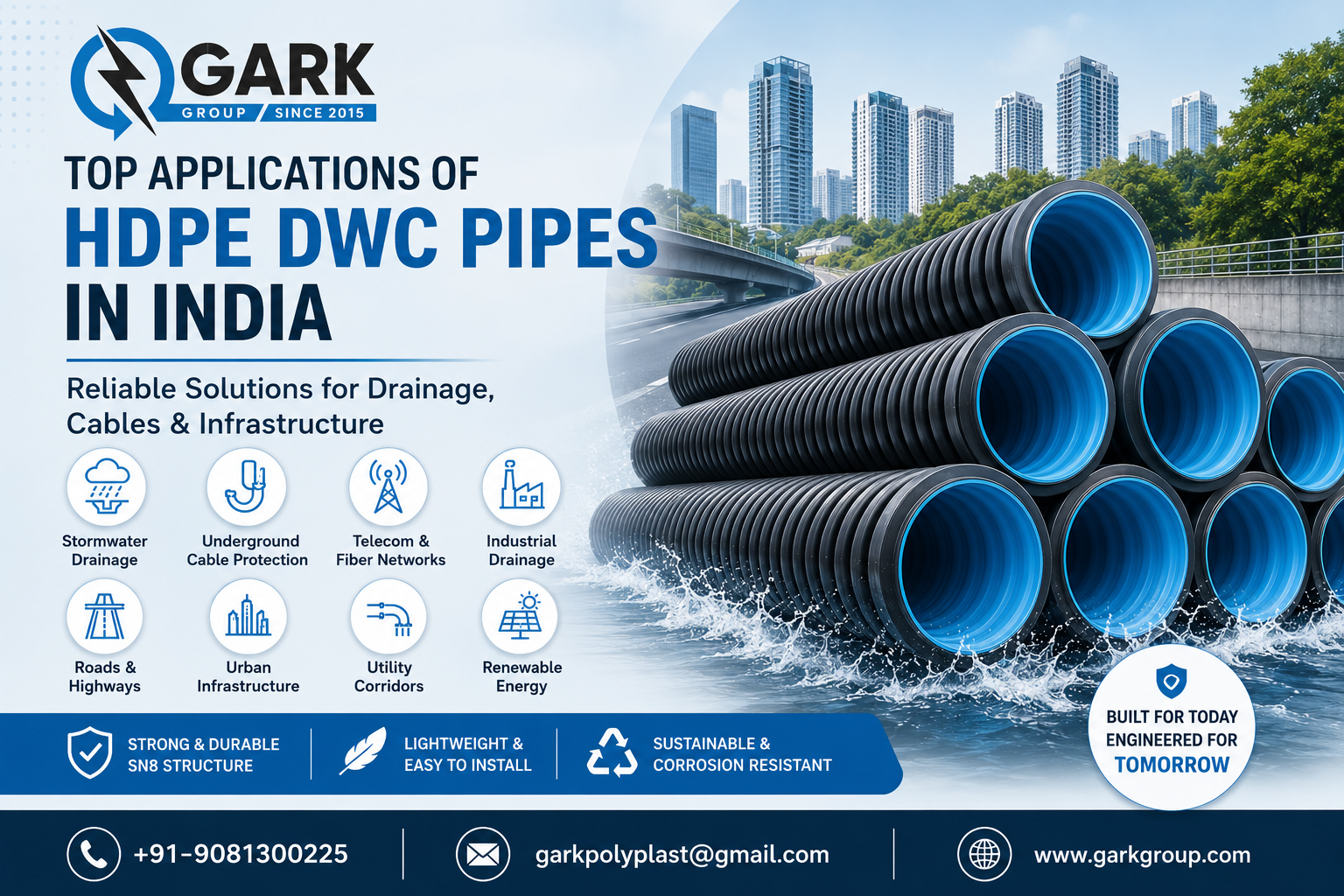
HDPE DWC Pipes: Hydraulic Performance in Drainage
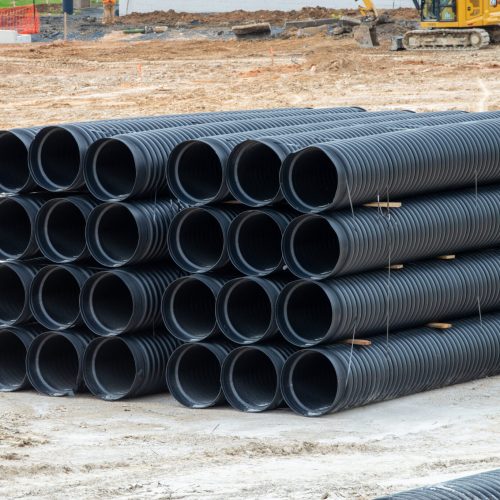
HDPE DWC (Double Wall Corrugated) pipes achieve their hydraulic performance through their smooth inner wall, which gives them a Manning’s n of 0.010–0.013 — dramatically better than single-wall corrugated HDPE (n = 0.021–0.030) and comparable to new concrete, but without concrete’s progressive roughening over time.
The smooth inner wall also resists sediment adhesion. Silts and fine sands in stormwater and agricultural drainage water that would adhere to a pitted or rough concrete surface flush cleanly through the smooth HDPE bore, maintaining design flow capacity without the periodic jetting maintenance that concrete and ceramic drainage pipes require.
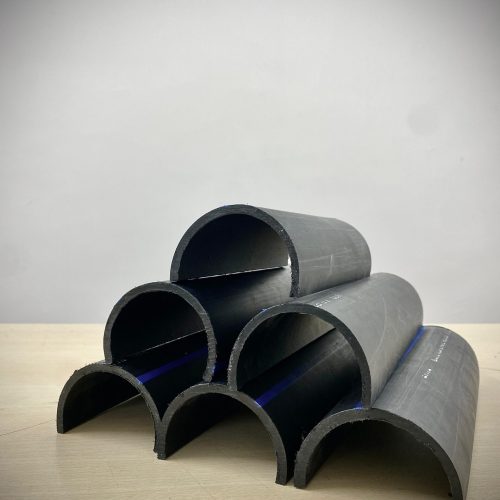
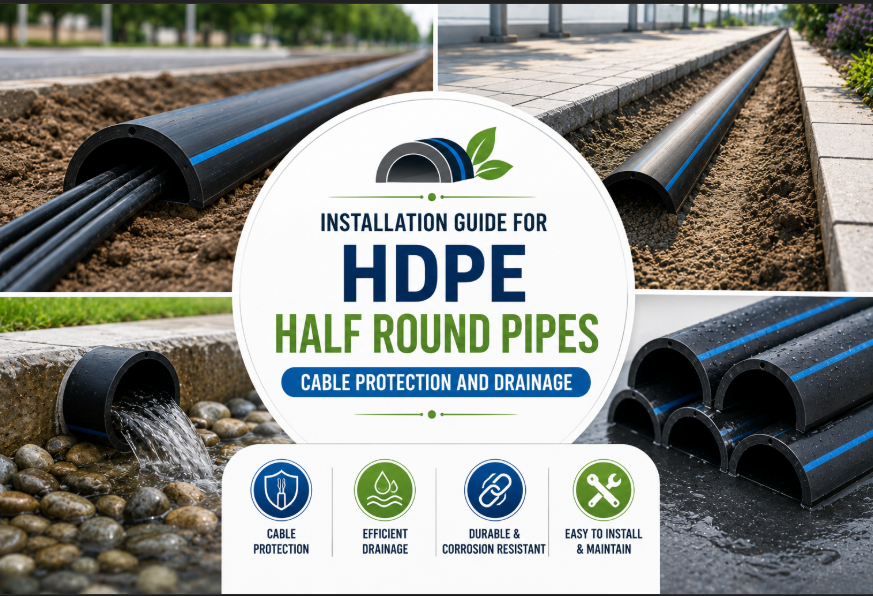
For HDPE Half Round Pipes used as open drainage channels on roadsides and in agricultural fields, the same n = 0.009 smooth-bore performance applies — allowing smaller channel sections to carry the required design flow, reducing material quantity and excavation volume in linear drainage projects.
Surge Pressure and Water Hammer: HDPE’s Flexibility Advantage
Hydraulic performance is not only about steady-state flow — it also includes behaviour under transient conditions. Water hammer — the pressure wave generated by sudden valve closure or pump shutdown — creates transient pressures that can far exceed the steady operating pressure.
HDPE’s viscoelastic behaviour gives it a significant advantage here. When a pressure surge propagates through an HDPE pipeline, the pipe wall flexes slightly, absorbing the surge energy through controlled elastic deformation. Under IS 4984:2016 and the international standards it aligns with, HDPE pipe is credited with:
- 1.5× the nominal pressure rating for recurring surge events
- 2.0× the nominal pressure rating for occasional surge events
A PE100 SDR 17 HDPE pipe rated at PN 10 (10 bar) can therefore handle recurring surge pressures of 15 bar and occasional surges of 20 bar. This inherent surge tolerance eliminates the need for expensive surge suppression equipment in many distribution system designs — a cost saving that project engineers and system owners consistently undervalue at procurement.
Rigid GI and concrete pipes do not flex under surge. They must be designed for the full surge pressure as a structural load, requiring heavier wall specifications or surge arrestors. HDPE absorbs the surge through material behaviour, returning to its design geometry as the pressure normalises.
Self-Cleaning Velocity and Minimum Flow Requirements
For drainage applications, maintaining a minimum self-cleaning velocity — typically 0.6 m/s for stormwater and 0.9 m/s for sewage — is essential to prevent sediment deposition and blockage. HDPE’s smooth bore enables lower minimum gradients to achieve self-cleaning velocities compared to rougher materials. For the same diameter and gradient, HDPE flows faster — meaning the minimum slope required to prevent silting is lower, which reduces excavation depth requirements on flat terrain.
For agricultural irrigation mains using HDPE Sprinkler Pipes, the hydraulic efficiency of HDPE means lower friction losses along distribution laterals, reducing the pump head required at the source and the operating energy cost per irrigated hectare.

 +91 9081300225 | +91 9081300226
 Sales@garkgroup.com | garkpolyplast@gmail.com
 www.garkgroup.com
 Gark Industrial Park, Kotda-Pirojpura Road, Palanpur, Gujarat 385010