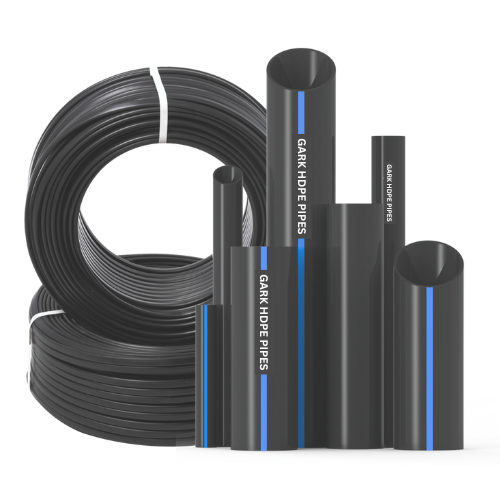
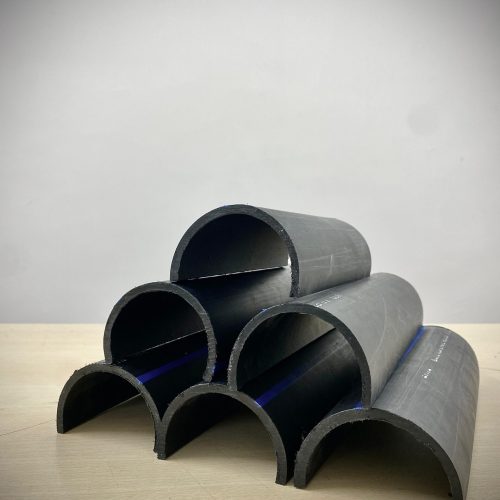
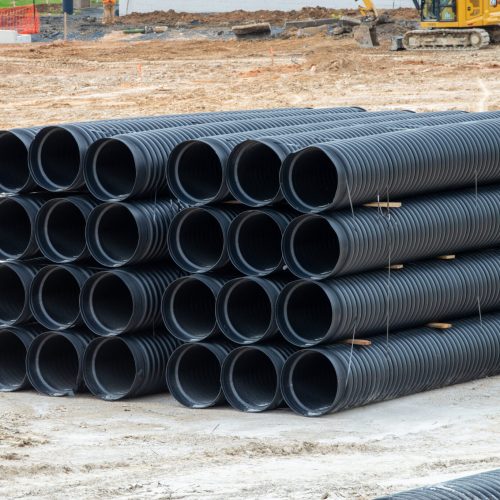
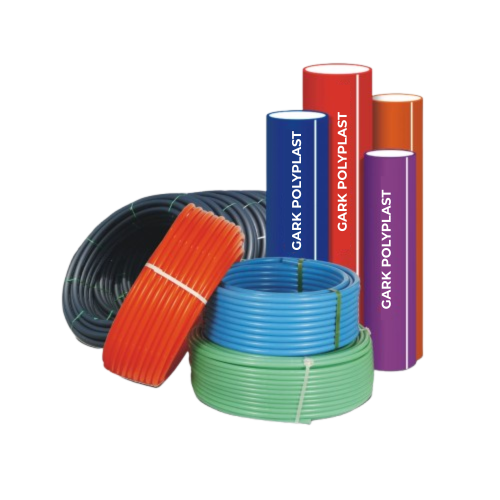
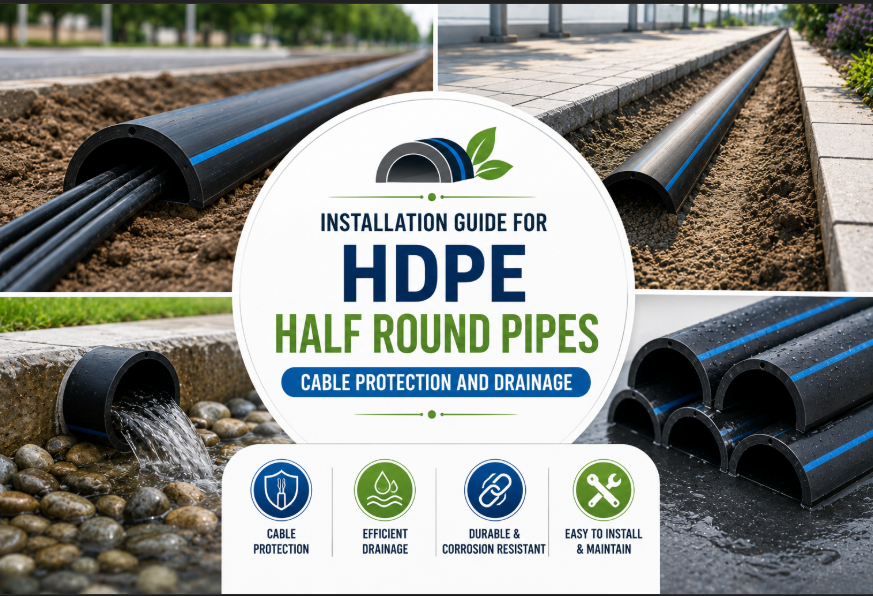
HDPE Half Round Pipes are one of the most installation-friendly products in India’s infrastructure pipe range. At 70–80% lighter than equivalent RCC half-round sections, they require no mechanical handling equipment, install at three times the speed of concrete, and arrive at site with factory-cut ±0.3mm precision that ensures consistent alignment without manual fitting adjustments.
But installation speed is only an advantage when the installation is done correctly. This guide covers every step for both primary applications — underground cable protection and open drainage channels — so contractors and site teams get a result that delivers the full 50-year service life the material is designed for.
Understanding the Two Installation Orientations
Before any trench work begins, confirm which of the two installation orientations applies to your project — because the placement direction is the opposite for each application.
Cable protection: Place the half-round curved-side-UP over the cable lying in the trench. The arch faces upward, forming a protective vault above the cable that deflects compressive loads from future excavation equipment away from the cable below.
Open drainage channel: Place the half-round curved-side-DOWN on the prepared channel bed. The arch faces downward, forming a smooth semi-circular invert that carries water flow efficiently at gradient with Manning’s n = 0.009.
Getting this orientation wrong is the most common installation error on mixed-purpose sites where both cable protection and drainage runs are being installed simultaneously.
Stage 1 — Site Survey and Material Check
Mark the route and confirm the following before opening any trench:
For drainage applications, establish the gradient — minimum 1:100 (1cm fall per metre) for diameters up to 200mm. Insufficient gradient allows sediment deposition; check using a spirit level or laser level referenced to boning rods at each pipe length.
For cable protection, locate all existing underground services using utility maps before excavating. Confirm cable size to select the correct half-round OD — the half-round pipe inner diameter must comfortably clear the cable outer diameter with a minimum 10mm clearance on each side.
Inspect each pipe section before use. Reject any piece showing visible cracks, deformation, or a cut edge that is not square. The ±0.3mm factory tolerance only delivers alignment value if the pipe is undamaged.
Stage 2 — Trench Preparation
Cable protection trench: Minimum trench depth = cable burial depth requirement + cable OD + half-round pipe wall thickness. Standard minimum cover above the pipe crown: 600mm under unpaved or agricultural land; 800mm under light traffic roads; 1,000mm minimum under highways.
Prepare the trench bottom with 75–100mm of compacted clean granular bedding (maximum 20mm particle size, maximum 5% fines) — the same specification used for HDPE DWC Pipe installation. Level the bedding at the correct gradient. Remove all stones, roots, and debris that could create point loads on the cable below.
Drainage channel: Excavate to a depth that provides the required invert level. Compact the channel bed to firm, stable ground. For soft soil conditions, overexcavate by 100–150mm and replace with compacted granular fill. The drainage channel bed must be shaped to the correct gradient before pipe laying — corrections after laying disrupt the run alignment.
Stage 3 — Laying and Alignment
Lower sections by hand — HDPE half-round sections up to 250mm OD in 1m and 3m lengths are well within manual handling weight. Do not drop sections onto the trench bed or allow them to strike hard surfaces; while HDPE is impact-resistant, sharp point impacts on the pipe edge can initiate cracking.
For cable protection runs, lay the cable first, then place the half-round sections over it progressively from one end of the run. Maintain consistent orientation — curved-side-up, with the flat cut face parallel to the trench sides. Check alignment at every 3–5 sections using a string line along the pipe crown.
For drainage channels, work from the downstream end upstream. Place each section with the flat cut face perpendicular to the flow direction. Check gradient at every joint using your level reference; a 2mm error at each 1m section accumulates to a 20mm total error over a 10m run — enough to create standing water points.
Stage 4 — Jointing
Three methods are available depending on application requirements:
Snap-fit couplers — purpose-designed HDPE mechanical sleeves that engage the pipe OD profile on both sections. Fast installation; appropriate for cable protection where watertightness is not required and for non-pressure drainage above water table level. Suitable for retrofit and repair work.
Heat fusion (butt fusion or electrofusion coupler) — creates a monolithic joint with strength equal to the parent pipe. Required for drainage applications below the water table, agricultural channels where flow continuity is critical, or any installation where joint infiltration or exfiltration must be zero. Apply manufacturer-specified fusion parameters; do not fusion-weld in wet conditions or when ambient temperature falls below 5°C without pre-heating.
Mechanical clamps (saddle clips) — used for attaching half-round sections to existing infrastructure, highway drainage kerb lines, or above-ground agricultural channels where the section is held in place by structural clamps rather than buried. Stainless steel or UV-stabilised HDPE clamps at maximum 1m spacing for 3m and 6m lengths.
Stage 5 — Backfilling and Warning Tape
For buried cable protection runs, backfill in compacted 150mm layers using granular sidefill to 300mm above the pipe crown — the same embedment zone specification as for full-bore HDPE pipe. Do not use heavy vibratory compaction equipment within 500mm of the pipe.
Place orange warning tape (for power cable) or yellow warning tape (for drainage) approximately 300mm above the pipe crown before final backfill — this alerts future excavation works to the buried service below.
For surface-laid drainage channels (roadside and agricultural applications), secure sections in their prepared bed with granular haunch material on each side before any surface treatment is applied. For permanent above-ground installations in high UV-exposure zones, note that Gark Polyplast HDPE Half Round Pipes are UV-stabilised through carbon black compound — no additional UV protection is required.


 +91 9081300225 | +91 9081300226
 Sales@garkgroup.com | garkpolyplast@gmail.com
 www.garkgroup.com
 Gark Industrial Park, Kotda-Pirojpura Road, Palanpur, Gujarat 385010