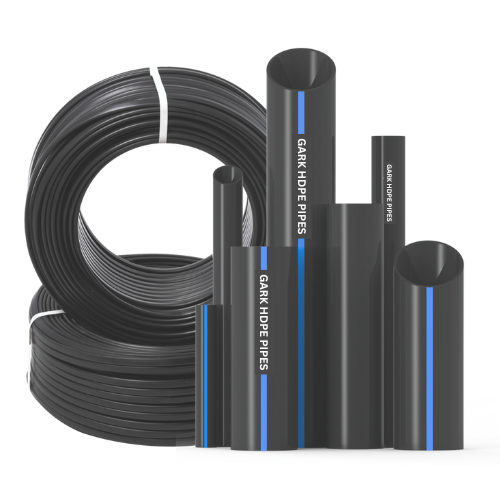
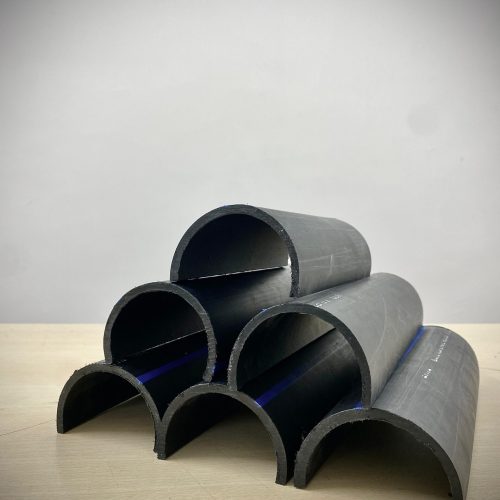
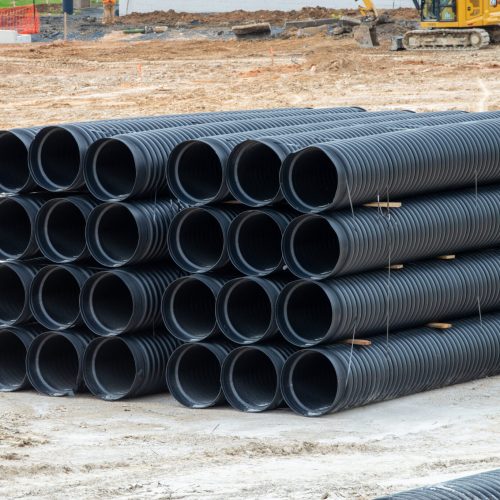
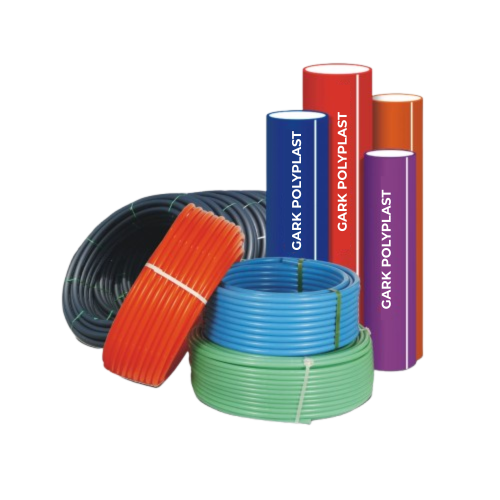
Every HDPE pipe carries a PN marking on its outer surface. It appears as PN 6, PN 10, PN 16 — and it is one of the most important specifications a project engineer, procurement manager, or contractor must verify before purchasing pipe for any pressurised water supply, irrigation, or industrial application. Get the PN wrong, and the pipe either fails under operating pressure or is unnecessarily over-specified at higher material cost.
This guide explains what PN means, how it is calculated, the difference between PN 6 and PN 10, and which PN is correct for which application in India.
What Does PN Stand For in HDPE Pipes?
PN stands for Pressure Nominal — derived from the French term Pression Nominale, meaning the standardised nominal pressure rating of the pipe expressed in bars at a reference temperature of 20°C. One bar equals 100 kPa or approximately 14.5 psi. A pipe marked PN 10 is rated for a maximum continuous operating pressure of 10 bar at 20°C.
The PN rating is not an arbitrary label. It is a precisely calculated value defined by India’s IS 4984:2016 standard, derived from the combination of two parameters: the PE material grade and the SDR (Standard Dimension Ratio) of the pipe. Together, these two inputs determine every important performance characteristic of an HDPE pressure pipe — wall thickness, pressure capacity, weight per metre, and cost.
How PN Rating Is Calculated: The IS 4984 Formula
The PN rating of an HDPE pipe is calculated using the formula:
PN = (20 × σ) ÷ (SDR − 1)
Where σ (allowable hoop stress) is derived from the PE material grade’s Minimum Required Strength (MRS) divided by the overall service design coefficient C = 1.25 per IS 4984:2016:
- PE63: MRS 6.3 MPa → σ = 5.0 MPa
- PE80: MRS 8.0 MPa → σ = 6.3 MPa
- PE100: MRS 10.0 MPa → σ = 8.0 MPa
This means the same SDR value produces different PN ratings depending on the PE grade. PE100 SDR 17 delivers PN 10; PE80 SDR 17 delivers only PN 8. This is why specifying PE grade and SDR together — not just the PN class — is the correct procurement practice. Our detailed guide on What is SDR in HDPE Pipes? covers this formula and the complete SDR-PN table in full.
PN 6 vs PN 10: Key Differences
| Parameter | PN 6 | PN 10 |
|---|
| Max operating pressure | 6 bar at 20°C | 10 bar at 20°C |
| PE100 SDR equivalent | SDR 26 | SDR 17 |
| PE80 SDR equivalent | SDR 21 | SDR 13.6 |
| Wall thickness (110mm OD, PE100) | 4.2mm | 6.6mm |
| Weight per metre (relative) | Lower | Higher |
| Cost per metre (relative) | Lower | Higher |
| Typical India application | Low-pressure drip/sprinkler irrigation, gravity rural supply | Municipal water distribution, Jal Jeevan Mission, AMRUT 2.0 |
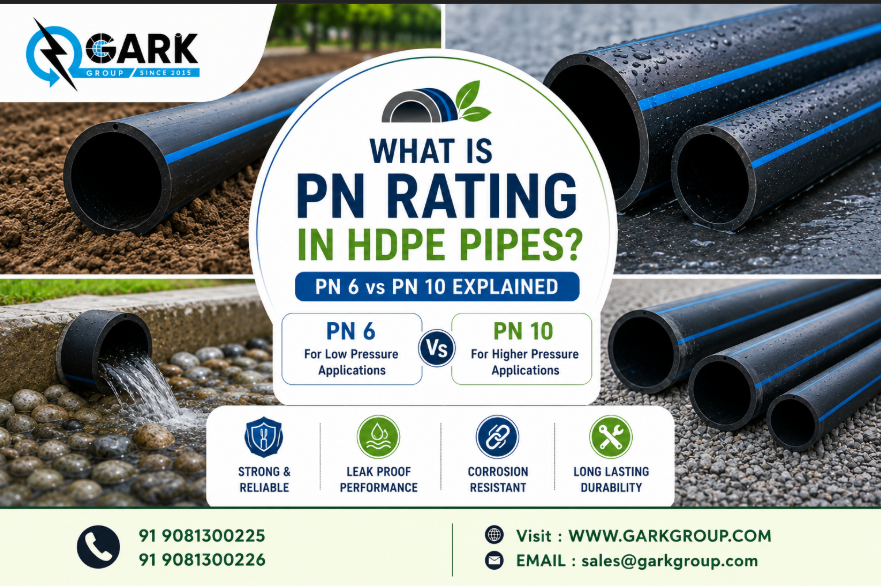
The single most important distinction is the maximum operating pressure: PN 6 handles up to 6 bar, PN 10 handles up to 10 bar. Using PN 6 pipe in a system designed for 8–10 bar operating pressure is a serious safety failure — progressive over-pressurisation causes fatigue cracking and pipe burst. Always confirm the system’s maximum operating pressure including surge allowance before specifying PN class.
PN 6 — When to Specify It
PE100 SDR 26 (PN 6) is the correct specification for genuinely low-pressure applications:
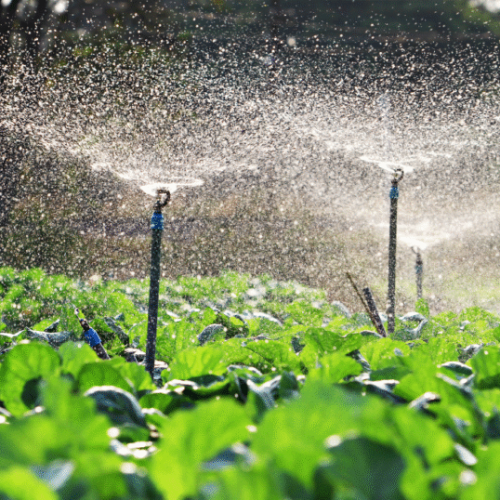
Agricultural micro-irrigation — PMKSY drip and sprinkler distribution mains where pump head at the lateral entry is 4–6 bar. Gark Polyplast’s HDPE Sprinkler Pipes (IS 17425) serve this application range with the correct PN and material grade for farm irrigation networks.
Gravity-fed rural water supply — flat terrain distribution systems where static head from the overhead storage tank generates pressures of 3–5 bar at the distribution main.
Non-pressure and low-head drainage — where some internal pressure is present but well within the PN 6 threshold.
PN 6 pipe is lighter, uses less material, and costs less per metre than PN 10 at the same diameter. Where it is genuinely adequate, it is the correct economic choice. Where it is not, it is a risk.
PN 10 — The Standard for Municipal Water Supply in India
PE100 SDR 17 (PN 10) is the most widely specified HDPE pipe in India today, and for a clear reason: it is the standard specification for Jal Jeevan Mission (Har Ghar Jal) rural water supply distribution mains.
The JJM programme has connected over 15.44 crore rural households to piped tap water, with JJM 2.0 extending to December 2028 under a total outlay of ₹8.69 lakh crore. Every new rural water supply main under JJM specifies IS 4984:2016 BIS-certified HDPE pipe, and PE100 SDR 17 (PN 10) is the engineering default for distribution networks where system operating pressure sits in the 7–10 bar range.
PN 10 is also standard for AMRUT 2.0 urban water supply networks across 500+ cities, industrial process water distribution, and any pressurised system where operating pressure — including surge allowance — could approach 10 bar.
For rising mains in high-elevation terrain, PE100 SDR 13.6 (PN 12.5) or SDR 11 (PN 16) is specified. Our complete guide on Are HDPE Pipes Safe for Drinking Water? explains the full IS 4984 certification framework that governs all potable water PN classes.
Temperature Derating: The Critical Adjustment
PN ratings are valid at 20°C. As operating temperature rises above 20°C, the allowable pressure must be derated. At 40°C, the allowable working pressure drops to approximately 80% of the rated PN value. At 60°C, further derating applies per IS 4984 tables.
For buried underground water mains in most Indian conditions, soil temperature remains below 20°C and derating is not required. For above-ground sections in high solar exposure zones — common in Gujarat, Rajasthan, and Andhra Pradesh — derating must be applied when selecting PN class. A PE100 SDR 17 pipe rated PN 10 at 20°C effectively carries approximately PN 8 when operating at 40°C surface temperature.
Complete PN Rating Table for IS 4984:2016 (PE100)
| SDR | PN Class | Max Pressure | Typical Application |
|---|
| SDR 6 | PN 25 | 25 bar | Very high-pressure industrial |
| SDR 9 | PN 20 | 20 bar | High-pressure process piping |
| SDR 11 | PN 16 | 16 bar | Gas distribution, HDD |
| SDR 13.6 | PN 12.5 | 12.5 bar | Sub-transmission mains |
| SDR 17 | PN 10 | 10 bar | JJM, AMRUT, municipal |
| SDR 21 | PN 8 | 8 bar | Medium-pressure rural |
| SDR 26 | PN 6 | 6 bar | Irrigation, low-pressure |
The Common Specification Mistake to Avoid
The most frequent PN-related procurement error in India is specifying PN class without specifying PE grade. “PN 10 HDPE pipe” is an incomplete specification — PE80 SDR 13.6 and PE100 SDR 17 both deliver PN 10, but with different wall thicknesses, material grades, slow crack growth resistance, and long-term service life assurance.
Always specify: PE grade + SDR + PN + IS 4984:2016 BIS/ISI mark. A pipe marked only “PN 10” without PE grade and SDR is not a verifiable specification.


 +91 9081300225 | +91 9081300226
 Sales@garkgroup.com | garkpolyplast@gmail.com
 www.garkgroup.com
 Gark Industrial Park, Kotda-Pirojpura Road, Palanpur, Gujarat 385010