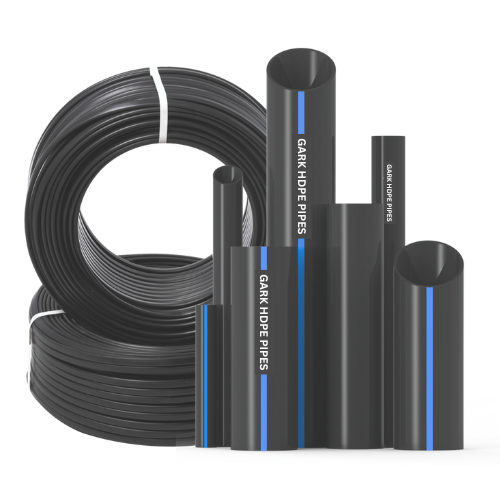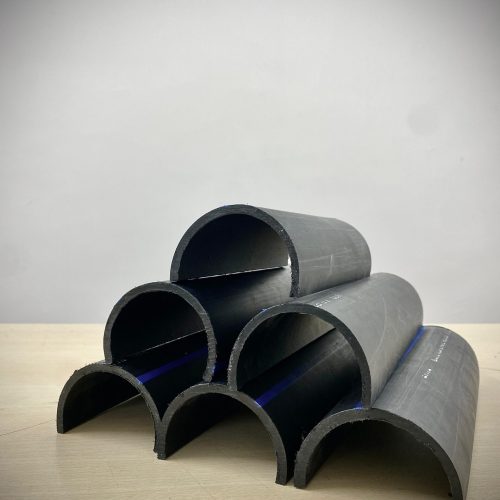
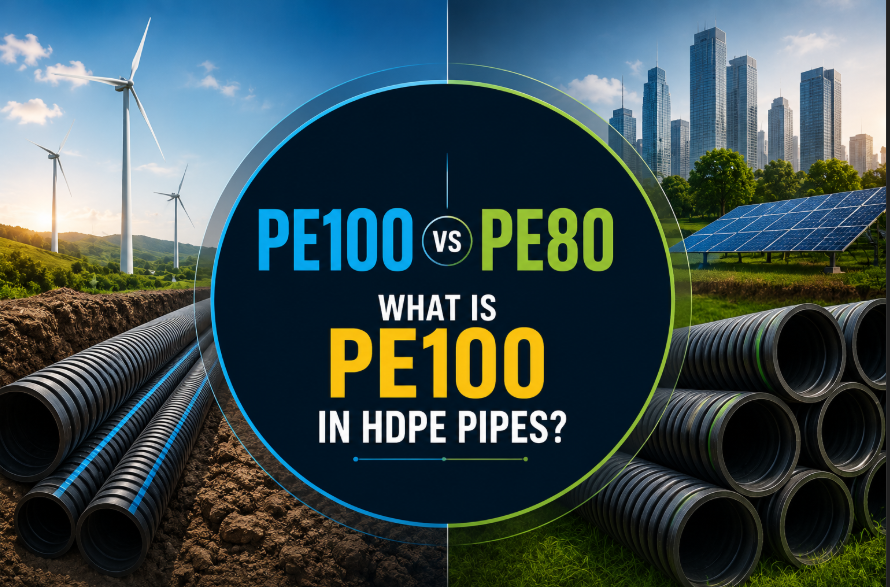
If you have ever looked at an HDPE pipe specification and seen “PE100” printed on the outer wall, you were looking at the most important material grade designation in modern pipe engineering. PE100 is not a brand name or a marketing label — it is a material classification defined by international and Indian standards that tells you exactly how strong the pipe is, what pressure it can carry, and whether it is the right choice for your project.
This guide explains what PE100 means, how it performs, how it compares to PE80, and where it is specified across India’s infrastructure programmes.
PE100 stands for Polyethylene with a Minimum Required Strength (MRS) of 10.0 MPa. The number 100 is derived by multiplying the MRS (10.0) by 10 — a convention defined under ISO 12162 and adopted in India’s IS 4984:2016 standard for HDPE water supply pipes.
The MRS is determined through long-term hydrostatic pressure testing: the material is subjected to sustained internal pressure at 20°C and the strength is extrapolated over a 50-year service lifetime using regression analysis per ISO 9080. A material qualifies as PE100 when its long-term hydrostatic strength is 10.0 MPa or above — the highest classification in standard pipe-grade polyethylene.
PE100 is classified as the third generation of pipe-grade polyethylene. It was developed to overcome the limitations of PE80, offering superior long-term strength, higher resistance to slow crack growth, better rapid crack propagation resistance, and a higher flexural modulus. Under IS 4984:2016, the allowable hoop stress (σ) for PE100 is 8.0 MPa — calculated by dividing the MRS by the design coefficient C = 1.25.
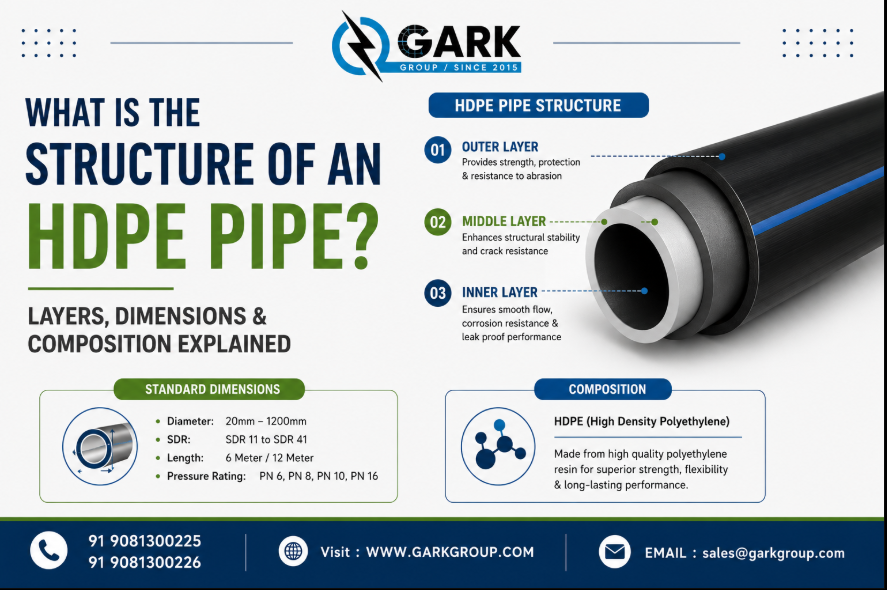
The pressure rating of any HDPE pipe is determined by combining the PE grade with the SDR (Standard Dimension Ratio — the ratio of outer diameter to wall thickness). Using the IS 4984 formula PN = (20 × σ) ÷ (SDR − 1), PE100 delivers:
| SDR | PN Rating | Application |
|---|---|---|
| SDR 6 | PN 25 | Very high-pressure industrial |
| SDR 9 | PN 20 | High-pressure process piping |
| SDR 11 | PN 16 | Gas distribution, high-pressure mains |
| SDR 13.6 | PN 12.5 | Sub-transmission mains |
| SDR 17 | PN 10 | Municipal water supply, JJM |
| SDR 21 | PN 8 | Medium-pressure distribution |
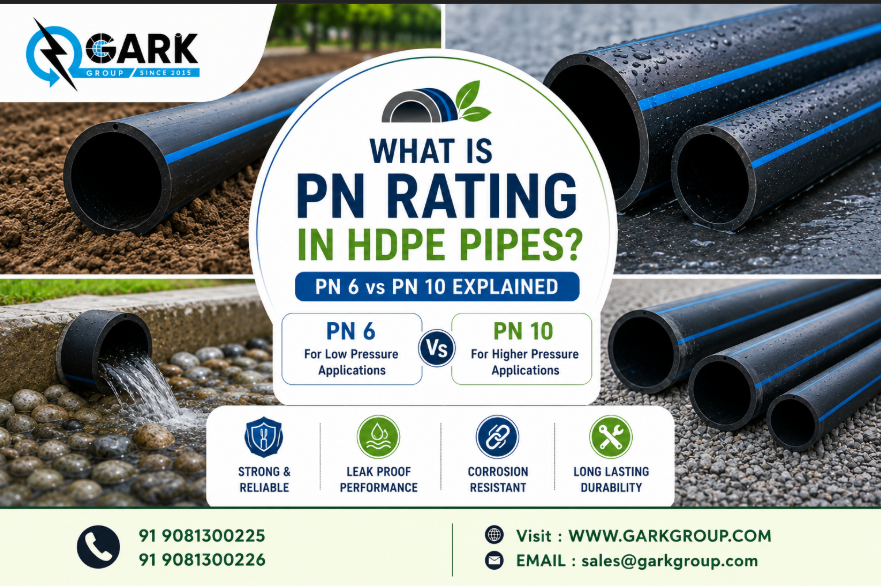
| SDR 26 | PN 6 | Low-pressure distribution |
PE100 SDR 17 (PN 10) is the most widely specified HDPE pipe in India today — the standard for Jal Jeevan Mission rural water distribution networks.
For the complete SDR-PN formula and selection guide, our technical post What is SDR in HDPE Pipes? covers everything in detail.
Highest long-term strength: MRS 10.0 MPa is the highest grade in IS 4984 — 25% stronger than PE80 on a material basis. This translates directly into higher pressure ratings at every SDR value.
Thinner wall, larger bore: For the same operating pressure, PE100 achieves it at a higher SDR (thinner wall) than PE80. PE100 SDR 17 delivers PN 10, while PE80 needs SDR 13.6 for the same rating. A thinner wall means a larger inner bore — improving hydraulic flow capacity at the same outer diameter.
Superior crack resistance: PE100 has significantly better slow crack growth (SCG) resistance than PE80 — a critical property for pipes buried underground subject to point loads, soil movement, and installation stress. PE100 also resists rapid crack propagation (RCP) down to −30°C, making it suitable for cold-climate and refrigerated applications.
50+ year service life: IS 4984:2016 certifies PE100 pipes for a 50-year design life, with conservative LTHS extrapolations projecting 60+ years in normal underground service. No corrosion, no metal leaching, no progressive wall degradation — the pipe installed today performs identically in 2075.
Potable water safe: IS 4984:2016 certifies PE100 for drinking water supply using virgin-grade compound. Zero BPA, zero lead, zero phthalates. Our full safety guide Are HDPE Pipes Safe for Drinking Water? explains the complete certification picture.
Chemical inertness: PE100 is inert across pH 2 to 13 — resistant to the full range of Indian soil chemistries including alkaline black cotton soils, saline coastal soils, and acidic agricultural soils. No external coating or cathodic protection required.
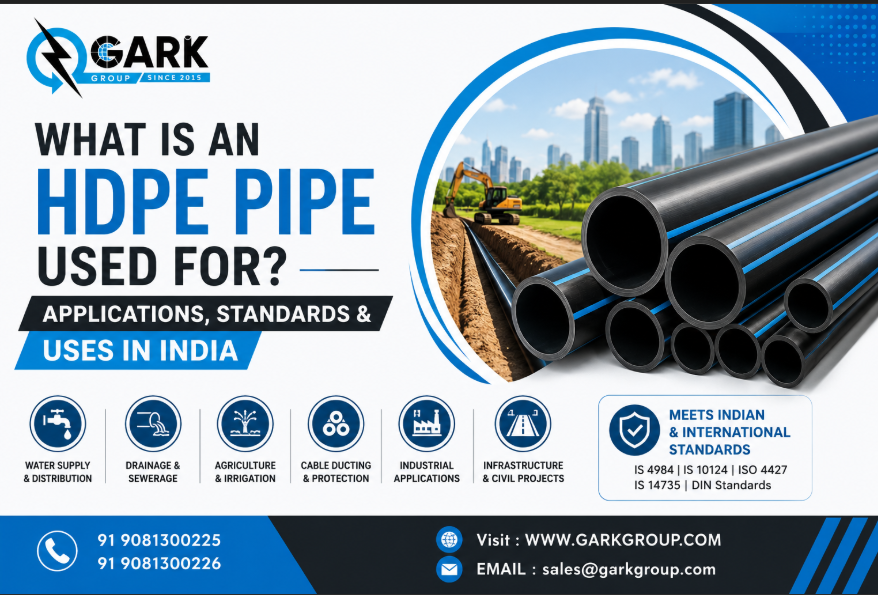
Jal Jeevan Mission: PE100 SDR 17 (PN 10) is the standard for JJM rural water distribution mains — the most significant single driver of HDPE pipe demand in India, connecting over 15.44 crore households to tap water with ₹8.69 lakh crore total programme outlay. Gark Polyplast’s IS 4984:2016 HDPE pipes in PE100 SDR 17 directly serve this specification.
Gas distribution: PE100 SDR 11 (PN 16) is the global and Indian standard for natural gas distribution networks under PNGRB guidelines — chosen for its superior SCG resistance and high safety margin.
Municipal water supply (AMRUT 2.0): PE100 SDR 13.6 and SDR 17 for urban distribution mains, rising mains, and trunk transmission lines across India’s 500+ AMRUT cities.
Industrial and chemical process piping: PE100 SDR 9 and SDR 11 for high-pressure industrial water, chemical transfer, and process piping where maximum long-term strength under aggressive chemical environments is required.
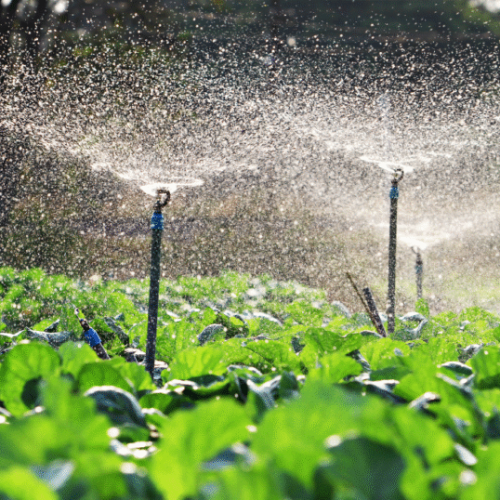
Agricultural irrigation (PMKSY): PE100 SDR 17 and SDR 21 for main supply lines in HDPE sprinkler pipe systems and micro-irrigation networks under the Pradhan Mantri Krishi Sinchayee Yojana.
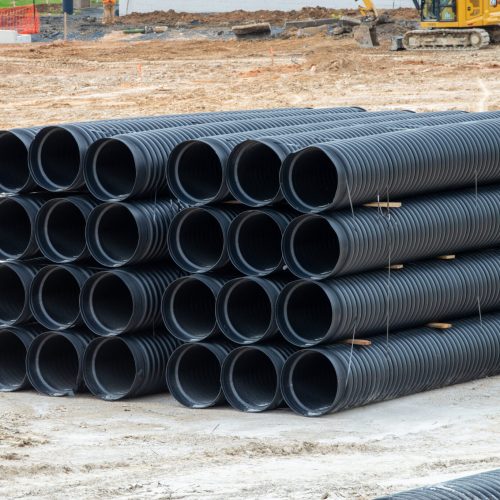
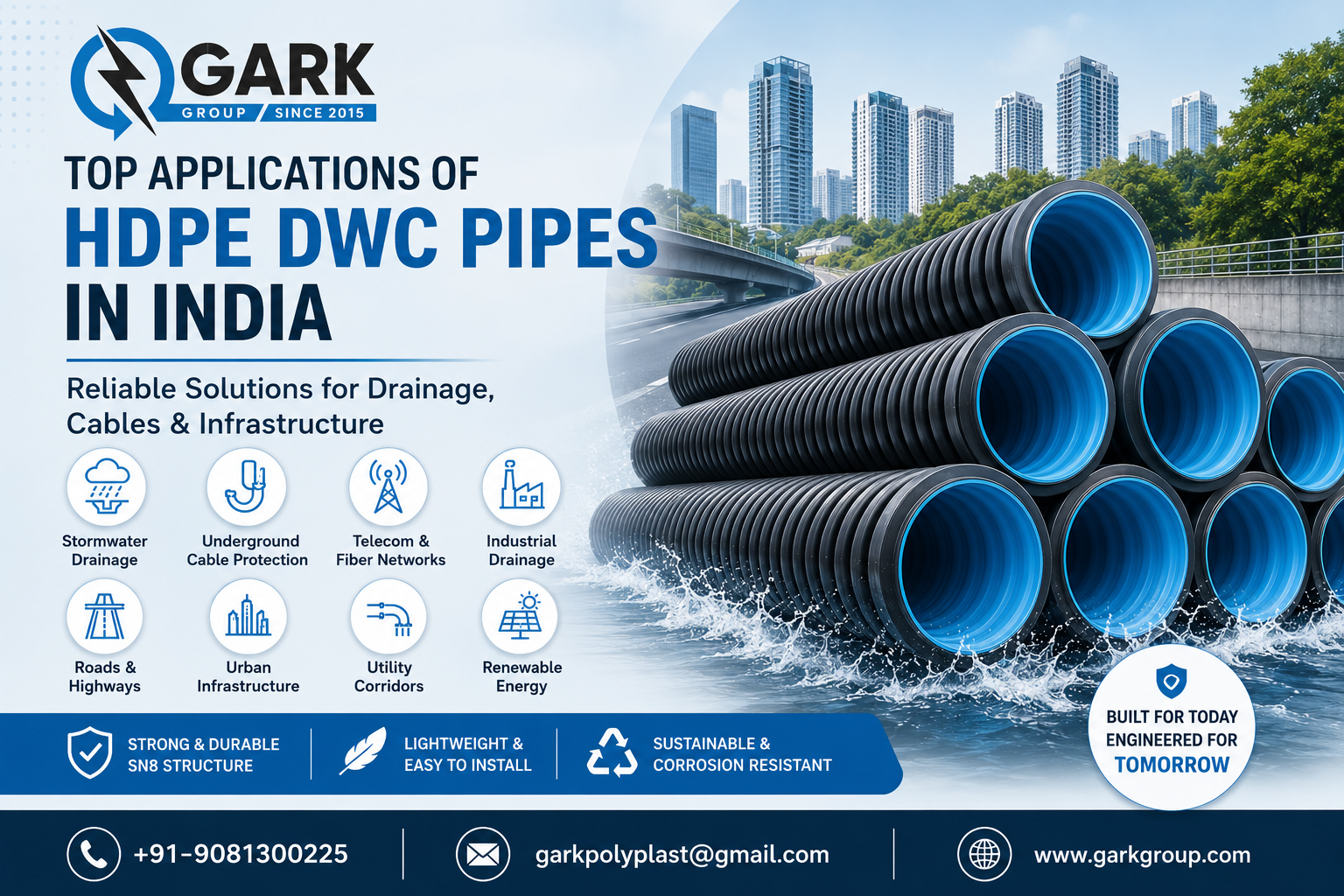
Telecom and power cable conduit: PE100 compound is the material base for HDPE DWC pipes (IS 16098/IS 16205) and PLB Duct Pipes (TEC GR/TX/CDS-008/03) — the conduit backbone of BharatNet and RDSS underground cabling.
| Parameter | PE100 | PE80 |
|---|---|---|
| MRS | 10.0 MPa | 8.0 MPa |
| Allowable hoop stress (σ) | 8.0 MPa | 6.3 MPa |
| SDR 17 pressure rating | PN 10 | PN 8 |
| SDR 11 pressure rating | PN 16 | PN 12.5 |
| Slow crack growth resistance | Superior | Standard |
| Wall thickness at same PN | Thinner | Thicker |
| JJM / gas distribution spec |  Preferred Preferred |  Suitable only for low-pressure Suitable only for low-pressure |
Choose PE100 for all municipal water supply, gas distribution, high-pressure industrial, and government scheme (JJM, AMRUT, RDSS) applications.
Choose PE80 for low-pressure agricultural distribution, domestic service connections, and small-diameter coiled pipe where flexibility and cost are priorities. Our companion guide What is PE80 in HDPE Pipes? covers PE80 in full detail.
Gark Polyplast Pvt. Ltd. is an ISI certified, BIS-marked manufacturer of HDPE DWC Pipes, HDPE Pipes, and PLB Ducts — operating from our state-of-the-art facility in Palanpur, Gujarat, since 2015.
 +91 9081300225 | +91 9081300226
 Sales@garkgroup.com | garkpolyplast@gmail.com
 www.garkgroup.com
 Gark Industrial Park, Kotda-Pirojpura Road, Palanpur, Gujarat 385010