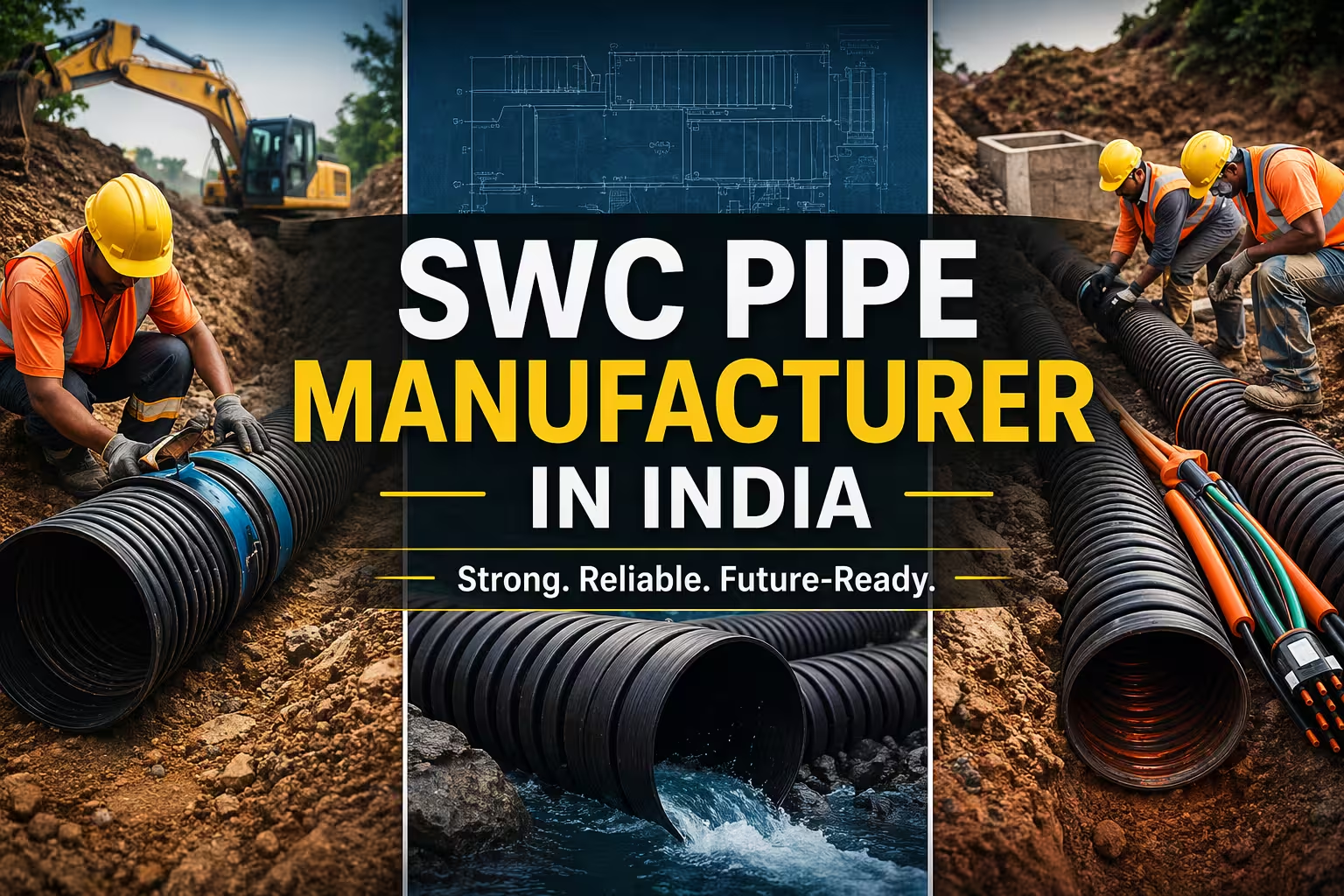
India’s critical infrastructure — its bridges, flyovers, metro corridors, and tunnels — is built to last. But that longevity depends heavily on one often-overlooked component: the duct that protects the prestressing tendon within it.
SWC Pipes (Single Wall Corrugated HDPE Sheathing Ducts) are the modern standard for internal bonded post-tensioning applications across India’s largest infrastructure programmes. Lightweight, corrosion-proof, and fully tested to fib Bulletin 7 / fib Bulletin 75 standards, they outperform traditional metallic ducts in every application where long-term structural integrity matters.
Procure SWC Sheathing Ducts in bulk for your bridge, metro, highway, or offshore project. [Request a Quote →]
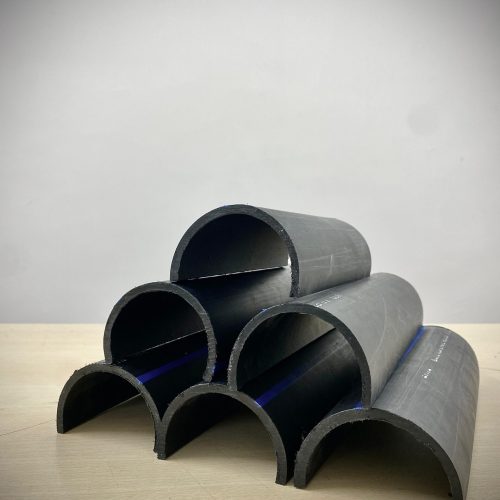
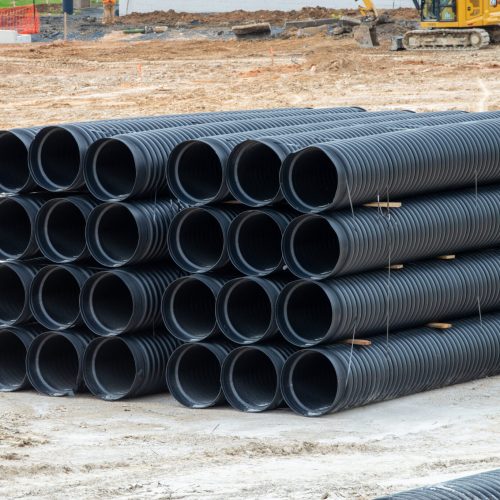
SWC stands for Single Wall Corrugated. An SWC Pipe — also referred to as an HDPE Sheathing Duct or HDPE Corrugated Post-Tensioning Duct — is a semi-rigid, corrugated conduit manufactured from High-Density Polyethylene (HDPE) resin. It is installed within prestressed concrete elements to form a precise channel through which post-tensioning tendons (high-strength steel strands or bars) are threaded, tensioned, and subsequently grouted.
The corrugated profile on the outer wall serves a dual engineering purpose. First, it provides the mechanical grip needed for effective grout-to-duct bonding — critical for load transfer in bonded post-tensioning systems. Second, the corrugation pattern gives the duct superior flexibility for navigating the curved tendon profiles demanded by bridge girder geometry and box beam designs, while still maintaining adequate stiffness and radial load resistance during concrete casting and compaction.
Unlike traditional metallic sheathing ducts, which are prone to galvanic corrosion even when galvanised, HDPE SWC Pipes offer inherent and permanent corrosion resistance. This is not a coating or surface treatment that degrades over time — it is a fundamental material property of HDPE that endures for the full service life of the structure.
India’s bridge construction and maintenance market reached USD 3.76 billion in 2024 and is projected to grow to USD 9.62 billion by 2033 at a CAGR of 11.00%. The Bharatmala Pariyojana with its approved Phase-I outlay of ₹5.35 lakh crore for 34,800 km of national highways, plus NHAI’s target of constructing 50 km of national highway per day, are generating a sustained multi-year pipeline of prestressed concrete bridge and flyover projects — each of which requires SWC Sheathing Ducts at scale. For procurement teams working on NHAI, metro rail, or state road development authority projects, reliable SWC Pipe supply from a quality-certified manufacturer is a procurement-critical requirement.
Permanent Corrosion Immunity The single most critical failure mode in post-tensioned bridge structures is corrosion of the prestressing tendon caused by water and chloride ingress through degraded metallic ducts. HDPE is chemically inert — it does not rust, pit, or develop galvanic corrosion under any environmental condition encountered in Indian infrastructure, from coastal saline environments to chloride-rich industrial soils. This is not an incremental improvement over metallic ducts — it is a categorical elimination of the primary failure pathway.
Engineered Flexibility with Structural Stiffness SWC Pipes achieve a carefully calibrated balance between flexibility and radial stiffness. The corrugated HDPE wall is flexible enough to accommodate tight tendon curvatures in curved girders and box beams, yet stiff enough to resist deformation under fresh concrete pressure during casting and vibration. This combination is what makes HDPE corrugated ducts the preferred specification for curved structural applications where metallic ducts are difficult to bend precisely.
Leak-Tight Performance Bonded post-tensioning systems depend on full grouting of the duct after tensioning to protect the steel strand from moisture and oxygen. HDPE SWC Pipes, when correctly jointed using proper duct couplers and end caps, provide a leak-tight duct system that prevents grout loss and ensures complete tendon encapsulation. Fib Bulletin 75 (the current international standard for polymer duct systems in bonded post-tensioning, published in 2014 and updated by fib Bulletin 113 in October 2024) specifies detailed leak-tightness tests that HDPE duct systems are required to pass.
Lower Friction Coefficients — Better Prestress Efficiency A key technical advantage of HDPE SWC Pipes over metallic ducts is their superior friction performance. HDPE corrugated ducts exhibit lower wobble coefficient (k) and friction coefficient (µ) values than steel ducts. This directly affects prestress efficiency — lower friction losses mean more of the applied jacking force is transferred to the effective prestress in the tendon, reducing the required tendon area and lowering overall construction cost.
Long Structural Service Life HDPE material degrades only under prolonged ultraviolet exposure (not relevant for embedded ducts). Within concrete structures, HDPE SWC Pipes have a service life equivalent to the structure itself — typically 50–100 years for major bridge infrastructure. There is no cathodic protection, inspection interval, or maintenance schedule required for the duct once it is embedded and grouted.
Lightweight — Faster, Safer Installation HDPE SWC Pipes weigh a fraction of equivalent metallic ducts. On a major bridge project with hundreds of metres of duct per girder and hundreds of girders, the handling weight reduction translates directly to reduced labour hours, faster placement, and improved on-site safety. Sections can be joined by hand using push-fit or twist-lock duct couplers without mechanical equipment.
Customisable to Project-Specific Standards SWC Sheathing Ducts can be manufactured to national specifications (NHAI, Indian Railways, DMRC, various State Road Development Authorities), international standards (fib Bulletin 7 / fib Bulletin 75 / fib Bulletin 113), or customer-specific technical specifications provided by the project’s post-tensioning system supplier.
1. Bridges and Flyovers — The Primary Application Post-tensioned concrete bridges are the largest volume application for SWC Sheathing Ducts in India. Every prestressed concrete bridge element — box girders, T-beams, segmental bridge sections, and deck slabs — contains a network of post-tensioning tendons encased in sheathing ducts. India’s bridge infrastructure market was valued at USD 42.16 billion in FY2024 and is projected to reach USD 68.26 billion by FY2032. The Bharatmala Pariyojana, NHAI’s expressway programme, and state highway expansion projects are building hundreds of new bridges annually, each consuming significant quantities of SWC Pipe.
2. Metro Rail Projects and Elevated Viaducts India’s metro rail network is one of the fastest-expanding in the world. Delhi, Mumbai, Bengaluru, Chennai, Hyderabad, Kolkata, Ahmedabad, Pune, and dozens of other cities are either constructing or expanding metro systems, the majority of which use prestressed concrete elevated viaducts and station structures. SWC Sheathing Ducts are used extensively in these viaduct box girders and precast segmental elements. Delhi Metro Rail Corporation (DMRC) and major metro corporations across India have approved and specified HDPE SWC Ducts for their projects.
3. Tunnels and Underpasses Cut-and-cover tunnels, NATM tunnels, and highway underpasses built in prestressed concrete use SWC Pipes in their structural lining and portal elements. Tunnel environments are among the most demanding for duct corrosion performance — perpetual moisture, groundwater, and limited access for post-construction inspection make the permanent corrosion immunity of HDPE SWC Ducts a specification requirement rather than merely a preference.
4. Railway Bridges and Infrastructure The Indian Railways network is undergoing its largest modernisation programme in decades. Dedicated Freight Corridors (DFC), the Vande Bharat rail network, and the expansion of high-speed rail corridors all involve extensive prestressed concrete bridge construction. Konkan Railway — one of India’s most demanding rail bridge environments due to its coastal location and high seismicity — has used HDPE SWC Sheathing Ducts, reflecting their reliability under the most challenging service conditions.
5. Offshore Platforms and Marine Structures Post-tensioned concrete elements in marine and offshore structures are subjected to the most aggressive corrosion environments of any infrastructure type — seawater, chloride saturation, tidal cycling, and splash zone exposure. Metallic ducts in these environments face rapid corrosion. HDPE SWC Pipes, being immune to marine electrochemical corrosion, are the only technically appropriate specification for prestressed structural elements in marine construction.
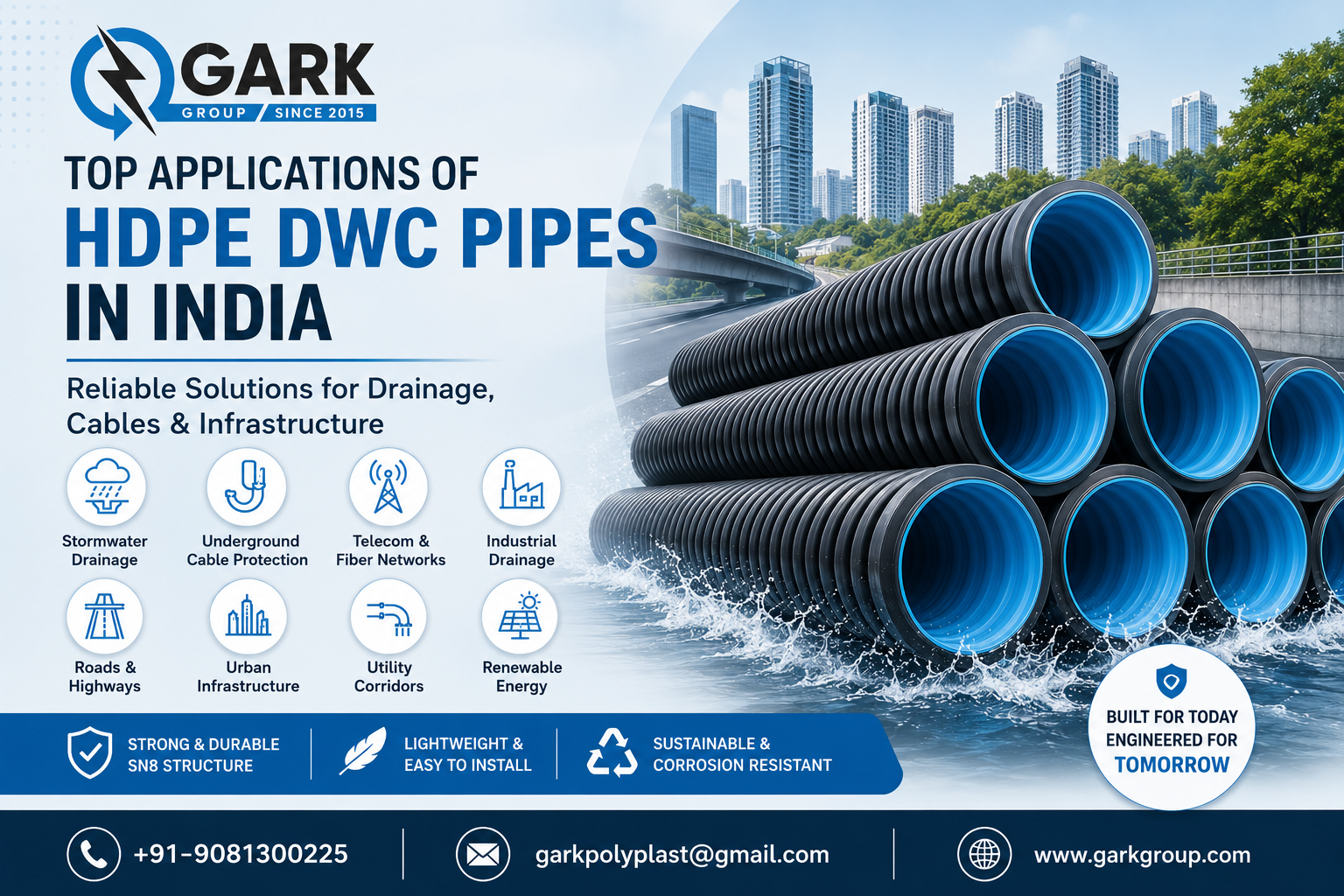
6. Solar Park and Industrial Structural Foundations Large-scale solar parks and industrial facilities in India increasingly use precast prestressed concrete foundations, equipment support structures, and cable troughs. SWC Pipes used in these precast elements provide the same post-tensioning duct function in an industrial context. Combined with HDPE DWC Pipes for underground cable protection and PLB Duct Pipes for optical fibre conduit routes, HDPE pipe systems form a comprehensive infrastructure layer for large solar installations.
7. Power and Telecom Cable Protection in Urban Networks Beyond their post-tensioning role, HDPE corrugated pipe products are specified for the protection of electrical and communication cables in underground city networks. Where the duct is used as a cable protection conduit rather than a structural post-tensioning duct, HDPE Pipes and HDPE DWC Pipes may be the more appropriate specification depending on the project’s requirements — our technical team can advise on the right product for your application.
Specifying SWC Pipes for a bridge, metro, or infrastructure project? Our team can work with your structural engineer and post-tensioning system supplier to confirm the right duct size, specification, and supply volume. [Contact Technical Support →]
| Parameter | Specification |
|---|---|
| Full Product Name | Single Wall Corrugated (SWC) HDPE Sheathing Duct |
| Material | High-Density Polyethylene (HDPE) |
| Profile | Corrugated outer wall; smooth or semi-smooth inner bore |
| Internal Diameter (ID) Range | 40 mm to 150 mm (common: 51, 63, 76, 84, 90, 103, 107, 120, 124 mm) |
| External Diameter (OD) | Varies with ID (typical OD sizes: 63, 76, 90, 98, 103, 120, 124, 150 mm) |
| Wall Thickness | 0.24 mm to 0.7 mm (structural wall); corrugation height varies with diameter |
| Standard Lengths | As per project specification (typically supplied in coils or straight lengths) |
| Colour | Black, Red, Blue, Yellow, White (as per project requirement or standard) |
| Applicable Standards | fib Bulletin 7 (2000), fib Bulletin 75 (2014), fib Bulletin 113 (2024) |
| Indian Approvals | NHAI, Delhi Metro Rail Corporation (DMRC), Konkan Railways, various State Road Development Authorities |
| Testing Parameters | Friction coefficient (µ), Wobble coefficient (k), Bond stress, Wear resistance, Leak tightness, Lateral load resistance |
| Testing Authority | Tested as per fib Bulletin 7 by IIT Mumbai (for friction/wobble/bond/wear) |
| Jointing | Push-fit or twist-lock duct couplers; end caps for grout retention |
| Customisation | Available in custom diameters and lengths to project-specific or client-specific technical specifications |
Commonly specified ID/OD combinations: 51/63 mm | 76/90 mm | 84/98 mm | 103/120 mm | 107/124 mm
This comparison is central to any structural engineer’s material selection decision for a post-tensioning duct specification in India.
| Parameter | Metallic Sheathing Duct | HDPE SWC Pipe |
|---|---|---|
| Corrosion Resistance | Prone to corrosion even with galvanising; fails in saline and chloride-rich environments | Fully corrosion-resistant — inherent HDPE material property |
| Friction Coefficient (µ) | Higher µ values → greater prestress losses | Lower µ → reduced prestress losses; better tendon efficiency |
| Wobble Coefficient (k) | Higher k values for curved profiles | Lower k → more accurate prestress prediction in curved profiles |
| Weight | Heavy — increases handling labour and project risk | Lightweight — faster placement; reduced on-site labour cost |
| Installation in Curved Profiles | Requires mechanical bending equipment; kink risk | Flexible; accommodates curvature easily by hand |
| Leak Tightness | Prone to leakage at joints and seams during grouting | Superior leak tightness with proper duct couplers and end caps |
| Service Life | Corrosion-limited — particularly in marine, saline, or chloride environments | Full structural service life (50–100 years) within concrete |
| Grout Bond | Adequate bond through corrugation | Excellent bond — corrugated HDPE profile provides reliable grout-to-duct grip |
| Electrical Conductivity | Electrically conductive — risk of stray current corrosion in metro and railway environments | Non-conductive — no stray current risk |
| Application Suitability | Adequate for benign, low-humidity inland environments | Specified by NHAI, DMRC, Konkan Railways, marine and offshore projects |
Engineer’s note: Corrosion of un-grouted or inadequately grouted post-tensioning tendons causes invisible, progressive loss of prestressing force — often with no visible surface distress until the structure is in advanced states of distress. HDPE SWC Pipes eliminate the duct-related pathway for this failure mode entirely.
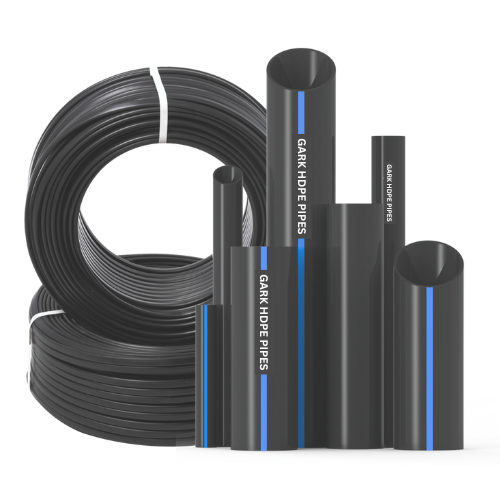
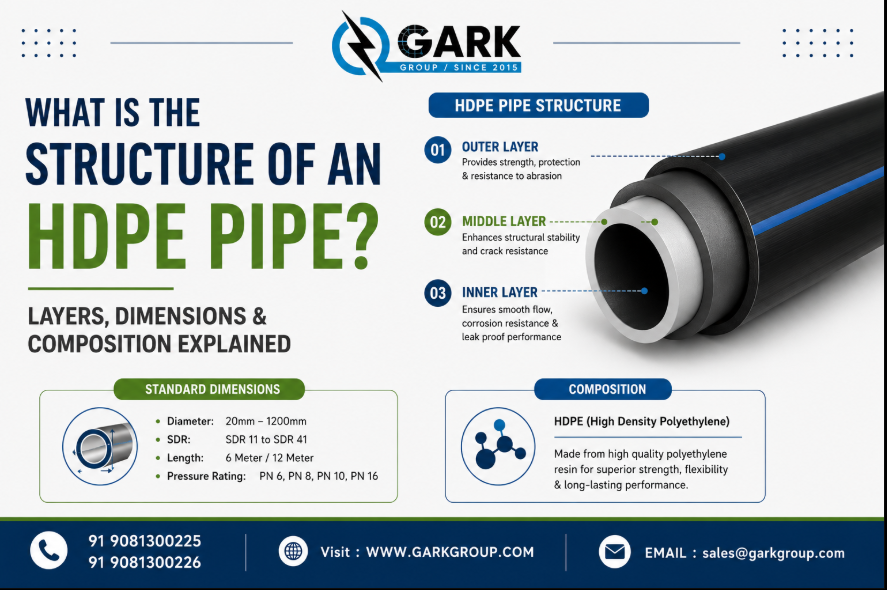
Gark Polyplast Pvt. Ltd. is an ISO 9001:2015, ISO 14001:2015, and ISO 45001:2018 certified manufacturer based in Palanpur, Gujarat. Since 2015, we have built a reputation for consistent product quality, reliable supply, and technical competence across multiple HDPE pipe product categories — including HDPE Pipes (IS 4984), DWC Pipes (IS 16098/16205), PLB Duct Pipes (TEC/RDSO specification), and Sprinkler Pipes (IS 17425).
Quality Manufacturing at Every Stage Our manufacturing processes are governed by documented quality procedures aligned with ISO 9001:2015. Every batch of SWC Pipes undergoes material-level verification (HDPE resin grade), dimensional checks, and performance testing before dispatch. We do not compromise on raw material specifications — our HDPE resin meets the material requirements for post-tensioning duct applications.
Manufactured to International and National Standards. We manufacture SWC Sheathing Ducts to meet fib Bulletin 7, fib Bulletin 75, and project-specific specifications provided by NHAI, metro corporations, state road development authorities, and post-tensioning system suppliers. Custom sizes and specification requirements can be accommodated with appropriate lead times.
Bulk Supply Capability for Large Infrastructure Projects Bridge projects, metro viaducts, and highway infrastructure require SWC Pipes in large, scheduled quantities. Our production capacity supports consistent bulk supply schedules aligned with project construction programmes. We coordinate with project procurement teams to ensure timely delivery in line with erection and casting sequences.
Pan-India Delivery Our logistics network covers all major states. Gujarat’s location at the heart of India’s western highway network — connected to NH-27, NH-48, and the Delhi-Mumbai Industrial Corridor — enables efficient dispatch to project sites across Maharashtra, Rajasthan, Madhya Pradesh, Uttar Pradesh, and beyond. We have supplied to projects in multiple states and can confirm delivery schedules for your specific site location.
Technical Sales and Specification Support Our team works with structural engineers, post-tensioning system suppliers, and EPC contractors to confirm the correct duct size, length, and specification for project requirements. We can provide technical data sheets, test certificates, and product samples to support your project’s approval process.
Shortlisting SWC Pipe suppliers for your project? Contact us with your project details — duct diameter required, total quantity, delivery schedule, and applicable standard — and our team will respond within one working day.
[Send Project Enquiry →]
HDPE DWC Pipes Where SWC Pipes serve as post-tensioning sheathing ducts inside prestressed concrete, DWC (Double Wall Corrugated) Pipes are the specification for underground drainage, sewerage, stormwater management, and cable protection conduits in the same infrastructure projects. Manufactured to IS 16098 / IS 16205, DWC Pipes combine a smooth inner bore for hydraulic efficiency with a corrugated outer structure for load resistance. For electrical cable protection and solar project cable management, DWC Pipes are the right product alongside SWC Sheathing Ducts.
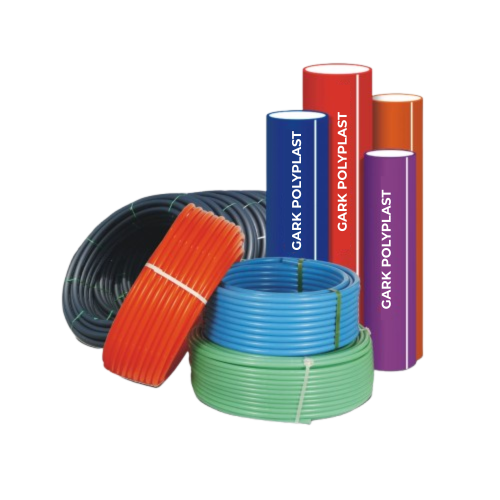
PLB Duct Pipes Manufactured to TEC and RDSO specifications, PLB Duct Pipes are the government-specified conduit for BharatNet optical fibre cable protection across the national highway and rail networks where SWC Pipes are simultaneously used for post-tensioning applications. Projects along national highway alignments often require both SWC Pipes (for bridge post-tensioning) and PLB Duct Pipes (for roadside fibre optic cable protection) — we supply both.
HDPE Pipes For water supply, pressurised irrigation, and industrial fluid conveyance at the project site level, HDPE Pipes manufactured to IS 4984 in PE63, PE80, and PE100 grades complete the HDPE pipe product range. Site water supply, dewatering, and utility connections at infrastructure project sites are typically served by HDPE Pipes.
An SWC Pipe (Single Wall Corrugated HDPE Sheathing Duct) is used primarily as the protective conduit for post-tensioning tendons in bonded post-tensioned prestressed concrete structures. It is installed inside bridge girders, metro viaduct sections, tunnel linings, offshore platform elements, and other prestressed concrete components before concrete casting. After casting and tensioning, the duct is pressure-grouted to permanently encapsulate the tendon. Secondary uses include protection of electrical and communication cables in underground city networks.
SWC (Single Wall Corrugated) and DWC (Double Wall Corrugated) pipes serve completely different structural functions. SWC Pipes are used as post-tensioning sheathing ducts inside prestressed concrete — the corrugated single wall provides the tendon channel, friction characteristics, and bond profile needed for structural post-tensioning. DWC Pipes are underground drainage and cable protection conduits — the double wall construction (smooth inner bore + corrugated outer profile) provides hydraulic efficiency and structural load resistance for buried pipe applications. They are not interchangeable.
HDPE provides four key advantages over metallic ducts in post-tensioning applications: (1) permanent corrosion immunity, eliminating the primary failure pathway for post-tensioned structures; (2) lower friction and wobble coefficients, resulting in better prestress efficiency; (3) flexibility for installation in curved tendon profiles without mechanical bending equipment; and (4) electrical non-conductivity, preventing stray current corrosion in metro and railway environments. The fib (Fédération internationale du béton) has published dedicated technical bulletins — most recently fib Bulletin 113 (October 2024) — specifically covering polymer duct systems for internal bonded post-tensioning.
SWC Pipes are available in a range of internal diameters from approximately 40 mm to 150 mm. Common ID/OD size pairings include 51/63 mm, 76/90 mm, 84/98 mm, 103/120 mm, and 107/124 mm. The appropriate duct size for a specific application is determined by the post-tensioning system supplier based on the tendon geometry (number of strands and strand diameter). Custom sizes are available to project-specific requirements.
The primary international standards governing HDPE SWC Pipes for post-tensioning applications are fib Bulletin 7 (2000), fib Bulletin 75 (2014), and fib Bulletin 113 (October 2024) — all published by the fib (Fédération internationale du béton). In India, SWC Pipes are approved and specified by NHAI, Delhi Metro Rail Corporation (DMRC), Konkan Railway, and multiple State Road Development Authorities. Project-level specifications typically reference fib Bulletin requirements alongside client-specific technical criteria. Testing to fib Bulletin 7 standards by IIT Mumbai has been used to qualify HDPE sheathing duct products for major Indian infrastructure projects.
Yes. SWC Sheathing Ducts can be manufactured to custom internal diameters, wall specifications, and lengths to meet project-specific or client-specific technical requirements. Customisation requests require technical specifications from the post-tensioning system supplier or project structural engineer. Contact our sales team with your project specifications for confirmation of lead time and minimum order quantities.
India’s infrastructure ambitions are building structures designed for 50 to 100-year service lives. The Bharatmala bridges, metro viaducts, dedicated freight corridor structures, and coastal highway crossings being built today will be carrying loads well into the second half of this century. The post-tensioning tendons inside those structures — and the ducts protecting them — must perform for every one of those years without intervention.
That is the case for HDPE SWC Sheathing Ducts. Their corrosion immunity is not conditional on maintenance, inspection, or cathodic protection. Their friction performance reduces prestress loss throughout the tendon’s life. Their flexibility allows precise installation in the curved profiles that efficient bridge design demands. And their compatibility with international standards (fib Bulletin 7 / 75 / 113) and Indian project specifications (NHAI, DMRC, Indian Railways) means they slot directly into any project approval process.
Gark Polyplast has the manufacturing capability, quality certification, and technical expertise to supply SWC Pipes to your project’s exact specification — on time and at competitive pricing for bulk orders.
Gark Polyplast Pvt. Ltd. is an ISI certified, BIS-marked manufacturer of HDPE DWC Pipes, HDPE Pipes, and PLB Ducts — operating from our state-of-the-art facility in Palanpur, Gujarat, since 2015.
+91 9081300225 | +91 9081300226
Sales@garkgroup.com | garkpolyplast@gmail.com
www.garkgroup.com
Gark Industrial Park, Kotda-Pirojpura Road, Palanpur, Gujarat 385010

Latest Post
Stay Updated With Insight
Subscribe to our social media channels, never miss the latest articles, expert blogs, your business effectively.
Related Post
Continue Reading
Table of Contents
×