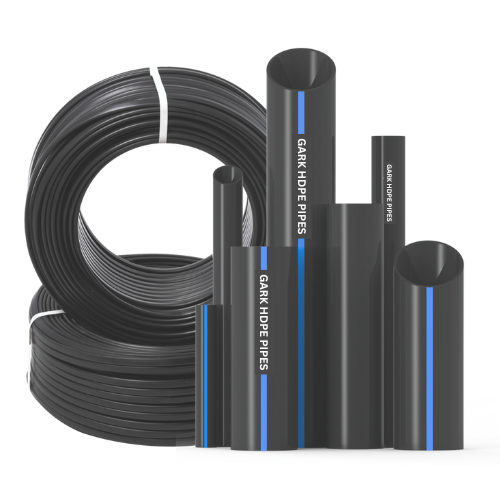
There is a three-letter acronym on practically every government telecom tender in India — PLB — and surprisingly few people in the infrastructure industry can explain what it stands for, how the product works at an engineering level, and why it is specified by every major telecom operator and government programme deploying optical fiber cable in the country today.
This guide answers every one of those questions. PLB Duct full form. How PLB Duct Pipes are constructed. What the permanent lubrication actually does during cable installation. How the TEC specification works. What sizes are used and when. Which government projects drive demand. And why — as India lays fiber to connect every gram panchayat in the country under a ₹1.39 lakh crore programme — understanding PLB Duct Pipes is no longer optional for anyone in the telecom, construction, or infrastructure supply chain.
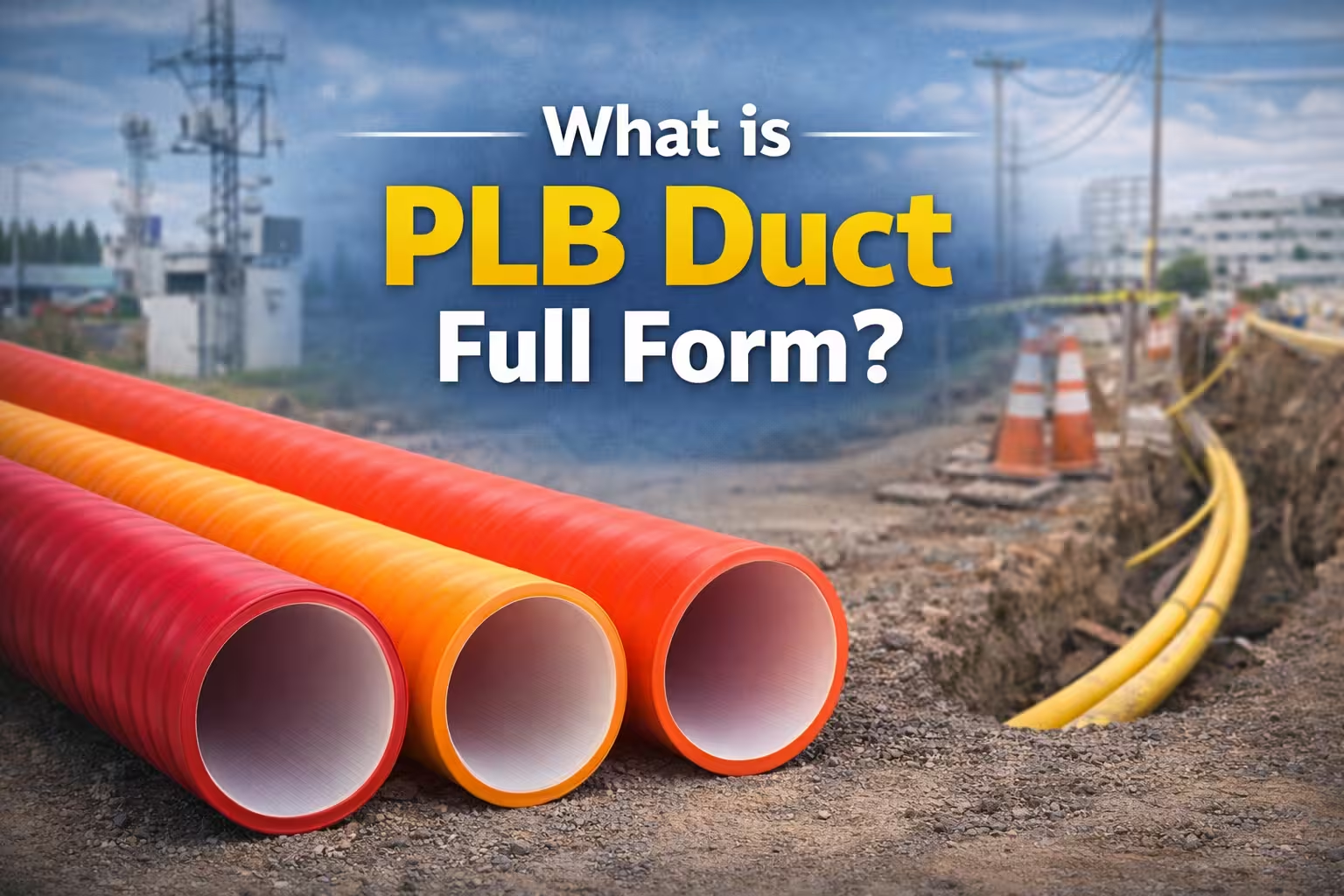
PLB stands for Permanently Lubricated Bore.
Each word in the full form carries precise technical meaning:
Permanent — The lubrication is not applied after manufacturing as a coating or gel. It is integrated into the pipe wall itself during the extrusion process, using a co-extrusion technique that bonds a silicone lubricant layer permanently to the inner surface of the HDPE pipe. It cannot be washed out, worn away, or depleted over the pipe’s service life. This is the defining characteristic that distinguishes a genuine PLB duct from inferior alternatives sold with temporary gel lubrication that evaporates or dries within months.
Lubricated — The inner surface of the duct is engineered to provide an extremely low coefficient of friction between the duct wall and the optical fiber cable being blown or pulled through it. The TEC specification requires a coefficient of friction not exceeding 0.06 between the duct interior and the cable jacket — a value that enables cable blowing at speeds up to 100 metres per minute and over distances exceeding 1,000 metres in a single operation without intermediate access pits.
Bore — The bore is the internal channel of the duct through which the cable passes. In PLB terminology, “bore” signifies that the lubrication is a property of the bore itself — of the internal channel’s surface — rather than a coating applied to the cable or a gel injected into the duct. The bore is permanently lubricated by design, not by maintenance intervention.
So the complete answer: PLB Duct full form is Permanently Lubricated Bore Duct — an HDPE duct whose inner bore carries a factory-bonded permanent silicone lubricant layer enabling low-friction optical fiber cable installation by the cable blowing method.
Understanding why PLB Duct Pipes work the way they do requires understanding the co-extrusion manufacturing process that creates the permanent lubrication.
A conventional HDPE pipe is extruded from a single material — HDPE compound is melted, pushed through a die, cooled, and cut to length. The result is a pipe whose inner surface is simply the inner surface of the HDPE material, with a roughness determined by the die surface quality and the HDPE polymer’s own properties.
A PLB Duct is manufactured using co-extrusion — a process in which two different materials are simultaneously extruded through a single die with concentric channels, one forming the outer HDPE pipe wall and one forming the inner lubricated liner. The inner layer is a specialised compound based on virgin HDPE with integrated silicone lubricant — typically Dow Corning Grade-50MB002 or equivalent CACT-approved material — that provides both the structural continuity of HDPE (matching the outer layer’s mechanical properties) and the ultra-low friction surface that the optical fiber cable jacket contacts during installation.
The result of this co-extrusion process is a pipe that is structurally identical to standard HDPE on the outside and permanently silicone-lubricated on the inside. The silicone lubricant in the inner layer is molecularly locked into the HDPE matrix — it does not leach, evaporate, or degrade over time. A PLB duct manufactured in 2026 has the same inner surface friction coefficient in 2076 as it did the day it left the factory. This permanence is not a marketing claim — it is a consequence of how the material is manufactured, and it is what justifies the TEC specification’s requirement for permanent lubrication rather than temporary alternatives.
The key technical properties of the PLB inner layer as specified under TEC GR/FA/CDS-008/04/AUG-19 (the current TEC Generic Requirement, which supersedes the earlier TEC/GR/TX/CDS-008/03/MAR-11):
The coefficient of friction between the duct inner surface and the OFC jacket shall not exceed 0.06 for HDPE PLB ducts. The density of the duct shall be between 0.940 and 0.958 g/cc at 27°C. Tensile strength at yield shall be a minimum of 20 N/mm². The inner lubricated layer shall be co-extruded and permanently bonded, not applied as a post-extrusion coating or gel.
Gark Polyplast manufactures PLB Duct Pipes fully compliant with this specification using 100% virgin-grade HDPE raw material and CACT-approved silicone lubricant compound, with TEC certification and batch traceability documentation supplied with every order.
To understand why the permanently lubricated bore matters so much in practice, you need to understand what happens during optical fiber cable installation in a duct without it.
Optical fiber cable is installed in underground ducts using the cable blowing method — compressed air is used to propel the cable through the duct at high speed. The principle is straightforward: compressed air flowing through the duct carries the cable along with it, reducing the tensile load on the cable to a small fraction of what pulling would impose. Cable blowing is the industry-standard method for installing fiber in underground ducts because it protects the fragile glass fiber from the tensile stress that direct pulling would create, and because it allows much longer continuous installation runs — up to 1,000+ metres between access pits — compared to the 100–200 metre runs typical with pulling in unlubricanted conduit.
The critical variable in cable blowing performance is friction between the cable jacket and the duct inner wall. High friction means the compressed air must work harder to move the cable, the installation speed is lower, the maximum blowing distance is shorter, and the risk of the cable jamming at bends is higher. Every additional unit of friction translates directly into installation time, labour cost, equipment rental cost, and project schedule risk.
The PLB inner bore’s coefficient of friction of 0.06 or less enables cable blowing speeds of up to 100 metres per minute — completing a 1,000-metre installation run in under 15 minutes. A standard HDPE conduit without lubrication typically achieves blowing distances of 200–400 metres before friction losses require an intermediate access pit. A PLB duct achieves 1,000+ metres in a single blow, reducing the number of access pits required by 60–80% on a typical highway or urban deployment.
In India’s BharatNet OFC deployments, where fiber is being laid along rural roads to connect gram panchayats across difficult terrain — river crossings, rocky ground, agricultural land — the ability to blow 1,000+ metres continuously without a pit is not a convenience. It is a project economics fundamental. Fewer pits means less excavation, faster installation, lower civil works cost, and significantly fewer potential failure points in the final network.
PLB Duct Pipes are manufactured in five standard sizes as specified under the TEC Generic Requirement. Each size is identified by its outer diameter / inner diameter designation in millimetres. The five standard sizes are:
25/20 mm — Outer diameter 25mm ±0.2mm, inner diameter approximately 20mm, wall thickness 2.5mm ±0.2mm. Standard coil lengths of 500 metres or 1,000 metres. Used for FTTH (Fibre-to-the-Home) last-mile connections and small-diameter secondary network OFC.
32/26 mm — Outer diameter 32mm ±0.3mm, inner diameter approximately 26mm, wall thickness 3.0mm ±0.2mm. Standard coil lengths of 500 or 1,000 metres. Used for secondary distribution network OFC and CATV installations.
40/33 mm — Outer diameter 40mm ±0.4mm, inner diameter approximately 33mm, wall thickness 3.5mm ±0.2mm. Standard coil lengths of 500 or 1,000 metres. The most widely used size in India’s OFC backbone deployments. Suitable for OPGW replacement ducts, BharatNet backbone, and highway cabling.
50/42 mm — Outer diameter 50mm ±0.4mm, inner diameter approximately 42mm, wall thickness 4.0mm ±0.2mm. Standard coil lengths of 500 or 1,000 metres. Used for larger-diameter OFC cables, multi-cable duct runs, and primary backbone network installations.
63/50 mm — Outer diameter 63mm ±0.5mm, inner diameter approximately 50mm, wall thickness 6.0mm ±0.5mm. Standard coil lengths of 500 metres. Used for trunk network ducts, duct bank installations, and protection of large-diameter cables at sub-station entry and road crossing points.
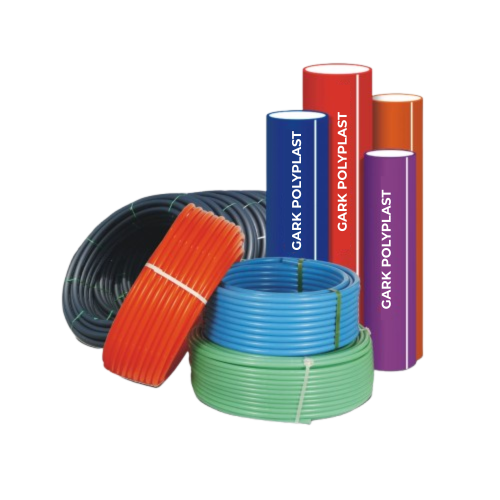
All sizes are available in colour options for network segregation: Red, Green, Blue, Orange, Yellow, and Grey — enabling installers and network maintenance teams to visually identify different cables or circuits in a duct bank without accessing documentation. Custom colours are available on request.
Coil length is a significant practical advantage of PLB Duct Pipes over rigid pipe sections: supplied in coils of up to 1,000 metres, a single delivery can supply an entire blowing run without joints. Each joint in an OFC duct is a potential weak point and a friction increase point. Minimising joints by using 1,000-metre coils directly improves network reliability and installation speed.
Gark Polyplast supplies PLB Duct Pipes in all five standard sizes in 500m and 1,000m coils, with full TEC certification, batch test reports, and traceability documentation.
When a PLB Duct Pipe is described as “TEC certified” or “TEC compliant,” this refers to the Telecommunication Engineering Centre (TEC) — the technical arm of India’s Department of Telecommunications (DoT) responsible for setting and enforcing standards for all telecom equipment and materials used in India’s networks.
The current TEC Generic Requirement for PLB HDPE ducts is TEC/GR/FA/CDS-008/04/AUG-19 — published in August 2019, superseding the earlier TEC/GR/TX/CDS-008/03/MAR-11 that many manufacturers still reference. This document specifies every measurable parameter of a compliant PLB duct: raw material properties, wall thickness tolerances, ovality limits, coefficient of friction requirements, impact strength, crush resistance, UV stability, dimensional accuracy, marking requirements, and the test methods used to verify each parameter.
Key TEC specification requirements that buyers should verify when procuring PLB ducts:
The coefficient of friction shall not exceed 0.06 for HDPE PLB ducts. Raw material shall be virgin-grade HDPE with CACT (Centre for Advanced Communication Technology) source approval. The inner lubricated layer shall be permanently bonded by co-extrusion — temporary gel or coating products do not qualify. Impact strength test: a 10 kg striker dropped from 1.5 metres onto a 150mm sample shall not cause fracture. Crush resistance minimum values: 800 kgf for 63mm, 550 kgf for 50mm, 450 kgf for 40mm, 320 kgf for 40mm, 250 kgf for 32mm sizes. UV stability: tested per UV exposure cycle requirements in TEC GR. Marking: every duct shall carry manufacturer identification, batch number, date of manufacture, size designation, and TEC specification number printed longitudinally.
Additionally, RDSO specification RDSO/SPN/TC/45/2006 applies to PLB ducts used in railway corridor OFC installations. Projects involving railway signalling, Indian Railways OFC networks, and the Dedicated Freight Corridor require RDSO specification compliance in addition to TEC certification.
Gark Polyplast’s PLB Duct Pipes carry TEC certification, comply with TEC/GR/TX/CDS-008/03 (current reference on live projects) and the updated TEC/GR/FA/CDS-008/04/AUG-19, and are manufactured with CACT-approved raw material from our ISO 9001:2015 facility in Palanpur, Gujarat. Every batch is supplied with test reports and certificate documentation for audit-ready government tender projects.
This is the single largest and most sustained demand driver for PLB Duct Pipes in India. The Amended BharatNet Programme (ABP), approved with a total outlay of ₹1.39 lakh crore, aims to connect 2.64 lakh Gram Panchayats using OFC in ring topology, and extend fiber to approximately 3.8 lakh non-GP villages on demand. As of October 2025, 6,94,711 km of OFC has already been laid under BharatNet. The BSNL middle-mile tender alone requires over 10 lakh kilometres of cables in the next three years.
Every kilometre of OFC laid underground in BharatNet goes through PLB Duct Pipe — because TEC certification is the mandatory specification for all government OFC conduit procurement. The scale of demand BharatNet represents for PLB Duct manufacturers is difficult to overstate: it is effectively an open-ended procurement programme running for years across every district in India.
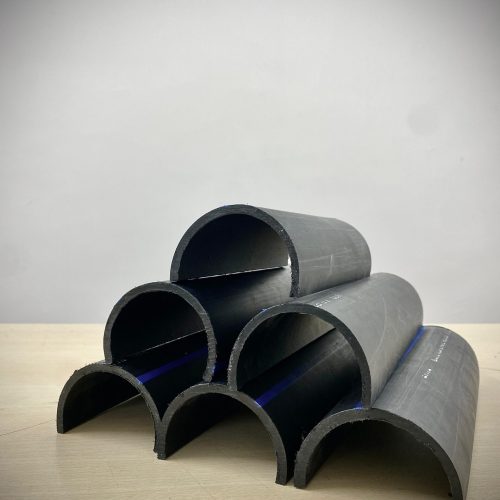
For a complete picture of OFC cable protection products beyond PLB Duct — including the protective covers placed over buried duct installations — our guides on HDPE Half Round Pipes and DWC Half Round Pipes cover the full cable protection system.
India’s 5G rollout requires fiberisation of base transceiver stations at an unprecedented scale. The National Broadband Mission targets fiberisation of 70% of India’s mobile towers — currently only around 44% of 7.95 lakh towers are fiberised. Connecting the remaining towers requires laying OFC from existing fiber nodes to tower sites, almost all of which runs underground in PLB Duct. At approximately 500–2,000 metres of duct per tower connection depending on terrain and site accessibility, the PLB Duct demand from 5G fiberisation alone represents millions of metres of product.
The India fiber optics market, valued at USD 517.2 million in 2025, is projected to reach USD 1.195 billion by 2034 at a CAGR of 9.76% — driven primarily by BharatNet Phase III, 5G deployment, and the expansion of FTTH (Fibre-to-the-Home) networks across India’s tier II and tier III cities. PLB Duct is the conduit through which all of this fiber runs.
NHAI and MoRTH mandate OFC conduit installation alongside National Highway construction for the highway management and surveillance systems that run along the road corridor. PLB Duct Pipes are the specified product for these highway OFC installations, buried alongside the carriageway in protected duct banks. The TEC specification and the requirement for long coil lengths (minimising joints along continuous highway runs) make PLB Duct the only viable product for this application.
The Smart Cities Mission has deployed underground utility infrastructure across 100 Indian cities, including OFC networks for city surveillance, smart street lighting control, and integrated command centre connectivity. PLB Duct Pipes provide the OFC conduit in these urban deployments, where the combination of confined underground space, multiple network crossings, and the need for long-duration reliability without maintenance access makes PLB specification essential.
Indian Railways’ OFC network — one of the largest in Asia, running alongside thousands of kilometres of track — uses PLB Duct Pipes compliant with RDSO specification for underground cable protection on the rail corridor. The Western Dedicated Freight Corridor, Eastern DFC, and upcoming high-speed rail projects all specify PLB Duct for OFC protection.
Beyond government-mandated deployments, India’s private broadband and cable TV operators — Jio, Airtel, BSNL, Tata, ACT, and thousands of smaller ISPs and LCOs (Local Cable Operators) — use PLB Duct Pipes for their OFC network buildout. FTTH (Fibre-to-the-Home) expansion in tier I and II cities, the continuous upgrade from copper to fiber in CATV networks, and data centre interconnect installations all create ongoing commercial demand for PLB Duct across India’s entire telecom ecosystem.
PLB Duct Pipes are also specified for power cable protection in some applications — specifically for LV and MV underground power cables where the smooth internal surface and crush resistance of the PLB duct provide better cable protection than standard conduit, and where the long coil lengths reduce civil works cost on urban cabling projects. For more on HDPE-based power cable protection solutions including HDPE Half Round Pipes and DWC Half Round Pipes, our HDPE Pipes product range covers the complete portfolio.
A question that arises consistently on procurement teams is whether a standard HDPE conduit or PVC conduit can substitute for PLB Duct on a telecom project. The answer is no — and understanding why clarifies exactly what makes PLB Duct irreplaceable in its application.
Inner surface friction: Standard HDPE pipe has a smooth inner bore but no lubrication — coefficient of friction is typically 0.15–0.25 against a cable jacket. PLB Duct’s co-extruded silicone inner layer achieves ≤0.06. This four to fivefold difference in friction is the difference between 200m cable blowing distances and 1,000m+ blowing distances.
Co-extrusion vs standard extrusion: Standard HDPE pipe is single-layer. PLB Duct is dual-layer co-extruded — the inner lubricated layer is structurally integrated, not applied or coated.
TEC specification compliance: Government tenders for OFC conduit in India require TEC/GR/FA/CDS-008/04 or TEC/GR/TX/CDS-008/03 compliance as a minimum qualification criterion. Standard HDPE conduit is not and cannot be TEC-certified for OFC applications. Using standard HDPE on a BharatNet or BSNL project is a disqualification event, not just an inferior choice.
Material specification: PLB Duct raw material requires CACT source approval of the HDPE resin and the silicone lubricant compound. Standard HDPE pipe does not involve this material qualification process.
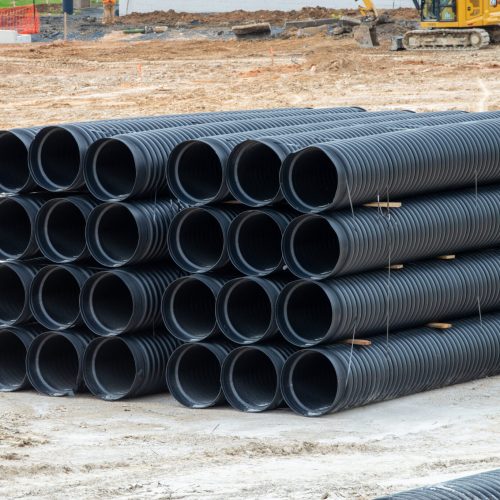
For projects requiring the full cable protection system — PLB Duct for the cable conduit, combined with HDPE protection above the buried duct — Gark Polyplast provides both PLB Duct Pipes and the full range of HDPE cable protection products including HDPE DWC Pipes, Split DWC Half Round Pipes, and HDPE Half Round Pipes from a single certified source.
Gark Polyplast Pvt. Ltd. manufactures PLB Duct Pipes at its ISO 9001:2015, ISO 14001:2015, and ISO 45001:2018 certified facility in Palanpur, Gujarat, using 100% virgin-grade HDPE compound with CACT-approved silicone inner layer material.
Product specification:
Standard: TEC/GR/TX/CDS-008/03/MAR-11 (and TEC/GR/FA/CDS-008/04/AUG-19) Sizes: 25/20 mm · 32/26 mm · 40/33 mm · 50/42 mm · 63/50 mm Coil lengths: 500 metres and 1,000 metres Colours: Red · Green · Blue · Orange · Yellow · Grey (custom available) Friction coefficient: ≤0.06 (TEC specified maximum) Material: 100% virgin HDPE outer layer + CACT-approved permanent silicone inner layer Construction: Co-extrusion (permanent bonding — no temporary gel or coating) Accessories: Couplers · end caps · cable sealing plugs
Supply capability: Pan-India within 48 hours from Gujarat · 500+ km of OFC networks supplied · Government tender documentation ready
Download our full product catalogue for complete dimensional tables, test report format samples, and installation guidelines. For tender procurement enquiries, project quantity pricing, or technical specifications, contact our sales team directly.
We supply PLB Duct Pipes alongside our complete HDPE cable infrastructure range: HDPE Half Round Pipes, DWC Half Round Pipes, HDPE DWC Pipes, HDPE Pressure Pipes, and HDPE Sprinkler Pipes — a complete portfolio for every underground cable protection and utility infrastructure requirement.
PLB Duct full form is Permanently Lubricated Bore Duct. It is an HDPE duct pipe whose inner bore carries a factory-bonded permanent silicone lubricant layer, manufactured by co-extrusion technique. The permanent lubrication enables low-friction optical fiber cable installation by the cable blowing method, achieving cable blowing speeds of up to 100 metres per minute and continuous blowing runs of 1,000+ metres without intermediate access pits.
A PLB duct has a permanently lubricated inner bore created by co-extrusion of a silicone lubricant layer during manufacturing. Its coefficient of friction is ≤0.06, enabling long-distance cable blowing. A standard HDPE conduit has no inner lubrication — its friction coefficient is 0.15–0.25, limiting cable blowing to 200–400 metres and requiring many more access pits. PLB ducts are also TEC-certified specifically for OFC applications; standard HDPE conduit is not TEC-compliant for telecom OFC projects.
The current TEC specification for PLB Duct Pipes in India is TEC/GR/FA/CDS-008/04/AUG-19, published by the Telecommunication Engineering Centre (TEC), Department of Telecommunications, Government of India. This supersedes the earlier TEC/GR/TX/CDS-008/03/MAR-11, which many existing projects and manufacturers still reference. Both specifications are valid on active projects. The key requirements include: coefficient of friction ≤0.06, CACT-approved virgin HDPE raw material, co-extruded permanent lubricant layer, minimum crush resistance by size, UV stability, and full dimensional tolerances.
PLB Duct Pipes come in five standard sizes under the TEC specification: 25/20 mm, 32/26 mm, 40/33 mm, 50/42 mm, and 63/50 mm (OD/ID). The most commonly used size in India’s BharatNet, 5G backhaul, and highway OFC projects is 40/33 mm. Gark Polyplast manufactures all five sizes in 500-metre and 1,000-metre coils, in six standard colours (Red, Green, Blue, Orange, Yellow, Grey) with custom colours available on request.
A cable can be blown through a TEC-compliant PLB Duct at speeds up to 100 metres per minute, over continuous distances of 1,000+ metres in a single blowing operation. This compares to approximately 100–200 metres maximum blowing distance in standard HDPE conduit without lubrication. The 1,000m+ blowing capability is what makes PLB Duct the standard product for BharatNet, highway OFC, and any deployment where long, continuous underground runs are required to minimise civil works cost and network joint count.
PLB Duct is manufactured from HDPE, but it is a specialised product distinct from standard HDPE pressure pipe. While both use HDPE as the base material, PLB Duct has a co-extruded permanent silicone inner lubricant layer, a specific dual-layer wall construction, and is manufactured to TEC telecom specification rather than IS 4984 (which governs standard HDPE pressure and drainage pipes). They serve different applications: HDPE pressure pipes carry water, gas, or slurry; PLB Ducts protect and enable the installation of optical fiber cables.
Yes. PLB Duct Pipes can protect LV (low voltage) and MV (medium voltage) power cables in underground applications. The smooth internal bore reduces cable jacket abrasion during installation, and the HDPE outer wall provides excellent crush resistance and chemical inertness in buried service. For applications specifically requiring cable protection covers (not full enclosure ducts), Gark Polyplast also manufactures HDPE Half Round Pipes and DWC Half Round Pipes used as cable protection covers above buried cables.
The permanence of the lubrication is critical for two reasons. First, re-lubrication of a buried underground duct is not a practical option — once installed and backfilled, there is no access to apply lubrication to the duct bore. The lubrication must be present for the entire service life of the duct, not just during initial installation. Second, the need to re-cable an OFC network — removing old fiber and blowing new cable through the existing duct — may arise years or decades after initial installation. A PLB duct retains its lubrication for this re-cabling operation regardless of how much time has passed, because the silicone is permanently bonded into the HDPE matrix of the inner layer.
PLB Duct full form — Permanently Lubricated Bore — names a product that is central to every kilometre of optical fiber cable being installed underground in India today. From BharatNet’s ₹1.39 lakh crore Amended Programme laying fiber to 2.64 lakh Gram Panchayats, to 5G backhaul networks fiberising India’s 7.95 lakh mobile towers, to private ISPs building FTTH networks in India’s rapidly growing cities — PLB Duct is the specified, TEC-certified conduit through which it all runs.
The India fiber optics market reached USD 517.2 million in 2025 and is on a trajectory toward USD 1.195 billion by 2034. Demand for PLB Duct Pipes will grow in direct proportion to that expansion. Understanding what PLB means — what the permanent lubrication does, why the TEC specification exists, what the five standard sizes are and when each is used — is no longer a specialist knowledge question. It is foundational to any procurement, project management, or supply chain role in India’s digital infrastructure buildout.
Gark Polyplast Pvt. Ltd. is Gujarat’s TEC-certified, ISO 9001:2015 certified manufacturer of PLB Duct Pipes — supplying the full range from 25/20 mm to 63/50 mm in 500m and 1,000m coils, with complete certification documentation, for government tenders, private telecom projects, and pan-India infrastructure deployments.
Explore our full product range · Download our product catalogue · Contact us for project requirements · Become a distributor
Gark Polyplast Pvt. Ltd. is an ISI certified, BIS-marked manufacturer of HDPE DWC Pipes, HDPE Pipes, and PLB Ducts — operating from our state-of-the-art facility in Palanpur, Gujarat, since 2015.
 +91 9081300225 | +91 9081300226
 Sales@garkgroup.com | garkpolyplast@gmail.com
 www.garkgroup.com
 Gark Industrial Park, Kotda-Pirojpura Road, Palanpur, Gujarat 385010
Latest Post
Stay Updated With Insight
Subscribe to our social media channels, never miss the latest articles, expert blogs, your business effectively.
Related Post
Continue Reading
Table of Contents
×