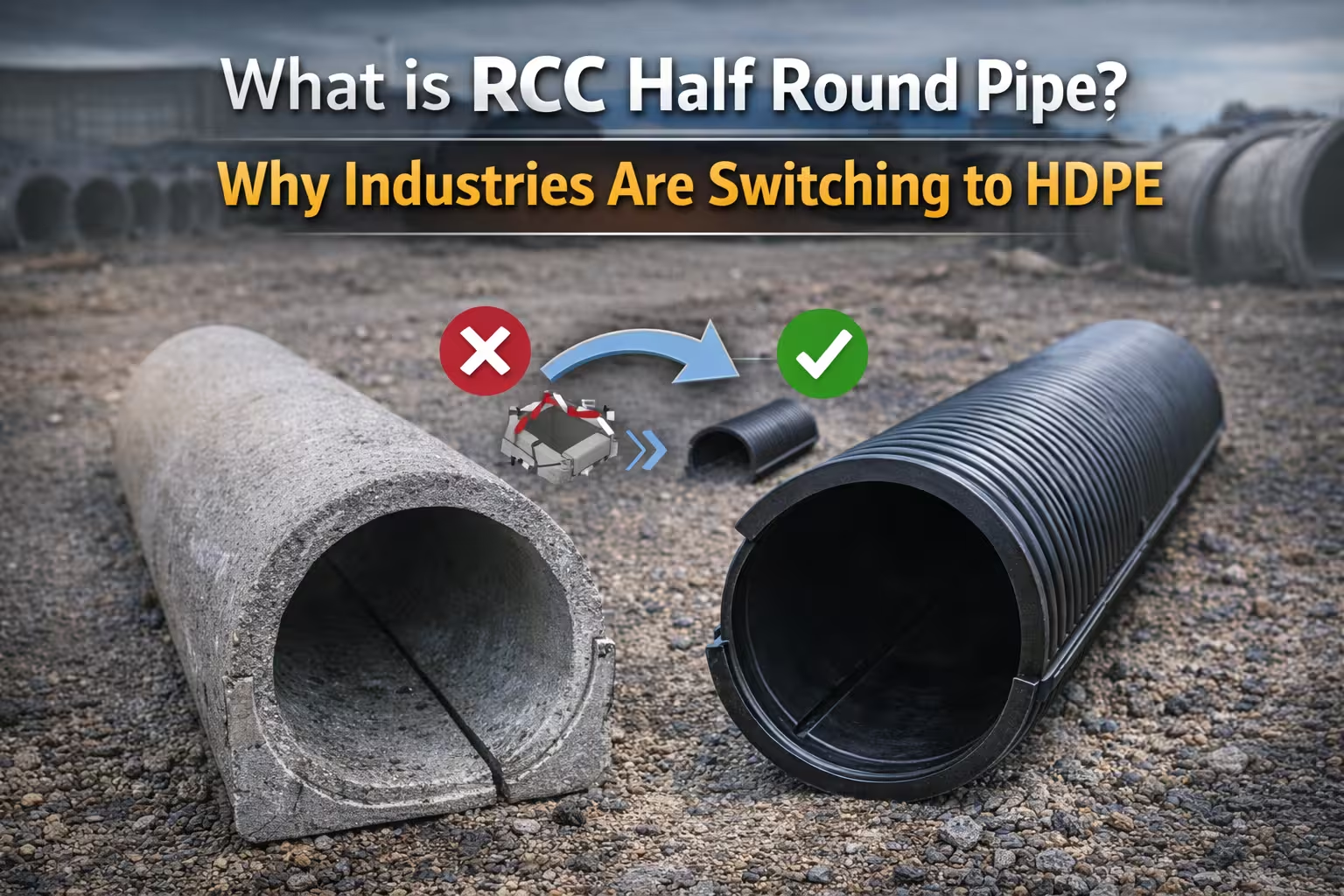
Walk past any infrastructure project in India built before the year 2000 and you will almost certainly find RCC Half Round Pipes running along cable trenches, drainage channels, and roadside culverts. For decades, Reinforced Cement Concrete was the default choice for half-round channel and cable cover applications. It was heavy, it was rigid, it broke during transport, it cracked under settlement — and contractors used it anyway because there was simply no better alternative on the market.
That era is ending. Rapidly.
Across India’s highways, Smart Cities, telecom networks, solar parks, and industrial estates, HDPE Half Round Pipes are replacing RCC at a pace that reflects not just a product preference but a fundamental shift in what infrastructure professionals now expect from the materials they specify. The India HDPE pipes market was valued at USD 689.70 million in 2024 and is projected to reach USD 990.15 million by 2033, growing at a CAGR of 4.10%. Government programmes like the Smart Cities Mission, BharatNet, and AMRUT are accelerating this shift by demanding modern, durable, and low-maintenance piping solutions — criteria that RCC consistently fails to meet.
This guide covers everything: what RCC Half Round Pipes actually are, how they work and where they were used, what their structural and operational limitations are, what HDPE Half Round Pipes bring to the same applications, and why the switch from RCC to HDPE is not a trend but a permanent infrastructure evolution.
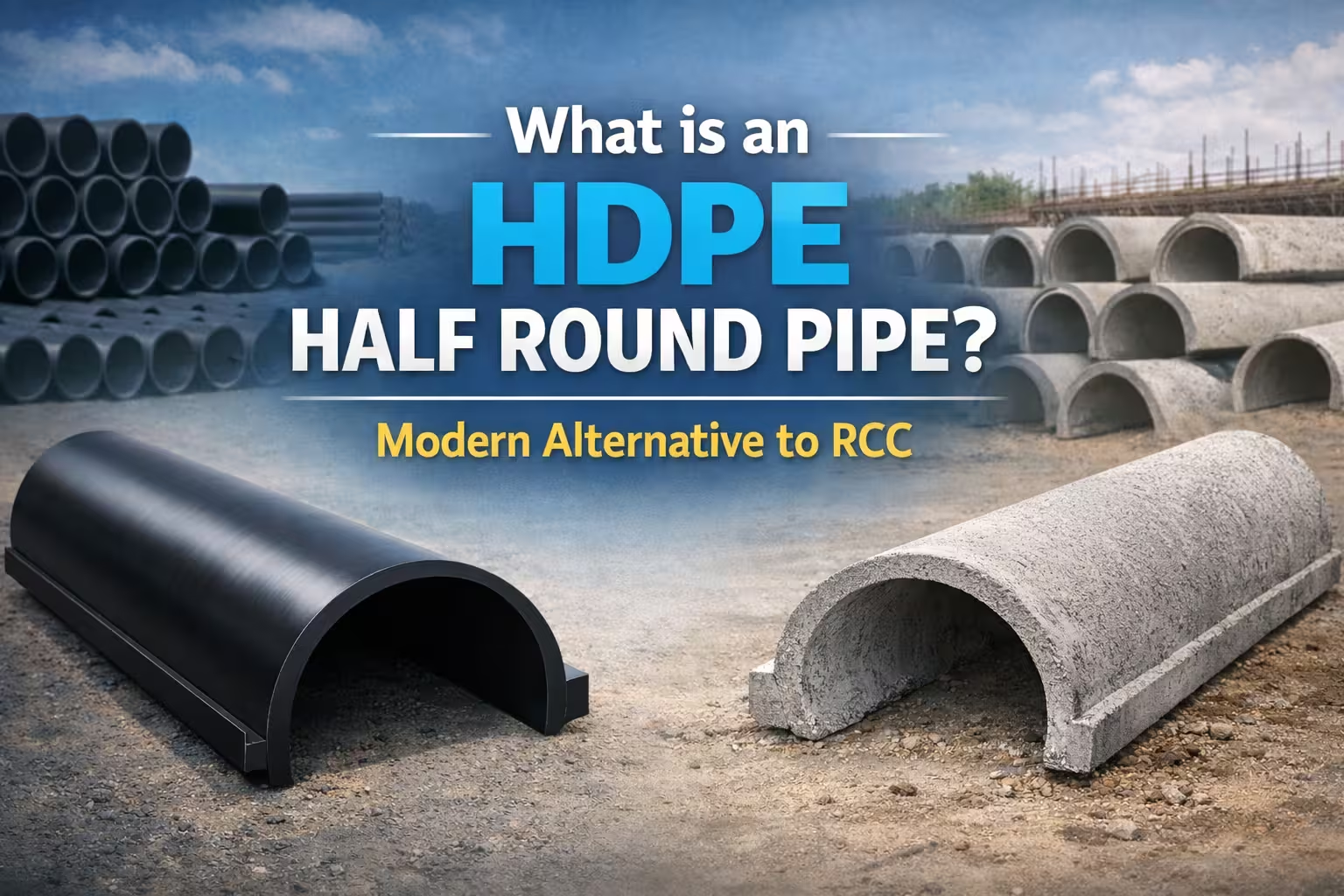
RCC stands for Reinforced Cement Concrete. An RCC Half Round Pipe is a semi-circular precast concrete channel or conduit manufactured from a mixture of cement, fine and coarse aggregates, and steel reinforcement bars (rebar) or wire mesh. The semi-circular profile — typically conforming to Class NP2 as per IS 458 — gives it a half-pipe cross-section that channels water along its curved base or sits over a buried cable as a protective cover.
The product has been a staple of India’s civil infrastructure for several decades. In the early years of India’s post-independence infrastructure buildout, when polymer alternatives were either unavailable or unproven, RCC Half Round Pipes made practical sense. Concrete is a material every civil contractor in India understands, the raw materials are locally available almost everywhere, and manufacturing requires nothing more sophisticated than a casting facility with the right moulds.
RCC Half Round Pipes are available in sizes ranging from 100mm to 450mm diameter (commonly 150mm, 230mm, 250mm, 300mm, and 380mm in Class NP2), supplied in 1-metre and 2-metre lengths. They are used in three primary applications: as open drainage channels for surface water and agricultural runoff, as protective covers placed over underground cables (laid face-down over the cable after it has been installed in the trench), and as minor culvert crossings under farm tracks and service roads.
Understanding how RCC Half Round Pipes are manufactured is important for understanding their limitations in service.
The production process involves preparing a concrete mix — typically cement, sand, and coarse aggregate at ratios specified for NP2 class — placing steel reinforcement mesh or bar in the mould, pouring the concrete, vibrating it to remove air voids, and allowing it to cure for a minimum of 28 days. Each pipe is cast individually in a half-round mould.
This manufacturing process has several characteristics that translate directly into field performance. First, the quality of the finished product depends heavily on the water-cement ratio used during mixing, the uniformity of vibration during casting, and the quality of curing. Batch-to-batch variation in manually operated small-scale RCC pipe facilities — the kind that supply most of India’s rural and semi-urban infrastructure markets — is significant. Second, the steel reinforcement is embedded in the concrete, not externally bonded to it. Any crack that develops in the concrete body over time exposes the reinforcement to the soil moisture and chemicals that surround it, initiating corrosion of the steel. Third, because each piece is cast to fixed dimensions, there is no flexibility in how the pipe performs when the soil beneath it moves.
To understand why industries are switching away from RCC, you need to understand what actually happens to these pipes in service — not in ideal laboratory conditions, but in the field.
A standard 300mm diameter RCC Half Round Pipe in 1-metre length weighs approximately 40–60 kg. A single truck carrying 100 pieces carries 4,000–6,000 kg of product. Compare this with HDPE Half Round Pipes of the same diameter, which are approximately 80% lighter — the same truck carries the equivalent of 500 metres of HDPE product at a fraction of the load weight.
At the project site, RCC Half Round Pipes require mechanical handling equipment or significant manual labour for unloading, stacking, and laying. On trenches that run for kilometres along a highway or telecom cable route, this handling cost accumulates rapidly. Workers managing 50-kg pieces over long distances and in confined trenches are also at significantly elevated risk of musculoskeletal injuries — a safety cost that never appears in the material price comparison but is borne by the contractor and the workforce.
RCC is a brittle material. It has high compressive strength — concrete carries loads well in compression — but very low tensile strength. When a half-round RCC pipe is dropped, impacts a sharp edge during transit, or is placed on uneven ground, the concrete cracks. The steel reinforcement delays complete fracture but the structural integrity of the piece is compromised the moment a crack propagates through the concrete cover to the reinforcement level.
Transit breakage rates for RCC Half Round Pipes on rough Indian roads — particularly for longer 2-metre pieces — are well known to contractors and project managers. The effective cost per metre delivered intact is substantially higher than the ex-factory price because a portion of every consignment arrives on site damaged and unusable.
Buried infrastructure in India is subject to constant minor ground movement — seasonal soil shrinkage and swelling, the vibration loads from road traffic above, and in many regions, minor seismic activity. RCC does not flex. When the ground moves and the support under an RCC Half Round pipe shifts, the pipe cracks at the point of unsupported span. This cracking may not be immediately visible — it happens underground, beneath backfill. But it creates a gap in the cable protection or drainage continuity that progressively worsens.
This is particularly consequential for cable protection applications. An RCC half-round cover that has cracked and shifted exposes the cable beneath it to exactly the kind of mechanical loading it was installed to prevent. Accidental contact from a future excavator strikes the exposed cable instead of the protective conduit above it.
The steel reinforcement in an RCC Half Round Pipe is protected from corrosion by the alkaline environment within the concrete — as long as the concrete remains crack-free and the cover thickness is adequate. In practice, neither condition is guaranteed over decades of underground service.
Carbonation — the reaction of atmospheric CO₂ with the calcium hydroxide in concrete — progressively reduces the pH of concrete from the surface inward. In India’s tropical and coastal environments, this process is accelerated. Once the pH in the concrete around the steel drops below the threshold that maintains passivation, the steel reinforcement begins to corrode. Corroding steel occupies more volume than the original bar, creating expansive pressure within the concrete that causes spalling and cracking — which in turn accelerates further corrosion. This is the classic “concrete cancer” failure mode, and it is responsible for the progressive deterioration of RCC infrastructure across India’s older highway and railway corridors.
For half-round pipes specifically — which sit at or near the surface, in direct contact with soil moisture and seasonal wetting and drying — this failure mode operates faster than it does in submerged full-round pipe installations. The result is a significant maintenance burden and a service life considerably shorter than the 50+ years that modern infrastructure specifications demand.
For drainage applications, the internal surface of the conduit determines hydraulic efficiency. RCC has a rough internal surface — Manning’s n value for concrete pipe is typically 0.013 to 0.015. This roughness retards flow, promotes sediment deposition in slow-flow conditions, and creates accumulation points for debris that reduces effective drainage capacity over time.
HDPE, by contrast, has a Manning’s n value of 0.009 to 0.010. This difference translates into measurably faster drainage flow at the same gradient, or the ability to use a smaller-diameter pipe at the same flow requirement — either of which represents a real operational and cost advantage over the service life of the drainage system.
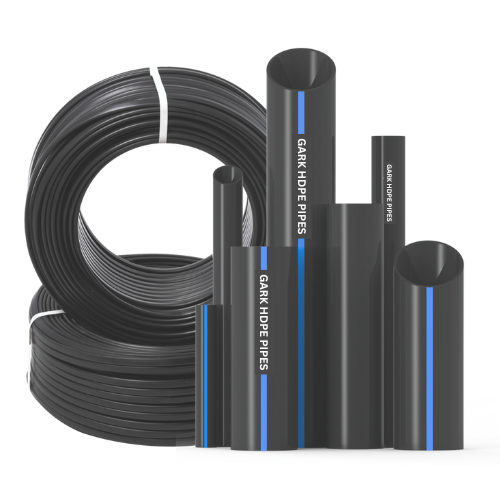
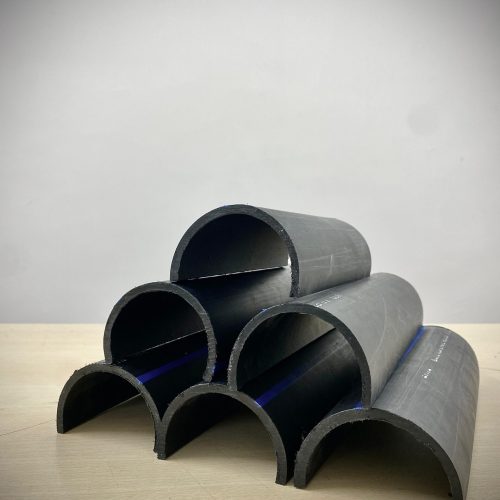
An HDPE Half Round Pipe is a semi-circular pipe manufactured from High-Density Polyethylene (HDPE) — a high-performance engineering polymer in PE80 or PE100 grade, produced to IS 4984 standards. Unlike RCC, which is cast in rigid concrete sections, HDPE Half Round Pipes are extruded from a single homogeneous polymer material that is chemically inert, permanently flexible, and immune to the corrosion and brittleness that govern the failure modes of RCC.
The product is available in sizes from 20mm to 250mm outer diameter, in standard lengths of 1m, 3m, and 6m, manufactured in black HDPE with carbon black UV stabilisation for outdoor durability. The 180° semi-circular profile is precision-machined to ±0.3mm tolerance, ensuring consistent alignment during installation without the fitting and alignment problems that arise from the dimensional variation common in manually cast RCC pipe.
To understand HDPE as a material in depth — including its molecular structure, grade classification, and why it outperforms concrete and metal in underground applications — our comprehensive guide on what HDPE is, its full form, properties, and industrial uses provides the complete technical picture. For a deeper understanding of HDPE’s performance in pipe applications specifically, the complete guide to HDPE pipes — uses, benefits, and applications in India covers the full application landscape.
The shift is not simply because HDPE Half Round Pipes are better — they have been better for years. The shift is happening now because the scale of infrastructure investment in India has reached a level where the operational costs of RCC’s limitations can no longer be justified, and because the projects driving India’s infrastructure growth in 2024–2025 specifically demand materials that RCC cannot provide.
The Smart Cities Mission has completed 7,380 out of 8,075 projects as of December 2024 with investment of approximately ₹1.47 lakh crore, deploying underground cable networks across 100 cities that require cable protection conduits with 50-year service life guarantees. BharatNet has laid over 6.93 lakh kilometres of optical fiber requiring underground protection across conditions from Gujarat’s saline coastal soils to the rocky terrain of northeast India. The RDSS scheme with ₹2.77 lakh crore sanctioned is converting overhead power networks to underground cables at scale across hundreds of cities. Every one of these projects creates a demand for cable protection infrastructure — and RCC Half Round Pipes cannot meet the technical, logistical, or longevity requirements these programmes specify.
The contractors and project managers executing these programmes have made the comparison. HDPE Half Round Pipes are approximately 80% lighter than equivalent RCC products, reducing transport and handling costs by up to 40%. They install at 3× the speed of RCC equivalent sections because no mechanical handling equipment is needed, alignment is precise, and jointing is either snap-fit or heat-fusion rather than the grout-filled collar joints used with RCC. Over a 50-year service life, they require zero maintenance — no crack repairs, no joint resealing, no corrosion treatment. And they perform consistently in every soil chemistry condition India presents, from Rajasthan’s alkaline soils to coastal Gujarat’s saline groundwater to the organic acids in paddy field drainage.
When a LT or HT power cable is laid underground, the cable cover placed above it is the last line of defence against accidental damage from future excavation. An RCC half-round cover that has cracked and shifted offers no protection. An HDPE half-round cover that has flexed slightly under ground movement is still structurally intact, still covering the cable, still protecting it.
Under the Revamped Distribution Sector Scheme (RDSS) and state-level underground cabling programmes, HDPE Half Round Pipes have become the specified cable cover product for new LT network underground cabling. The combination of light weight (critical for the manual labour-intensive last-mile trench work in narrow urban streets), corrosion immunity, and confirmed long service life makes HDPE the technical and commercial choice for every project manager executing RDSS works.
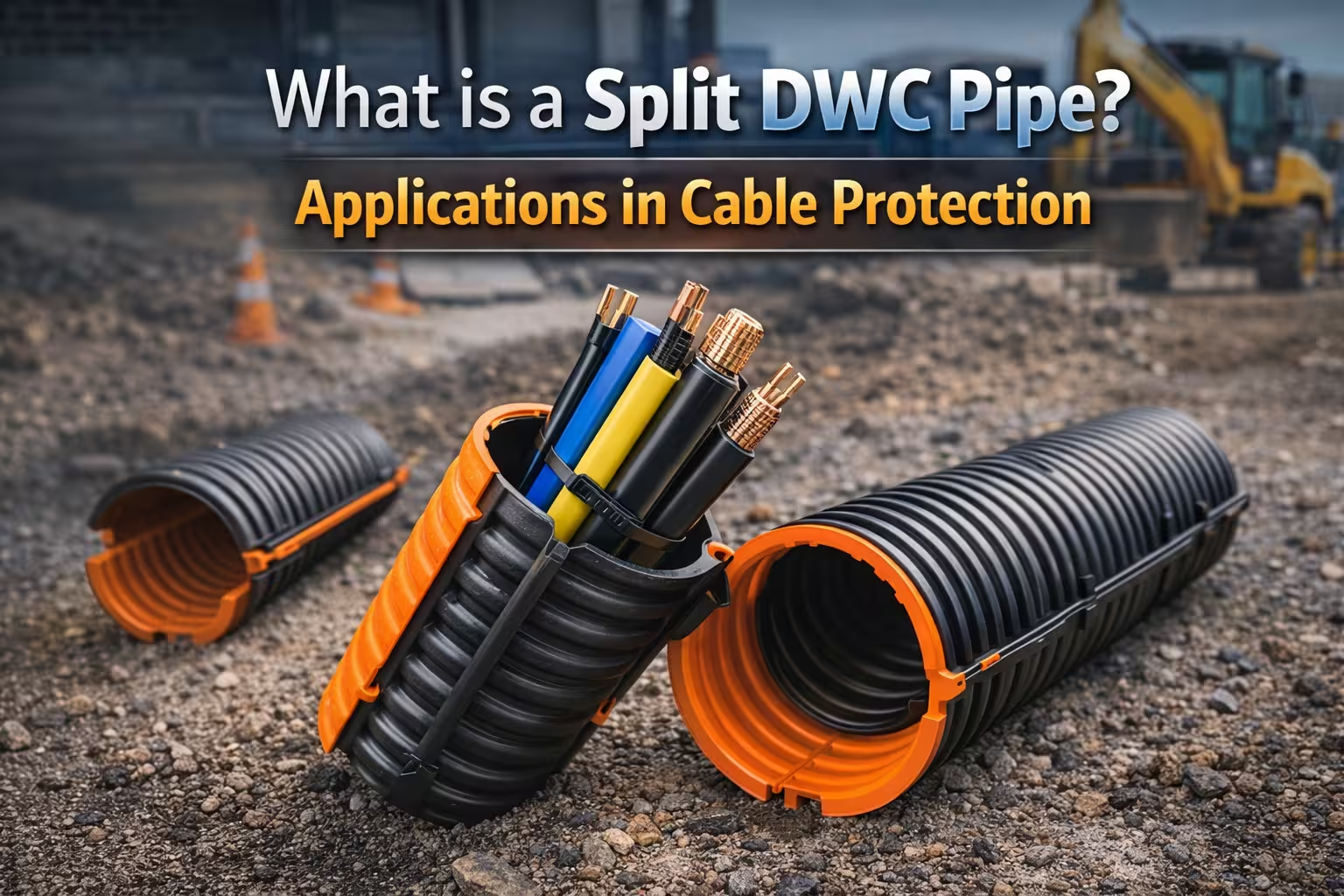
The full range of HDPE DWC Pipes for underground cable conduit applications and DWC Half Round Pipes for retrofit cable protection complement HDPE Half Round Pipes in cable infrastructure projects, with each product serving a distinct installation scenario.
Optical fiber cables are physically fragile — their glass core transmits data at light speed but cannot withstand compressive loads. A cracked RCC half-round cover settling onto the cable beneath it can cause micro-bending losses or outright fiber breaks that are invisible from the surface but create measurable degradation in the network.
HDPE Half Round Pipes maintain a consistent internal clearance over the cable because they flex rather than fracture under soil movement. The smooth inner surface prevents any abrasive contact with the cable jacket. And the HDPE material does not shrink or expand with temperature changes in the way concrete does — critical for maintaining joint continuity in cable protection runs that extend for kilometres.
For telecom OFC installations requiring pre-lubricated ducts for cable blowing operations, Gark Polyplast also manufactures PLB Duct Pipes — Permanent Lubricant Bore HDPE ducts compliant with TEC GR/TX/CDS-008/03, the telecom-grade specification that BSNL and private telecom operators require for fiber deployment.
Surface water drainage along highway verges, medians, and shoulders is a critical function that directly affects road pavement life. Standing water in road subgrade accelerates base failure. A drainage system that fails — whether because its RCC channels have cracked, joints have opened, or sediment accumulation has reduced capacity — causes exactly the kind of subgrade saturation that leads to pothole formation and pavement failure.
HDPE Half Round Pipes installed as roadside drainage channels provide continuous, smooth-bore drainage with zero joint leakage (heat-fusion jointed) and zero sediment accumulation at the level that RCC rough surfaces promote. Their light weight makes installation along long highway stretches genuinely practical for small contractor teams without mechanical handling equipment — a critical consideration for the maintenance works on state highways and district roads where mechanised plant availability is limited.
Gujarat, Rajasthan, and Maharashtra’s farming belts face the combined challenge of monsoon waterlogging and dry-season water scarcity. Sub-surface drainage using perforated HDPE Half Round Pipes placed at the bottom of shallow trenches in waterlogged fields provides a drainage path for excess groundwater without the full-scale earthworks of open channel drainage.
The flexibility of HDPE means these drainage channels follow irregular field contours without the cutting and fitting that rigid RCC sections require. Their immunity to soil chemistry means they function in the alkaline black cotton soils of Vidarbha and the saline coastal soils of Saurashtra where concrete pipes suffer accelerated deterioration. Gark Polyplast’s HDPE Sprinkler Pipes complement this agricultural drainage work, together forming a complete surface and subsurface water management system for progressive farmers.
India’s target of 500 GW of renewable energy by 2030 is driving solar park construction across millions of hectares of open land. Every solar park contains kilometres of underground cable connecting panels to inverters and inverters to substations. These cables run through open field soil, subject to agricultural vehicle loads, thermal cycling, and in many locations, aggressive soil chemistry from fertiliser residues.
HDPE Half Round Pipes provide the cable cover for these field cable runs, protecting the cables from mechanical damage without the weight, brittleness, and corrosion vulnerability of RCC. Their UV-stabilised black outer surface means they can also be used as surface-laid cable guides in above-ground applications within the solar park boundary, where concrete would absorb heat and create thermal stress problems.
In factory premises, chemical plants, and GIDC industrial estates, the combination of ground vibration from heavy machinery, chemical spills, and high-frequency maintenance activity creates an environment that progressively destroys RCC cable covers. HDPE Half Round Pipes withstand all of these conditions without deterioration. Their chemical resistance is effective across the pH range from 2 to 13 — covering virtually every industrial chemical environment encountered in India’s chemical manufacturing, textile dyeing, pharmaceutical, and food processing industries.
Gark Polyplast Pvt. Ltd. manufactures HDPE Half Round Pipes from virgin-grade PE80 and PE100 HDPE compound at its ISO 9001:2015, ISO 14001:2015, and ISO 45001:2018 certified manufacturing facility at Gark Industrial Park, Palanpur, Gujarat. Compliant with IS 4984 and carrying BIS/ISI mark certification, our HDPE Half Round Pipes are available in sizes from 20mm to 250mm OD in custom lengths of 1m, 3m, and 6m, with factory-cut precision to ±0.3mm tolerance for perfect alignment.
Every batch is tested in our in-house laboratory for ovality, wall thickness consistency, and impact resistance before release. Black colour with carbon black UV stabilisation ensures zero degradation in outdoor storage and exposed installations. Jointing options include snap-fit, mechanical coupler, or heat fusion for applications requiring watertight continuous drainage.
For projects requiring complete cable protection systems, our HDPE Half Round Pipes work alongside our DWC Half Round Pipes, HDPE DWC Pipes, PLB Duct Pipes, and HDPE Pressure Pipes — a complete piping portfolio from a single ISO-certified manufacturer.
Read our detailed RCC vs HDPE Half Round Pipes comparison and the comprehensive HDPE vs RCC Pipes analysis for a full technical and cost-lifecycle breakdown of the two materials.
An RCC (Reinforced Cement Concrete) Half Round Pipe is a precast semi-circular concrete channel made from cement, aggregates, and steel reinforcement. Available in diameters from 100mm to 450mm in Class NP2 as per IS 458, it is used for cable protection, surface drainage, and minor culverts. While historically common across India’s civil infrastructure, its weight, brittleness, susceptibility to cracking, and steel corrosion are causing rapid replacement by HDPE alternatives.
RCC Half Round Pipes crack due to a combination of factors: their inherent brittleness (concrete has very low tensile strength), ground settlement and soil movement that creates unsupported spans in the pipe, the thermal expansion and contraction cycle in outdoor installations, and the progressive corrosion of the internal steel reinforcement which generates expansive pressure within the concrete body. Once cracked, the protective function of the pipe is permanently compromised.
HDPE Half Round Pipes are approximately 80% lighter than equivalent RCC Half Round Pipes of the same diameter. For a 300mm diameter section in 1-metre length, this means handling a product that weighs under 10 kg instead of 50–60 kg — eliminating the need for mechanical handling equipment and enabling installation at significantly higher linear speed with standard labour.
HDPE Half Round Pipes have a confirmed service life of 50 to 60 years or more under normal underground and surface-laid conditions. They do not corrode, crack under soil movement, or degrade from soil chemistry exposure. RCC Half Round Pipes in demanding conditions — coastal environments, chemically aggressive soils, high-vibration zones — may begin structural degradation within 15–25 years as steel reinforcement corrosion initiates.
Yes — and this is their primary growth application in India today. HDPE Half Round Pipes placed over underground cables in trenches provide permanent mechanical protection with a smooth inner surface that prevents abrasion of the cable jacket, flexibility that maintains coverage under ground movement, and chemical inertness that protects the cable from soil chemistry attack. They are used extensively in RDSS underground cabling projects, BharatNet OFC protection, and solar farm cable infrastructure.
Gark Polyplast manufactures HDPE Half Round Pipes from 20mm to 250mm OD in PE80 and PE100 grades, available in 1m, 3m, and 6m lengths. All products are IS 4984 compliant and carry BIS/ISI mark certification. Contact our sales team for size-specific availability and project quantity requirements.
Gark Polyplast has published a detailed comparison of RCC vs HDPE Half Round Pipes covering material properties, installation, hydraulic performance, lifecycle cost, and environmental impact. The broader HDPE vs RCC Pipes detailed comparison covers the full range of pipe types and applications.
The question in the title — Why are industries switching from RCC to HDPE? — has a simple answer: because the evidence of field performance accumulated over decades of service makes RCC Half Round Pipes untenable in any infrastructure context where long-term reliability, low maintenance, and installation efficiency matter.
RCC Half Round Pipes served a generation of Indian infrastructure faithfully. But that generation was built under different constraints, with different material options, and to different longevity expectations than the infrastructure India is building today. The highways, telecom networks, urban cable systems, solar parks, and smart city deployments of 2024–2030 demand products that will still be performing in 2074 without maintenance intervention. HDPE delivers that. RCC, in its half-round form, does not.
The India HDPE pipes market is growing toward USD 990.15 million by 2033. The India pipes market overall is projected to reach USD 41.63 billion by 2034 at 11.20% CAGR. Government programmes from BharatNet to RDSS to Smart Cities are deploying HDPE cable protection infrastructure at scale. The switch from RCC to HDPE Half Round Pipes is not a future possibility — it is a present reality already underway on thousands of project sites across the country.
Gark Polyplast Pvt. Ltd. is Gujarat’s ISO 9001:2015, ISO 14001:2015, ISO 45001:2018 certified and BIS/ISI marked manufacturer of HDPE Half Round Pipes and the complete range of HDPE infrastructure piping. Explore our product range, download our product catalogue, or contact us for specifications, pricing, and expert guidance on your next project.
Gark Polyplast Pvt. Ltd. is an ISI certified, BIS-marked manufacturer of HDPE DWC Pipes, HDPE Pipes, and PLB Ducts — operating from our state-of-the-art facility in Palanpur, Gujarat, since 2015.
 +91 9081300225 | +91 9081300226
 Sales@garkgroup.com | garkpolyplast@gmail.com
 www.garkgroup.com
 Gark Industrial Park, Kotda-Pirojpura Road, Palanpur, Gujarat 385010
Latest Post
Stay Updated With Insight
Subscribe to our social media channels, never miss the latest articles, expert blogs, your business effectively.
Related Post
Continue Reading
Table of Contents
×