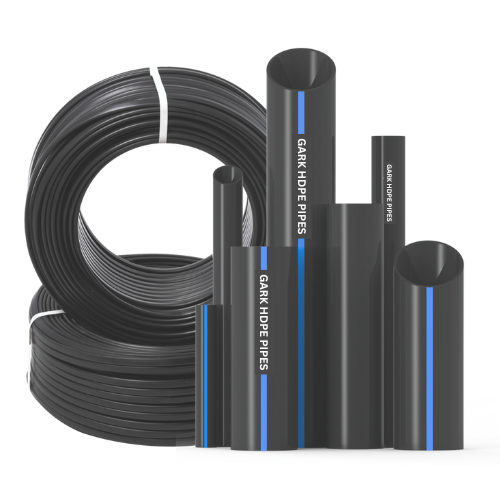
There is a product installed along roads, buried under cable trenches, running through solar parks, and lining agricultural drainage channels across India today that most people cannot name — but that every infrastructure engineer in the country is learning to specify. It is the HDPE Half Round Pipe: a semi-circular channel section made from High-Density Polyethylene that has quietly become one of the most important pipe products in India’s infrastructure buildout.
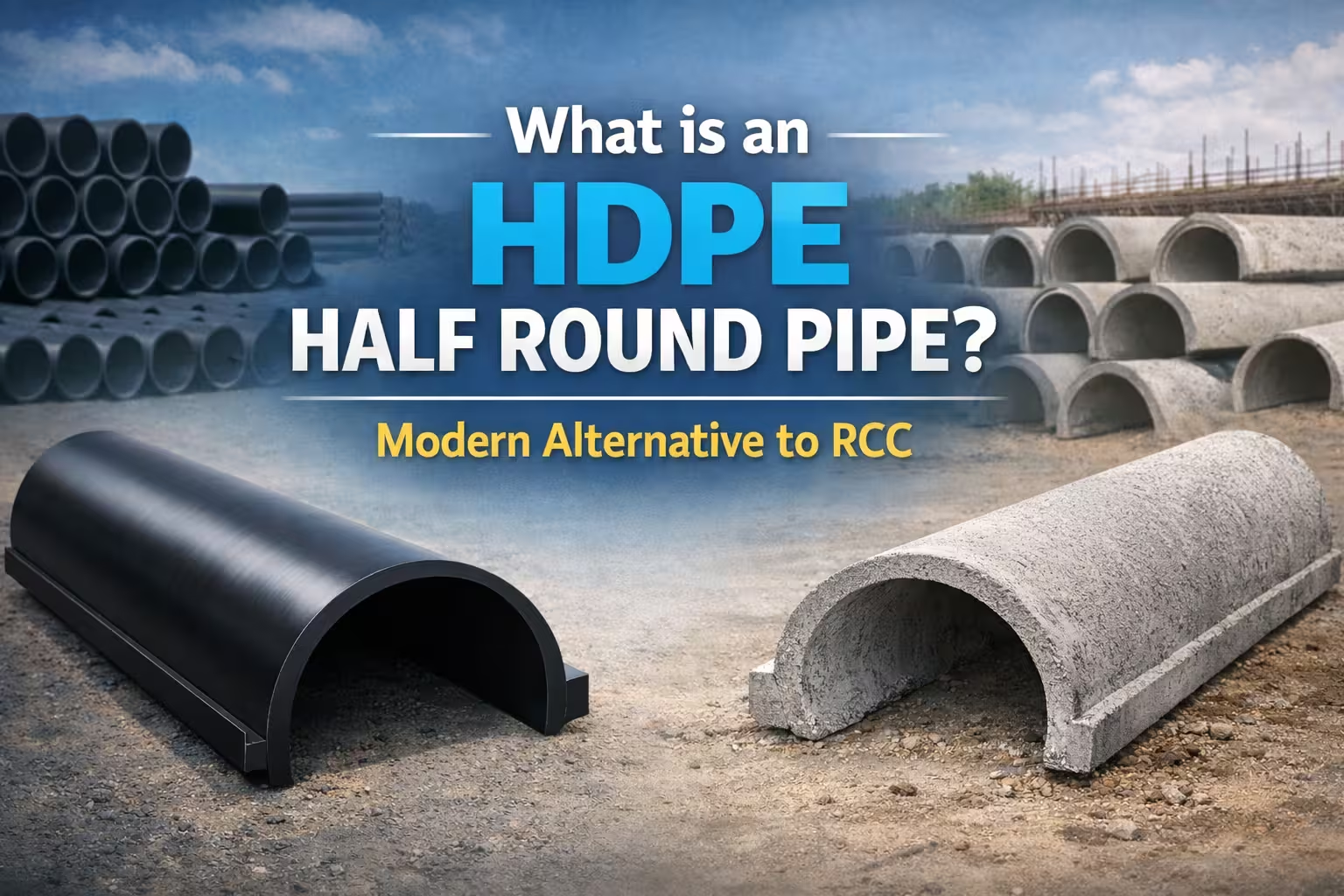
It replaces a product most people do know: the heavy, grey RCC Half Round Pipe that sat in drainage channels and covered buried cables for generations. The replacement is not cosmetic. It is structural, economic, and permanent. To understand why, you first need to understand what an HDPE Half Round Pipe actually is — its material science, its geometry, its engineering properties, and exactly what it does in the field that its predecessor could not.
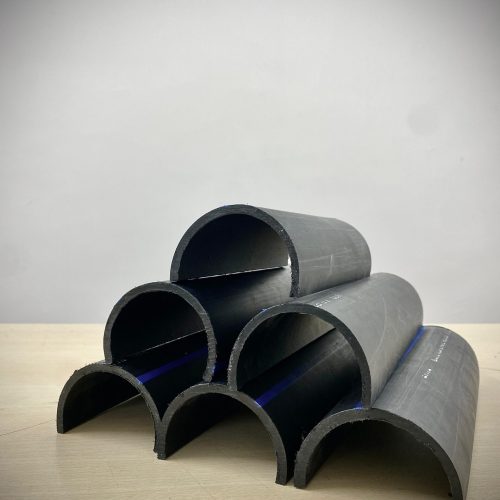
An HDPE Half Round Pipe is a semi-circular pipe section — shaped as an exact 180° arc of a full pipe — manufactured from High-Density Polyethylene (HDPE) in PE80 or PE100 grade, compliant with IS 4984, India’s Bureau of Indian Standards specification for HDPE pipes. The product is produced in black colour with carbon black UV stabilisation, available in outer diameters from 20mm to 250mm, and supplied in standard lengths of 1 metre, 3 metres, and 6 metres.
The term “half round” describes the product’s cross-sectional profile precisely: it is exactly half of a full-bore round pipe, cut longitudinally along its diameter. This geometry gives the product its two core functions. When placed curved-side-down over a cable in a trench, it forms a rigid protective arch above the cable, shielding it from the impact of future excavation equipment. When placed curved-side-down on a prepared bed as an open channel, it forms a smooth, semi-circular drainage section that carries surface water or agricultural runoff efficiently at gradient.
Both functions exploit the same fundamental engineering: the 180° arch profile is one of the most structurally efficient shapes in civil engineering, distributing compressive loads around its curve rather than concentrating stress at a single point. In HDPE — a material that is flexible under soil movement yet strong in impact resistance — this arch geometry delivers cable protection and drainage performance that rigid RCC concrete cannot match under real field conditions.
Before examining the product’s applications and performance, it is worth understanding the material it is made from — because the properties of HDPE are the reason this product outperforms everything that came before it.
High-Density Polyethylene is a linear polymer of ethylene — the same monomer used across the polyethylene family, but processed to produce an exceptionally high-density molecular structure with very low branching. The result is a material with a unique combination of properties that no other common pipe material shares in full: high tensile strength, significant impact resistance, complete chemical inertness across the pH range of 2 to 13, permanent flexibility without fatigue, UV stability (when compounded with carbon black), and zero corrosion susceptibility regardless of environmental chemistry.
These properties are graded into material classes. PE63 is the standard grade, used in lower-pressure water supply applications. PE80 is an intermediate grade with higher minimum required strength (MRS of 8.0 MPa), suited to pressure and drainage applications. PE100 is the highest performance grade — MRS 10.0 MPa — used in industrial and high-specification infrastructure applications where maximum long-term strength is required.
Gark Polyplast manufactures HDPE Half Round Pipes in both PE80 and PE100 grades — PE80 for cost-effective standard drainage and cable protection work, PE100 for industrial, chemical-exposure, and high-load applications where the highest material performance is specified.
The distinction matters because PE grade directly determines long-term performance under sustained stress. A PE100 HDPE Half Round Pipe installed in a chemical plant in 2026 will be performing identically in 2076 under continuous chemical exposure that would have destroyed an RCC cover in a decade. That is the value of understanding material grade, not just product category.
For a comprehensive explanation of HDPE as a material — its full form, molecular structure, grade classification, and the science behind its properties — our detailed guide, What is HDPE? Full Form, Properties and Industrial Uses covers the complete technical picture. To understand how these properties translate into pipe performance across India’s major infrastructure applications, What is an HDPE Pipe? Uses, Benefits and Applications in India provides the full application landscape.
Understanding what distinguishes a quality HDPE Half Round Pipe from a substandard one requires knowing what the product’s critical dimensions actually are and why they matter.
Outer Diameter (OD) is the controlling dimension — it determines both the cable size that the pipe will protect and the hydraulic cross-section available for drainage flow. Gark Polyplast manufactures HDPE Half Round Pipes from 20mm to 250mm OD, covering the full range of cable protection and drainage applications encountered in India’s infrastructure projects.
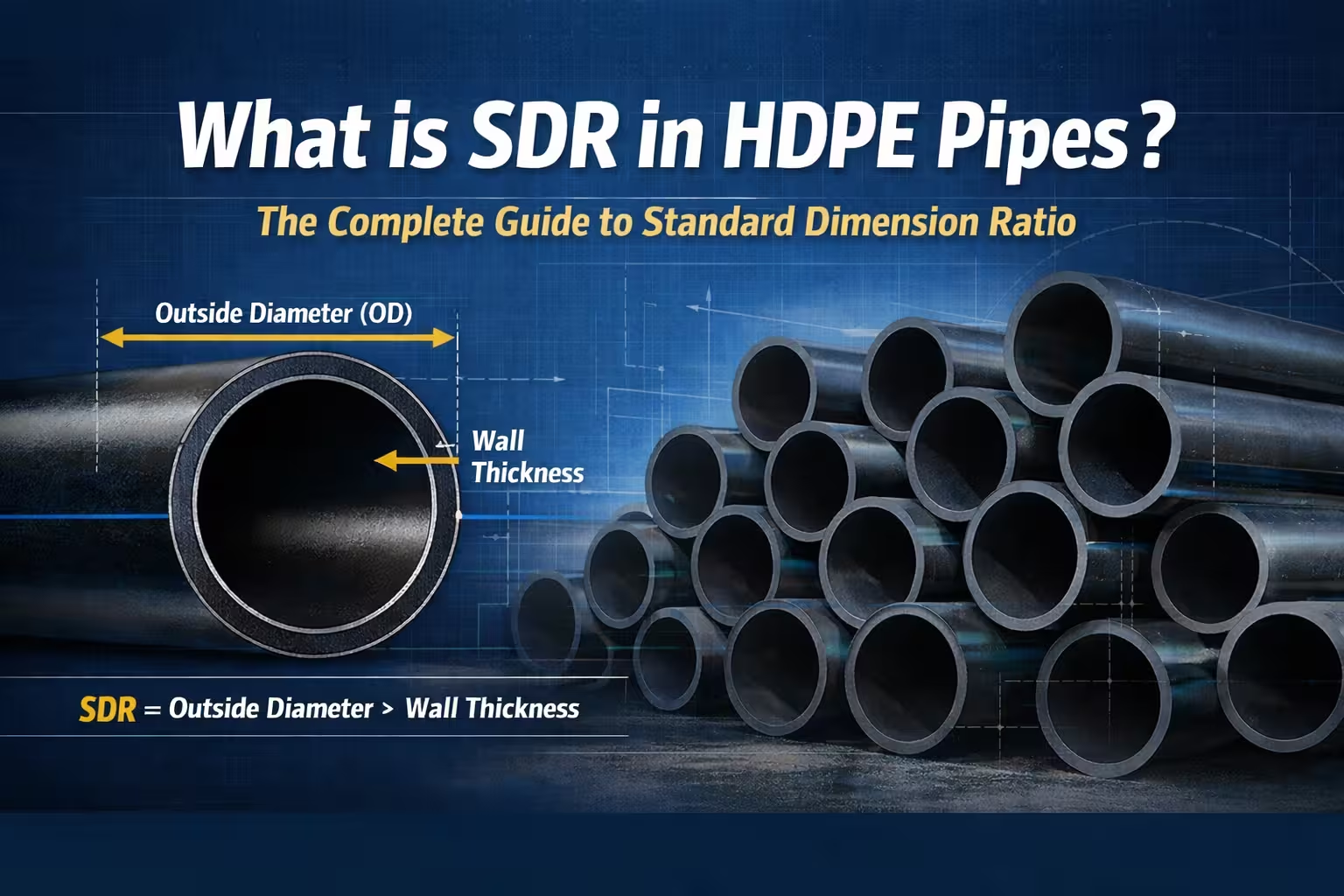
Wall Thickness is determined by the OD and the SDR (Standard Dimension Ratio) specification. Wall thickness determines the structural strength of the half-round profile — its resistance to compressive loads from soil overburden and vehicular traffic. IS 4984 specifies minimum wall thickness for each diameter and grade combination. Every Gark Polyplast HDPE Half Round Pipe is tested against IS 4984 wall thickness requirements in our in-house laboratory before release.
Profile Accuracy is the manufacturing quality parameter that most directly affects installation performance. The 180° semi-circular profile must be cut to precise tolerance — Gark Polyplast’s factory precision is ±0.3mm — to ensure that adjacent sections align correctly in the trench without gaps or misalignment that compromise cable protection continuity or create hydraulic irregularities in drainage channels. RCC half-round pipes, cast manually in individual moulds, cannot achieve this dimensional consistency.
Surface Quality matters for both applications. For drainage, the internal surface roughness directly determines hydraulic efficiency — the Manning’s roughness coefficient for HDPE smooth bore is n = 0.009, compared to n = 0.013 for precast concrete. This difference means an HDPE Half Round drainage channel moves approximately 30% more water at the same gradient than an equivalent-diameter RCC channel, or achieves the same flow rate in a smaller diameter. For cable protection, the smooth internal surface prevents abrasive contact with the cable jacket during installation and throughout the service life.
Colour and UV Stabilisation are specified as black for outdoor applications. The black pigment in HDPE Half Round Pipes is not a coating — it is carbon black masterbatch compounded into the polymer melt during extrusion. Carbon black is the most effective UV stabiliser available for polyethylene: it absorbs UV radiation before it can initiate polymer chain degradation. Gark Polyplast’s HDPE Half Round Pipes are UV-stabilised for outdoor storage and exposed installations without any degradation in material properties.
The manufacturing process for HDPE Half Round Pipes determines the product’s consistency, dimensional accuracy, and long-term performance — and it is fundamentally different from the manual casting process used to make RCC half-round sections.
The process begins with virgin-grade PE80 or PE100 HDPE compound — the raw material pellets in which the polymer, carbon black UV stabiliser, and any other additives have been pre-compounded to precise specification. Virgin-grade compound is essential: reprocessed or blended materials cannot guarantee the molecular weight distribution and long-term strength properties that IS 4984 requires.
The compound is fed into a screw extruder that melts and homogenises the polymer under controlled temperature and pressure. The molten HDPE is then pushed through a precision circular die to form a full-round pipe. The pipe exits the die and passes through a vacuum calibration tank — a water-cooled chamber that holds the pipe to its exact outer diameter while the material solidifies. Controlled cooling in this calibration stage is what determines dimensional accuracy: the ±0.3mm tolerance achieved by precision manufacturing facilities is the result of correctly managing this cooling process.
The full-round pipe is then longitudinally cut — either during the production line or as a downstream finishing operation — using a precision saw or cutting tool that creates the 180° semi-circular profile with a clean, flat cut edge. This factory cutting is what ensures the ±0.3mm profile accuracy that manual RCC casting cannot achieve.
At Gark Polyplast’s Palanpur facility, every production batch undergoes in-house quality testing for ovality (ensuring the cross-section remains truly circular), wall thickness (confirming compliance with IS 4984 minimums), and impact resistance (drop impact testing at specified temperature). Only batches that pass these tests are released for dispatch.
Each of the following performance advantages is a direct consequence of HDPE’s material properties and the precision manufacturing process. They are not marketing claims — they are engineering outcomes that any contractor, project manager, or procurement engineer can verify on site.
This is the advantage that most immediately affects project economics. An HDPE Half Round Pipe weighs approximately 70–80% less than an equivalent RCC half-round section of the same diameter and length. For a 300mm diameter, 1-metre section, this translates to a product you can lift and carry with one hand instead of a 40–60 kg concrete piece requiring mechanical handling equipment.
The economic consequence is significant. Reduced transport weight means more product per truck per delivery — lower freight cost per linear metre of project. At the site, installation teams work at 3× the linear speed without the mechanical handling equipment, staging logistics, and injury risk that RCC section installation involves. On a 10km telecom cable protection project, these logistics savings typically amount to 35–40% of the total installed cost — a figure that consistently surprises project managers who have only compared ex-factory material prices.
HDPE does not corrode. There is no steel reinforcement to rust, no calcium silicate matrix to carbonise, no surface to pit under acid attack. The HDPE polymer is chemically inert across the pH range of 2 to 13 — which covers every soil chemistry condition encountered in India’s civil infrastructure landscape, from the pH 9.5 alkaline black cotton soils of Vidarbha to the pH 3.5 acidic organic soils of Kerala’s agricultural zones to the highly saline groundwater environments of coastal Gujarat and the Rann of Kutch.
RCC Half Round Pipes rely on the alkalinity of the concrete matrix to passivate and protect their steel reinforcement from corrosion. The moment the concrete carbonates — a slow but inevitable process driven by atmospheric CO₂ — the protection is lost and steel corrosion begins. In India’s coastal and tropical environments, this carbonation front advances faster than in temperate climates. HDPE has no such vulnerability. The material that leaves our factory in Palanpur is chemically identical to the material in service 50 years later.
HDPE is flexible. This is one of its most important engineering properties for buried infrastructure, and it is the property that most clearly separates it from concrete in performance terms.
India’s infrastructure is continuously subject to soil movement: seasonal expansion and contraction of clay soils, differential settlement under variable loading, water table fluctuation, and in seismically active zones, minor tremors. RCC responds to soil movement by cracking — brittlely, irreversibly, and often invisibly, because the crack happens underground. HDPE responds by flexing — elastically, reversibly, and without structural compromise. When the soil movement stops or reverses, the HDPE pipe returns to its design geometry.
For cable protection applications, this distinction is critical. A cracked RCC half-round cover has lost its function: the crack has created a direct load path from the soil above to the cable below. An HDPE half-round cover that has flexed under soil movement is still structurally intact and still protecting the cable. This difference in failure mode is why underground cabling projects on seismic corridors, highway embankments, and soft soil urban areas have moved decisively to HDPE cable protection products.
For drainage applications, the smooth HDPE bore delivers measurably better hydraulic performance than equivalent-diameter RCC channels. HDPE’s Manning roughness coefficient n = 0.009 compares to n = 0.013 for precast concrete — a difference that translates directly into flow capacity.
Using Manning’s equation, a 200mm diameter HDPE Half Round drainage channel at a given slope carries approximately 30% more water than a 200mm diameter RCC channel at the same slope. In practical terms, this means an engineer can specify a smaller HDPE Half Round channel diameter to carry the same design flow as a larger RCC section — reducing material cost, excavation depth, and trench width simultaneously.
Over time, this hydraulic advantage compounds. Concrete surfaces accumulate biological growth, mineral deposits, and sediment adhesion over years of service. These accumulations progressively increase the effective roughness of the channel, reducing flow capacity and increasing maintenance frequency. HDPE’s chemically inert, non-wettable surface resists adhesion — the Manning n value of an HDPE channel in year 30 of service is essentially unchanged from year 1.
HDPE Half Round Pipes manufactured to IS 4984 in PE100 grade have a certified service life of 50 years at design stress and temperature, with conservative extrapolations consistently projecting 60+ years under normal underground service conditions. This service life estimate is based on the long-term hydrostatic strength (LTHS) testing methodology that is the foundation of IS 4984 and its international equivalent ISO 4427.
RCC Half Round Pipes have no comparable certified service life standard. In practice, their service life is highly variable — dependent on soil chemistry, steel cover quality, manufacturing consistency, and the site conditions they are exposed to. In aggressive soil environments, structural deterioration from steel corrosion can begin within 15–20 years.
The lifecycle cost implication is straightforward. A product that lasts 50+ years with zero maintenance over a product that may require intervention within 15–20 years is not a marginal improvement — it is a fundamentally different economic proposition for the infrastructure owner.
No painting. No crack repair. No joint resealing. No anti-corrosion treatment. No periodic inspection for structural integrity. HDPE Half Round Pipes installed correctly require no maintenance intervention over their design life. This zero-maintenance characteristic is a direct function of the material’s corrosion immunity, flexibility, and long-term stability of mechanical properties.
For government infrastructure departments managing thousands of kilometres of drainage and cable protection across India, this characteristic translates into real budget savings that accumulate annually over decades — savings that never appear in the initial material cost comparison but dominate the total cost of ownership calculation when it is honestly done.
HDPE Half Round Pipes serve a wider range of applications than most buyers initially appreciate. The product is not specialist — it is versatile. Here is where it is being deployed across India’s current infrastructure buildout.
The single largest and fastest-growing application for HDPE Half Round Pipes in India today is cable protection — specifically the protection of LT and HT power cables being laid underground under the Revamped Distribution Sector Scheme (RDSS) and state-level cabling programmes, and the protection of optical fiber cables being deployed under BharatNet and private telecom operator network expansion.
In this application, the HDPE Half Round Pipe is placed curved-side-up over the cable after it has been laid in the trench. The pipe forms a protective arch that directs any compressive load from excavation equipment away from the cable. Its smooth inner surface prevents jacket abrasion. Its HDPE material ensures the protection remains structurally intact for the cable’s entire service life.
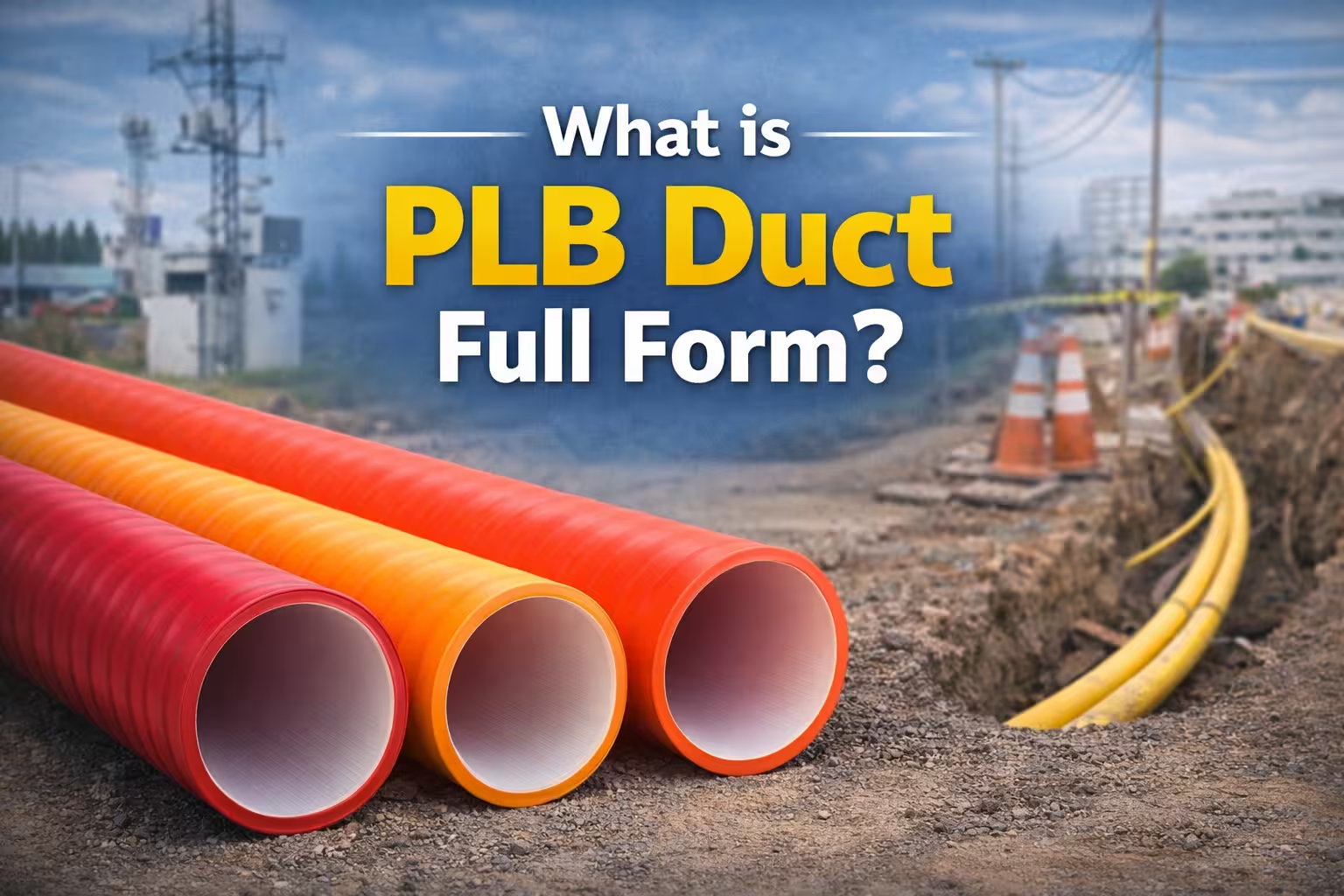
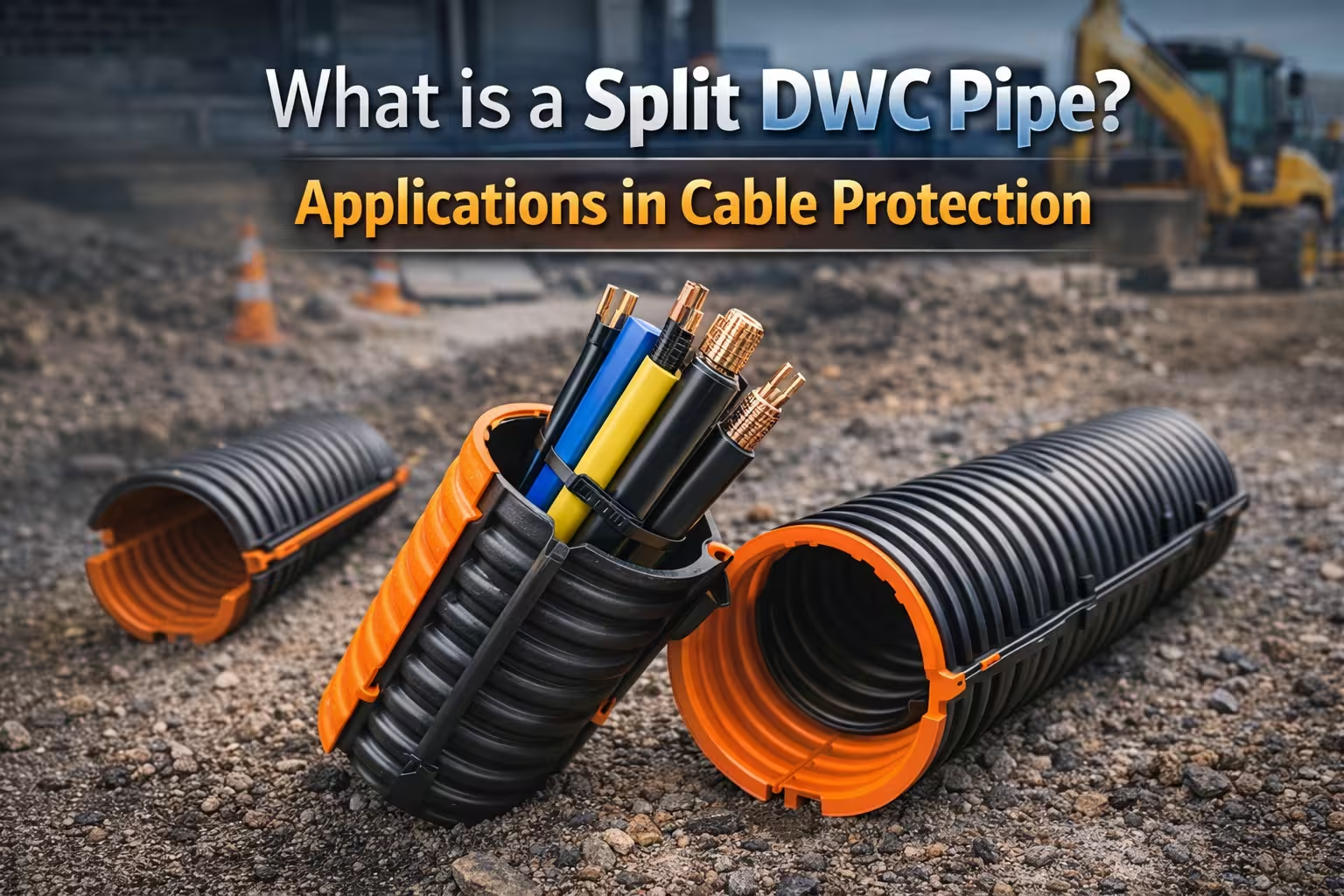
For complete cable infrastructure systems, HDPE Half Round Pipes work alongside HDPE DWC Pipes — used as the buried conduit through which cables are pulled — and DWC Half Round Pipes for applications requiring the combined corrugated-outer and smooth-inner wall structure. For telecom optical fiber deployment requiring pre-lubricated inner walls for cable blowing, PLB Duct Pipes provide TEC GR/TX/CDS-008/03 compliant conduit for high-speed fiber installation. Together, these products from Gark Polyplast cover every scenario in a modern underground cable infrastructure project.
Along National Highways, State Highways, and district roads, HDPE Half Round Pipes are installed as roadside drainage channels — placed in prepared beds along road shoulders and medians to carry surface water runoff away from the road pavement efficiently.
The 30% hydraulic advantage over RCC channels means smaller pipe diameters can achieve the required drainage flow rates, reducing both material cost and the depth of excavation required. Light weight enables rapid installation along long highway stretches with small teams and no heavy lifting equipment — critical for the maintenance cycles on existing highway networks where minimising traffic disruption and lane closure time is paramount.
Gujarat’s farming belts — Banaskantha, Patan, Mehsana, and Kutch districts — present some of the most challenging drainage conditions in India: black cotton soils that waterlog severely during monsoon, saline soils in coastal zones, and alkaline soils that aggressively attack concrete. HDPE Half Round Pipes installed as field drainage channels in these agricultural environments provide drainage capacity that concrete cannot deliver reliably — because HDPE performs uniformly in every soil chemistry that Gujarat’s farming zones present.
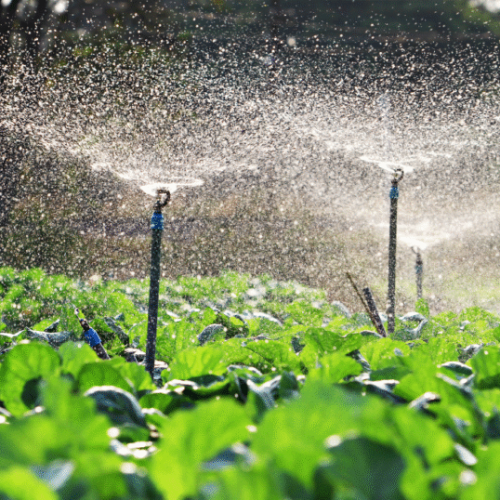
For irrigation applications complementing the drainage work, Gark Polyplast’s HDPE Sprinkler Pipes provide the distribution network — together creating an integrated water management system for agricultural infrastructure.
India’s renewable energy expansion — targeting 500 GW by 2030 — is one of the fastest-growing demand drivers for HDPE cable protection products. Every utility-scale solar park contains kilometres of inter-array cabling and grid connection cables running through open field terrain. HDPE Half Round Pipes protect these field cables from mechanical damage, UV exposure (in surface-laid applications), and the chemical effects of fertiliser residues in the agricultural land typically surrounding solar installations.
Under the Smart Cities Mission — with ₹1.47 lakh crore invested across 100 cities and 7,380 projects delivered as of December 2024 — underground utility infrastructure has been deployed across India’s urban centres at unprecedented scale. HDPE Half Round Pipes are a core component of these urban utility networks, providing cable protection for power and telecom cables in the confined, chemically complex soil environments of urban areas where concrete products would accelerate deterioration from vehicle vibration, pipe leakage from adjacent infrastructure, and the acidic soil chemistry common in urban fill material.
GIDC industrial estates across Gujarat — Ankleshwar, Vapi, Vatva, Naroda — present the most chemically aggressive environments that any pipe product can encounter. Effluent leakage, chemical spills, and deliberately applied process chemicals create soil pH conditions outside the tolerance range of any metal or concrete pipe. HDPE’s chemical resistance across the full pH 2 to 13 range makes it the only material capable of maintaining structural integrity in these environments over a 50-year service life.
Gark Polyplast Pvt. Ltd. has manufactured HDPE Half Round Pipes at its ISO 9001:2015, ISO 14001:2015, and ISO 45001:2018 certified facility in Palanpur, Gujarat, since 2015. All HDPE Half Round Pipes carry BIS/ISI mark certification under IS 4984, manufactured from virgin-grade PE80 and PE100 HDPE compound.
The complete product specification is as follows:
Material grade: PE80 and PE100 (both available) Outer diameter range: 20mm to 250mm OD Available lengths: 1 metre, 3 metres, 6 metres Profile accuracy: ±0.3mm factory-cut tolerance Colour: Black (carbon black UV-stabilised) Standard compliance: IS 4984 with BIS/ISI mark In-house quality testing: Ovality, wall thickness, impact resistance — per IS 4984
Our complete product portfolio provides everything needed for an integrated pipe infrastructure project. The HDPE Half Round Pipes covered in this guide form one part of a full range that includes HDPE DWC Pipes, DWC Half Round Pipes, PLB Duct Pipes, HDPE Pressure Pipes, and HDPE Sprinkler Pipes — all from a single BIS-certified manufacturer with consistent quality documentation and pan-India supply capability.
Download our product catalogue for full technical specifications and dimensional tables, or contact our sales team for project-specific advice on grade selection, diameter specification, and quantity requirements.
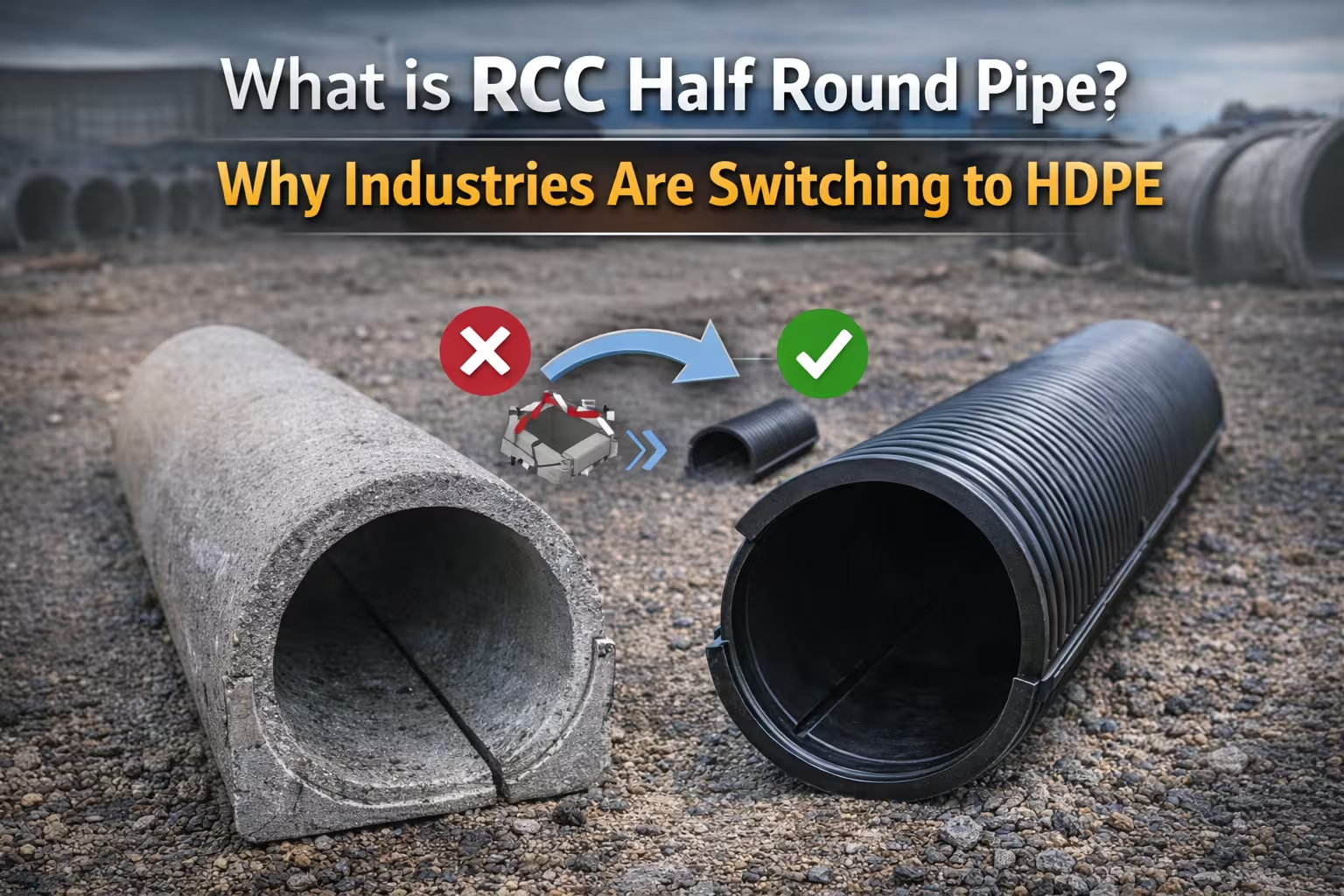
For a direct technical and cost comparison between HDPE and RCC Half Round Pipes, our published guide What is RCC Half Round Pipe? Why Industries Are Switching to HDPE provides the complete side-by-side analysis. For the broader comparison across all pipe types and materials, RCC vs HDPE Half Round Pipes and the comprehensive HDPE vs RCC Pipes detailed comparison cover every dimension of the decision.
An HDPE Half Round Pipe is a semi-circular pipe section — a 180° arc of a full-bore pipe — manufactured from High-Density Polyethylene (HDPE) in PE80 or PE100 grade, compliant with IS 4984. It serves two primary functions: as a protective cover placed over underground cables (power cables, telecom OFC cables, fiber) to shield them from excavation damage; and as an open drainage channel for surface water, roadside runoff, and agricultural field drainage. It is the modern, corrosion-free, lightweight replacement for RCC (Reinforced Cement Concrete) half-round channel sections.
PE80 and PE100 refer to the minimum required strength (MRS) of the HDPE material — 8.0 MPa and 10.0 MPa respectively. PE100 is the higher-performance grade, offering greater long-term structural strength under sustained loads and better resistance to slow crack growth. For standard cable protection and drainage in residential and commercial projects, PE80 provides excellent performance at a cost-efficient price point. PE100 is specified for industrial environments, chemical plant applications, and projects requiring maximum confirmed service life under challenging conditions.
Gark Polyplast manufactures HDPE Half Round Pipes from 20mm to 250mm outer diameter, covering the full range from small cable protection applications through to highway and agricultural drainage channels. Standard lengths are 1 metre, 3 metres, and 6 metres. The size selection depends on the cable diameter being protected (for cable cover applications) or the design drainage flow requirement (for drainage channel applications). Contact our technical team with your project requirements for size and grade recommendations.
HDPE’s smooth internal surface has a Manning’s roughness coefficient of n = 0.009, compared to n = 0.013 for precast concrete. Using Manning’s hydraulic flow equation, this difference means an HDPE half-round drainage channel delivers approximately 30% more flow capacity at the same pipe diameter and gradient compared to an equivalent RCC channel. Additionally, HDPE maintains this smooth surface over its entire service life — concrete roughens progressively due to biological growth, mineral scaling, and micro-erosion, reducing flow capacity over time.
HDPE Half Round Pipes manufactured to IS 4984 in PE100 grade have a certified design life of 50 years under standard conditions, with conservative extrapolations projecting 60+ years in normal underground service. This long-term performance is confirmed by LTHS (Long Term Hydrostatic Strength) testing protocols in the IS 4984 standard. HDPE does not corrode, does not crack under soil movement, and maintains its material properties consistently throughout its service life — there is no mechanism analogous to concrete carbonation or steel reinforcement corrosion that progressively degrades its strength.
Yes — this is one of HDPE’s defining advantages over concrete and metal alternatives. HDPE is chemically inert across the pH range of 2 to 13, covering the full spectrum of soil chemistries encountered in India’s infrastructure environments: alkaline black cotton soils (pH 8.5–10), saline coastal soils, acidic organic agricultural soils, and the chemical spill environments of industrial estates. No special coating, lining, or cathodic protection is required in any of these environments. This universal chemical resistance is a key reason HDPE Half Round Pipes are specified by project engineers in Gujarat’s GIDC industrial zones, coastal districts, and agricultural areas where concrete products require frequent replacement.
HDPE Half Round Pipes in India are manufactured under IS 4984 — the Bureau of Indian Standards specification for High-Density Polyethylene pipes. Pipes carrying the BIS/ISI mark under this standard have been licensed by the Bureau of Indian Standards and are verified to meet its dimensional, material, and mechanical performance requirements. When specifying HDPE Half Round Pipes for government tenders or infrastructure projects, always confirm IS 4984 compliance and BIS licence mark as minimum procurement criteria.
HDPE Half Round Pipes are installed by placing them curved-side-up over the cable (for cable protection) or curved-side-down in a prepared bed (for drainage). Sections are joined using three methods depending on the application: snap-fit mechanical couplers for quick above-ground or easy-access applications; heat fusion welding for watertight continuous drainage channels requiring zero joint leakage; and mechanical clamps or saddle joints for retrofit connections to existing infrastructure. Installation speed is typically 3× faster than equivalent RCC sections because no mechanical handling equipment is needed and alignment is achieved by the factory-precision cut profile without manual fitting adjustments.
The HDPE Half Round Pipe is not a marginal improvement on the RCC half-round products it replaces. It is a fundamentally different engineering solution — lighter, stronger in the ways that matter for real field performance, immune to the failure modes that govern concrete infrastructure deterioration, and economically superior over any realistic service life comparison.
As India invests at unprecedented scale in underground power networks under RDSS, optical fiber deployment under BharatNet, highway drainage, agricultural water management, and urban smart city infrastructure, the demand for cable protection and drainage products that perform reliably for 50+ years without maintenance is not a preference — it is a specification requirement. HDPE Half Round Pipes meet that requirement. RCC does not.
The India HDPE pipes market, valued at USD 689.70 million in 2024 and growing to USD 990.15 million by 2033 at 4.10% CAGR, reflects exactly this shift. The engineers and project managers executing India’s infrastructure programmes have made their assessment. HDPE Half Round Pipes are the modern standard.
Gark Polyplast Pvt. Ltd. is Gujarat’s BIS/ISI certified, ISO 9001:2015 and ISO 14001:2015 certified manufacturer of HDPE Half Round Pipes, HDPE DWC Pipes, DWC Half Round Pipes, PLB Duct Pipes, HDPE Pressure Pipes, and Sprinkler Pipes — operating from Palanpur, Gujarat, with pan-India supply capability.
Explore our full product range · Download our catalogue · Contact us for project requirements · Become a distributor
Gark Polyplast Pvt. Ltd. is an ISI certified, BIS-marked manufacturer of HDPE DWC Pipes, HDPE Pipes, and PLB Ducts — operating from our state-of-the-art facility in Palanpur, Gujarat, since 2015.
 +91 9081300225 | +91 9081300226
 Sales@garkgroup.com | garkpolyplast@gmail.com
 www.garkgroup.com
 Gark Industrial Park, Kotda-Pirojpura Road, Palanpur, Gujarat 385010
Latest Post
Stay Updated With Insight
Subscribe to our social media channels, never miss the latest articles, expert blogs, your business effectively.
Related Post
Continue Reading
Table of Contents
×