If you’ve ever wondered what goes underground when civil engineers lay a modern drainage network, the answer is very often a DWC pipe — a high-performance, dual-layer conduit that has transformed infrastructure construction across India and the world. In this complete guide, we break down exactly what a DWC pipe is, how it is structured, why it outperforms conventional pipes, and where it is used across key sectors.
DWC stands for Double Wall Corrugated. A DWC pipe is a type of HDPE pipe constructed with two layers: a smooth inner wall that maximises fluid flow, and a corrugated outer wall that provides structural strength and crush resistance. DWC pipes are widely used in underground sewerage, stormwater drainage, agricultural drainage, and telecom cable ducting applications across India, conforming to IS 16098 and IS 16205 standards.
1. What is a DWC Pipe?
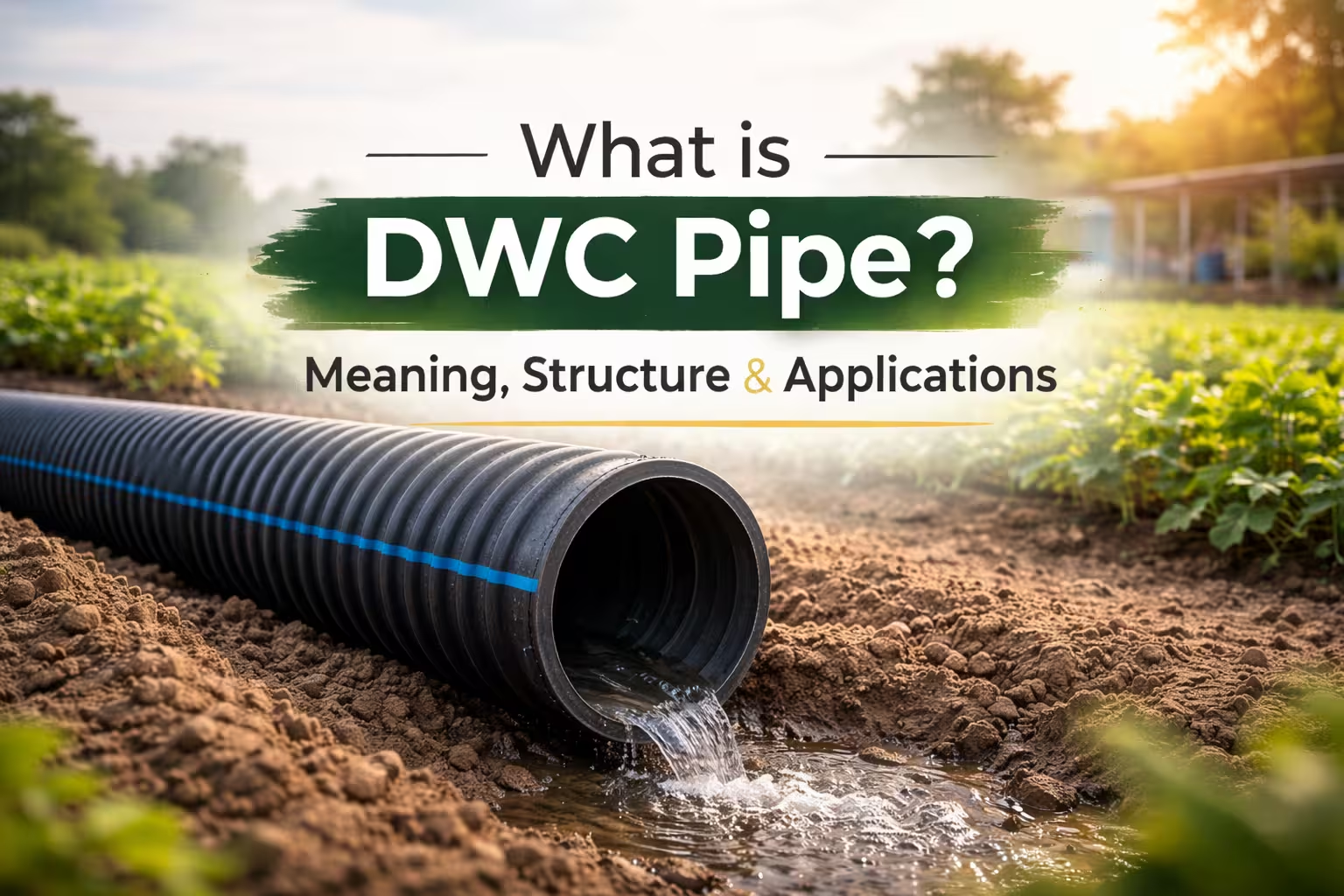
DWC stands for Double Wall Corrugated. A DWC pipe is an advanced plastic piping solution constructed with two distinct layers — a smooth inner wall that maximises fluid flow, and a corrugated (wave-ribbed) outer wall that delivers exceptional mechanical strength, crush resistance, and load-bearing capacity. Most DWC pipes are manufactured from High-Density Polyethylene (HDPE) or Polypropylene (PP), making them lightweight, flexible, and chemically inert.
In simpler terms, think of a DWC pipe as the backbone of underground drainage — robust enough to bear soil overburden and vehicular traffic loads from above, yet hydraulically smooth on the inside so waste and stormwater flow freely without blockage or buildup.
The “double wall” in its name refers precisely to this two-layer engineering innovation. Unlike solid-wall pipes that are either too heavy or too weak, DWC pipes achieve the perfect balance between structural rigidity and physical flexibility. They have, over the past two decades, emerged as the preferred choice for sewerage, stormwater drainage, underground cable protection, and agricultural drainage across India and global infrastructure projects.
 Key Takeaway: The defining feature of a DWC pipe is its two-layer design — corrugated outside for strength, smooth inside for flow. It is this combination that makes it superior to every traditional alternative.
2. Origin & Evolution of DWC Pipes
Double wall corrugated pipes were first developed in Europe during the 1980s as a revolutionary alternative to concrete and vitrified clay pipes used in gravity sewer systems. European engineers recognised that traditional pipes were heavy, brittle, and prone to joint leakage over time — problems that increased maintenance costs and reduced service reliability.
The corrugated plastic pipe concept addressed all of these shortcomings simultaneously. By the early 2000s, DWC pipes began entering the Indian market and quickly gained traction across urban infrastructure, highway drainage, and telecom ducting projects.
Today, with governing standards like IS 16098 and IS 16205 firmly in place, DWC pipes are a BIS-compliant, nationally accepted infrastructure solution. The Indian government’s push for smart cities, Jal Jeevan Mission water projects, and the expansion of optical fiber networks under BharatNet have further accelerated adoption — making DWC pipes an integral part of India’s modern infrastructure landscape.
3. Structure & Anatomy of a DWC Pipe
Understanding why DWC pipes perform so well begins with understanding how they are built. The dual-wall structure is not just an aesthetic choice — every layer serves a critical engineering purpose.
The Outer Corrugated Wall
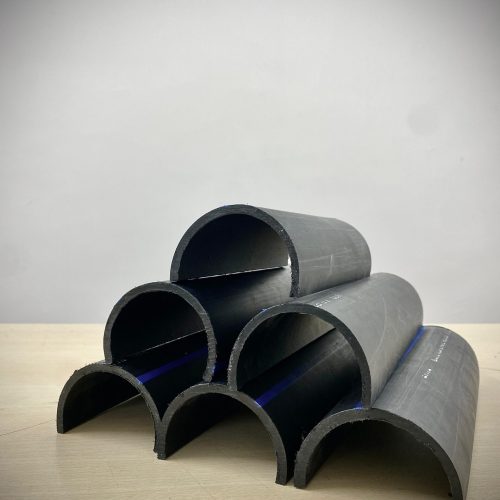
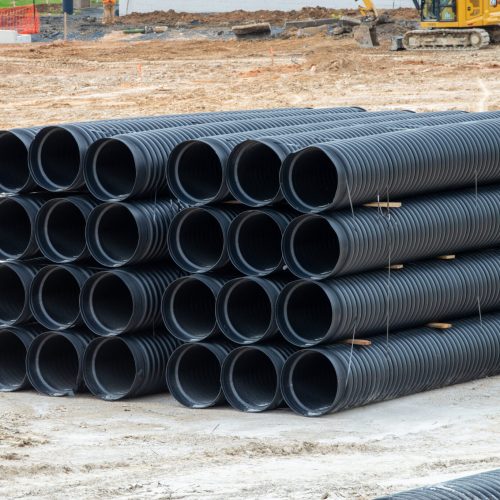
The outer wall of a DWC pipe features a distinctive wave-like or ring-groove corrugation profile. This geometry is the engineering secret behind the pipe’s impressive strength-to-weight ratio. The corrugated ribs act like arches — redistributing external compressive loads (from soil, vehicles, or construction activity) uniformly around the pipe’s circumference rather than concentrating stress at a single point.
This is why a DWC pipe, despite being dramatically lighter than a concrete pipe of equivalent diameter, can withstand far greater ring stiffness loads without deforming. The corrugation also makes the pipe inherently flexible, allowing it to absorb minor ground movement or soil settlement without cracking.
The Inner Smooth Wall
The inner surface of a DWC pipe is deliberately manufactured to be glass-smooth. This matters enormously for hydraulic performance. A smooth inner bore minimises frictional resistance, enabling waste, stormwater, or slurry to flow at higher velocities without generating turbulence or causing debris accumulation.
Manning’s roughness coefficient (n) for the smooth interior of a DWC pipe is approximately 0.009 to 0.010 — significantly lower than concrete (n = 0.013) — which translates to up to 40% greater flow capacity for the same pipe diameter. In practical terms, this means engineers can sometimes specify a smaller pipe for the same drainage requirement, saving both materials and installation cost.
The Air Cavity Between Walls
The space between the corrugated outer wall and the smooth inner wall forms air pockets at each corrugation valley. These cavities serve a dual purpose: they reduce the overall weight of the pipe dramatically — DWC pipes are approximately 20 times lighter than concrete pipes of similar diameter — and they contribute to the pipe’s thermal insulation properties, which is beneficial in cold-climate burial applications.
4. Raw Materials & Manufacturing
The performance of a DWC pipe is inseparable from the quality of the polymer used in its manufacture. At Gark Polyplast, we use only virgin-grade High-Density Polyethylene (Moulding Grade HDPE) — not recycled or blended material — ensuring every metre of pipe meets consistent quality benchmarks.
HDPE (High-Density Polyethylene) The primary raw material for DWC pipes. HDPE offers an exceptional balance of tensile strength, chemical resistance, flexibility, and recyclability. It performs reliably across temperatures ranging from −40°C to +60°C, making it suitable for diverse geographic and climatic conditions across India.
Carbon Black Stabilisers Added to the compound to protect against UV degradation during outdoor exposure and storage. This is what gives DWC pipes their characteristic black outer colour. Without UV stabilisation, polyethylene would become brittle and degrade when exposed to sunlight over time.
Co-Extrusion & Corrugation Process Two layers of HDPE are co-extruded simultaneously through a specially designed die. The outer layer passes through corrugator moulds that form the characteristic ribbed profile, while the inner tube remains perfectly smooth. The two layers are then thermally fused together into a single, inseparable unit during the manufacturing process.
Quality Control Testing Each production batch undergoes ring stiffness, impact resistance, ring flexibility, and elongation at break tests as per IS 16098 and IS 16205 before leaving our facility. Gark Polyplast holds ISO 9001:2015 certification, ensuring every batch is traceable and documented to the highest quality standard.
5. SN Classes Explained: How Strong is Your DWC Pipe?
Unlike pressure-rated pipes which use PN (Pressure Nominal) classes, DWC pipes are classified by their Ring Stiffness (SN) — a measure of the pipe’s resistance to external radial deformation. The SN value directly reflects how much external load the pipe can bear before deforming beyond acceptable limits.
| SN Class |
Ring Stiffness |
Typical Burial Depth |
Best For |
| SN 4 |
4 kN/m² |
1 – 4 metres |
Residential drainage, agricultural fields |
| SN 8 |
8 kN/m² |
1 – 6 metres |
Roads, highways, industrial zones, deeper trenches |
| SN 16 |
16 kN/m² |
Deep installations |
Heavy traffic, railway crossings, high overburden |
Gark Polyplast’s HDPE DWC Pipes are supplied in SN 8 class — the most widely specified grade for infrastructure-grade sewerage and drainage — conforming to IS 16098 and IS 16205. SN 8 pipes are engineered to withstand dynamic vehicle loads, high soil cover depths, and the rigours of long-term underground service without loss of shape or structural integrity.
6. IS Standards & BIS Compliance
In India, DWC pipes are manufactured and tested against specific Bureau of Indian Standards (BIS) specifications. These standards define everything from dimensional tolerances and ring stiffness to joint performance and material properties.
IS 16098 (Part 2): 2013 The primary Indian standard for structured-wall plastic piping systems for non-pressure underground drainage and sewerage. This standard governs HDPE DWC pipes with a smooth inner and corrugated outer surface (Type B) — the most commonly used configuration in India.
IS 16205 Part 24: 2017 Covers DWC pipes specifically designed for telecom and electrical cable protection applications. It defines dimensions for duct sizes ranging from 40/33 mm through 315/275 mm, used widely for fiber optic and power cable ducting projects nationwide.
ISO 21138-3 The international equivalent standard for buried, flexible plastic piping systems. Often cross-referenced for export projects or international project specifications.
Gark Polyplast Certifications Gark Polyplast Pvt. Ltd. holds ISO 9001:2015 (Quality Management), ISO 14001:2015 (Environmental Management), ISO 45001:2018 (Occupational Health & Safety), and BIS/ISI mark certification — covering both IS 16098 and IS 16205.
7. Key Advantages of DWC Pipes
DWC pipes did not displace concrete and clay pipes by accident. Every advantage listed below solves a real problem that project engineers, contractors, and municipalities face on the ground.
1. Exceptional Ring Stiffness at Low Weight The corrugated structure gives DWC pipes ring stiffness values of SN 4 to SN 16 while remaining 15–20 times lighter than equivalent concrete pipes. This dramatically reduces handling, transport, and installation costs on every project.
2. Superior Hydraulic Flow The smooth inner bore (Manning’s n = 0.009–0.010) ensures flow capacity up to 40% higher than concrete pipes of the same diameter. This allows engineers to specify a smaller pipe diameter for the same design flow rate, directly saving material costs.
3. Corrosion & Chemical Resistance HDPE is inherently resistant to acids, alkalis, salts, and biological agents generated by sewage putrefaction. Unlike metal or concrete pipes, DWC pipes do not corrode, spall, or degrade from chemical attack — even under aggressive soil conditions.
4. Long Service Life — 50 to 100 Years Based on European field data and laboratory testing, HDPE DWC pipes are rated for 50 to 100 years of service life under normal installation and operating conditions. This far exceeds the typical 25–30 year lifespan of concrete pipes in acidic or wet environments.
5. Flexibility & Seismic Adaptability DWC pipes can accommodate ground movement, minor soil settlement, and seismic events without cracking. Their inherent flexibility allows them to deflect up to 5% of their diameter without compromising structural integrity or joint performance.
6. Fast & Low-Cost Installation Lightweight pipes can be handled without heavy machinery. Standard 6-metre pipe lengths with rubber ring push-fit joints mean installation proceeds up to 100% faster compared to concrete pipes requiring bedding, heavy lifts, and cement jointing.
7. Zero Maintenance Scale-Up The smooth inner wall prevents scaling or encrustations, eliminating the dredging and de-scaling costs that plague old concrete sewer systems over their operational life.
8. Eco-Friendly & Recyclable HDPE is fully recyclable. The manufacturing process generates minimal scrap, and end-of-life pipes can be reprocessed, aligning with circular economy principles and sustainability commitments.
9. No Concrete Bedding Required Under normal soil conditions, DWC pipes do not need a costly concrete cradle or foundation, reducing civil works cost and significantly shortening project timelines.
10. Leak-Proof Joints Elastomeric (EPDM) rubber ring joints provide watertight seals that also accommodate angular deflection — making DWC systems far more leak-resistant than jointed concrete pipe systems across their full operational life.
8. DWC Pipes vs Conventional Pipes: Head-to-Head
How does a DWC pipe actually stack up against the alternatives that have been used for decades? The comparison below covers nine key parameters that matter most to engineers, contractors, and project owners.
-
Weight: DWC (HDPE) pipes are very light. Concrete and cast iron pipes are very heavy. PVC pipes are medium weight.
-
Flexibility: DWC pipes are very flexible. Concrete and cast iron pipes are hard and rigid. PVC pipes are moderately flexible.
-
Corrosion Resistance: DWC pipes do not rust and have excellent resistance. PVC pipes are also good. Concrete and cast iron pipes can get damaged by chemicals and rust.
-
Service Life: DWC pipes last 50–100 years. PVC pipes last 30–50 years. Concrete pipes last 25–40 years. Cast iron pipes last 20–30 years.
-
Flow Efficiency: DWC pipes have very smooth inner surface, so water flows easily. PVC is also smooth. Concrete and cast iron pipes are less smooth.
-
Installation Speed: DWC pipes are installed very fast. PVC pipes are moderate. Concrete and cast iron pipes take more time.
-
Concrete Bedding: DWC and PVC pipes usually do not need concrete bedding. Concrete and cast iron pipes need it.
-
Recyclable: DWC and PVC pipes are recyclable. Concrete pipes are not recyclable. Cast iron pipes are partly recyclable.
-
Overall Cost: DWC pipes have lower total project cost. PVC pipes have moderate cost. Concrete pipes are costly. Cast iron pipes are the most expensive.
Key Insight: Real-world project data from infrastructure deployments across India shows that switching from concrete to DWC pipes can reduce total project costs by 15–25%, primarily through savings on transportation, labour, installation time, and the elimination of concrete bedding requirements.
9. Applications & Use Cases of DWC Pipes
The versatility of DWC pipes is one of their greatest strengths. The same fundamental dual-wall structure serves radically different engineering requirements across multiple sectors.
Municipal Sewerage & Drainage
The most widespread application of DWC pipes in India. They form the underground backbone of city sewerage systems, transporting domestic and commercial wastewater to treatment plants efficiently. Their chemical resistance to hydrogen sulphide gas — which corrodes concrete from within — makes them ideal for long-term sewer environments where concrete alternatives would fail within years.
Stormwater Management
Urban flooding is a growing challenge across Indian cities. DWC pipes buried beneath city roads and residential colonies channel rainwater runoff rapidly into drainage networks, preventing waterlogging and road damage. Their high flow capacity handles peak monsoon discharge effectively — a critical requirement in flood-prone urban zones.
Highway & Road Drainage
Roads and highways demand drainage pipes that can handle heavy vehicle loads and deep burial depths. SN 8 class DWC pipes are routinely specified for drainage under national highways, expressways, and airport runways where structural demands are at their highest. Their lightweight nature also makes installation under busy roads far quicker, reducing traffic disruption and project timelines.
Agricultural Drainage
Waterlogged agricultural land reduces crop yields significantly. DWC pipes installed as subsurface drainage systems help farmers remove excess soil water from their fields, improving soil aeration and enabling year-round cultivation across flood-prone agricultural regions. Their flexibility allows them to be laid across uneven terrain without special equipment.
Telecom & Optical Fiber Ducting
Smaller DWC pipes (32 mm to 315 mm as per IS 16205) serve as underground conduits protecting optical fiber cables, telephone lines, and broadband infrastructure across India. Their smooth interior makes cable pulling or blowing easier, while the corrugated outer wall shields cables from soil pressure, root intrusion, and external mechanical damage.
Electrical Cable Protection
Power distribution companies, railways, and state electricity boards use DWC pipes to protect HT/LT electrical cables from mechanical damage, moisture, and rodent attack. The pipes’ UV stability and flame-retardant options make them suitable for diverse underground environments across varied soil types.
Industrial Effluent Management
Factories, chemical plants, and industrial estates generate corrosive effluents that attack conventional pipes rapidly. HDPE DWC pipes resist a broad spectrum of industrial chemicals, making them the safe, long-lasting choice for industrial drainage and effluent conveyance systems.
Residential & Housing Projects
Gated communities, townships, and housing complexes use DWC pipes for underground stormwater and sewerage systems. Their ease of installation with rubber ring joints and availability in compact sizes from 32 mm makes them practical and cost-effective for residential-scale infrastructure development.
10. Available Sizes — Gark Polyplast DWC Pipes
Gark Polyplast manufactures HDPE DWC Pipes conforming to IS 16098 and IS 16205, available in sizes from 32 mm to 315 mm, supplied in standard 6-metre straight lengths (larger sizes) and 100-metre coils (smaller sizes). All pipes are SN 8 class with a black outer surface and multicolour inner surface as per requirement.
| Duct Size |
Nominal O.D. (mm) |
Nominal I.D. (mm) |
Standard Length |
| 40/33 |
40 |
33 |
100 m coil |
| 50/41 |
50 |
41 |
100 m coil |
| 63/50 |
63 |
50 |
100 m coil |
| 75/61 |
75 |
61 |
100 m coil |
| 90/76 |
90 |
76 |
100 m coil |
| 110/92 |
110 |
92 |
100 m coil |
| 120/103.5 |
120 |
103.5 |
6 m |
| 160/135 |
160 |
135 |
6 m |
| 180/152 |
180 |
152 |
6 m |
| 200/175 |
200 |
175 |
6 m |
| 250/217 |
250 |
217 |
6 m |
| 300/260 |
300 |
260 |
6 m |
| 315/275 |
315 |
275 |
6 m |
Dimensions as per IS 16205 Part 24:2017. Stiffness Class: SN 8. For custom size requirements, contact our sales team.
11. Installation Basics
One of the most cited practical advantages of DWC pipes is how straightforward they are to install compared to traditional alternatives. Here is a simplified overview of the standard installation process for underground drainage applications.
Step 1 — Trench Excavation
Trenches are excavated to widths and depths specified in IS 16098 Part 2 for the respective pipe diameter. The trench width should allow for adequate compaction of backfill material on each side of the pipe barrel, typically a minimum of 150 mm clearance on each side.
Step 2 — Bedding Layer
A granular bedding layer (sand or selected granular material) of 100–150 mm is placed at the trench bottom to provide uniform support for the pipe. Unlike concrete pipes, DWC pipes do not require a concrete cradle under normal soil conditions, which significantly reduces time and cost.
Step 3 — Pipe Laying & Jointing
Pipes are laid starting from the downstream end. EPDM rubber ring joints — pre-fitted into the pipe socket or corrugation valley — are lubricated and the spigot end is pushed firmly home using a lever bar or jacking equipment for larger diameters. Proper joint assembly ensures watertight seals without adhesives or welding.
Step 4 — Haunching & Side Fill
Selected granular material is compacted in layers on each side of the pipe (haunching) up to the pipe centreline, then to the top of the pipe. Proper compaction at this stage is critical — it activates the pipe–soil composite action that gives flexible pipes their superior load-bearing performance in service.
Step 5 — Backfilling & Reinstatement
Once the pipe zone is properly compacted, general backfill is placed and compacted in layers above the pipe up to the surface. For road crossings, the final fill and surface reinstatement follow the applicable road authority specification.
12. Frequently Asked Questions (FAQs)
Q1. What does DWC stand for in piping?
DWC stands for Double Wall Corrugated. It refers to a pipe design featuring two distinct walls — a smooth inner wall for fluid flow and a corrugated outer wall for mechanical strength — fused together into a single integrated unit.
Q2. What material is a DWC pipe made of?
DWC pipes are primarily manufactured from HDPE (High-Density Polyethylene), Moulding Grade. Some variants also use PP (Polypropylene). HDPE is preferred in India for most drainage and ducting applications due to its outstanding balance of flexibility, chemical resistance, and long-term durability.
Q3. What is the difference between SN 4 and SN 8 DWC pipes?
SN refers to ring stiffness in kN/m². SN 4 pipes have a ring stiffness of 4 kN/m² and are suited for light to moderate loading conditions such as shallow residential drainage. SN 8 pipes have double the stiffness (8 kN/m²) and are designed for deeper burial depths, road crossings, and areas with heavy vehicle traffic.
Q4. What is the lifespan of a DWC pipe?
Based on accelerated ageing tests and real-world data from European installations, HDPE DWC pipes are expected to last 50 to 100 years under normal underground operating conditions. Actual lifespan depends on installation quality, burial depth, soil conditions, and the nature of the fluid being conveyed.
Q5. Can DWC pipes be used above ground?
DWC pipes are designed and optimised specifically for underground, non-pressure applications. They are not recommended for exposed above-ground use where they would be subject to UV radiation, mechanical impact, or thermal expansion cycles without adequate structural support.
Q6. What Indian standard governs DWC pipes?
The primary standard is IS 16098 (Part 2): 2013 — Structured-Wall Plastics Piping Systems for Non-Pressure Underground Drainage and Sewerage. For telecom and electrical cable ducting applications, IS 16205 Part 24: 2017 applies. Gark Polyplast pipes are manufactured and tested to both standards.
Q7. What sizes does Gark Polyplast supply for DWC pipes?
Gark Polyplast manufactures HDPE DWC Pipes in sizes ranging from 32 mm to 315 mm, with nominal delivery lengths of 100 metres for sizes up to 110/92 mm, and 6 metres for sizes 120/103.5 mm and above, conforming to IS 16205 Part 24:2017.
Q8. How is a DWC pipe joined?
DWC pipes are typically joined using EPDM rubber ring push-fit joints, either with integral pipe sockets or separate couplers. The rubber ring seated in the corrugation valley provides a watertight, flexible seal without the need for adhesives, solvent cement, or hot welding.

 +91 9081300225 | +91 9081300226
 Sales@garkgroup.com | garkpolyplast@gmail.com
 www.garkgroup.com
 Gark Industrial Park, Kotda-Pirojpura Road, Palanpur, Gujarat 385010