India’s infrastructure is growing at a pace the country has never seen before. From rural water supply networks and smart city drainage systems to national broadband rollouts and modern irrigation grids — there is one material quietly powering almost all of it: HDPE pipe.
If you’ve been searching for a clear, no-nonsense guide on what HDPE pipe actually is, how it performs against alternatives like PVC and GI, and where it’s being used across India in 2025 — you’re in the right place.
This guide covers everything: the science, the standards, the BIS grades, the real-world applications, the government schemes pushing demand, and a detailed product breakdown based on what GARK POLYPLAST PVT. LTD. — an ISO 9001:2015, ISO 14001:2015 & ISO 45001:2018 certified HDPE pipe manufacturer from Palanpur, Gujarat — manufactures for India’s biggest infrastructure projects.
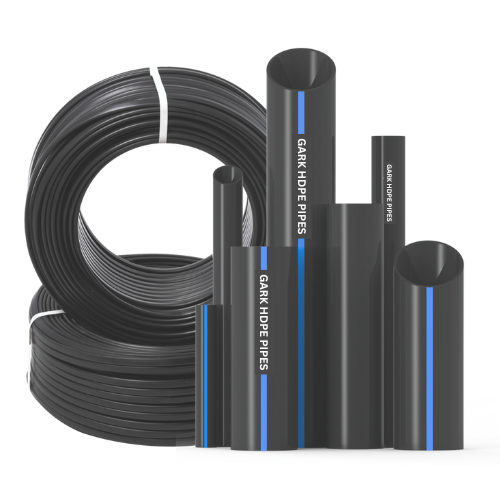
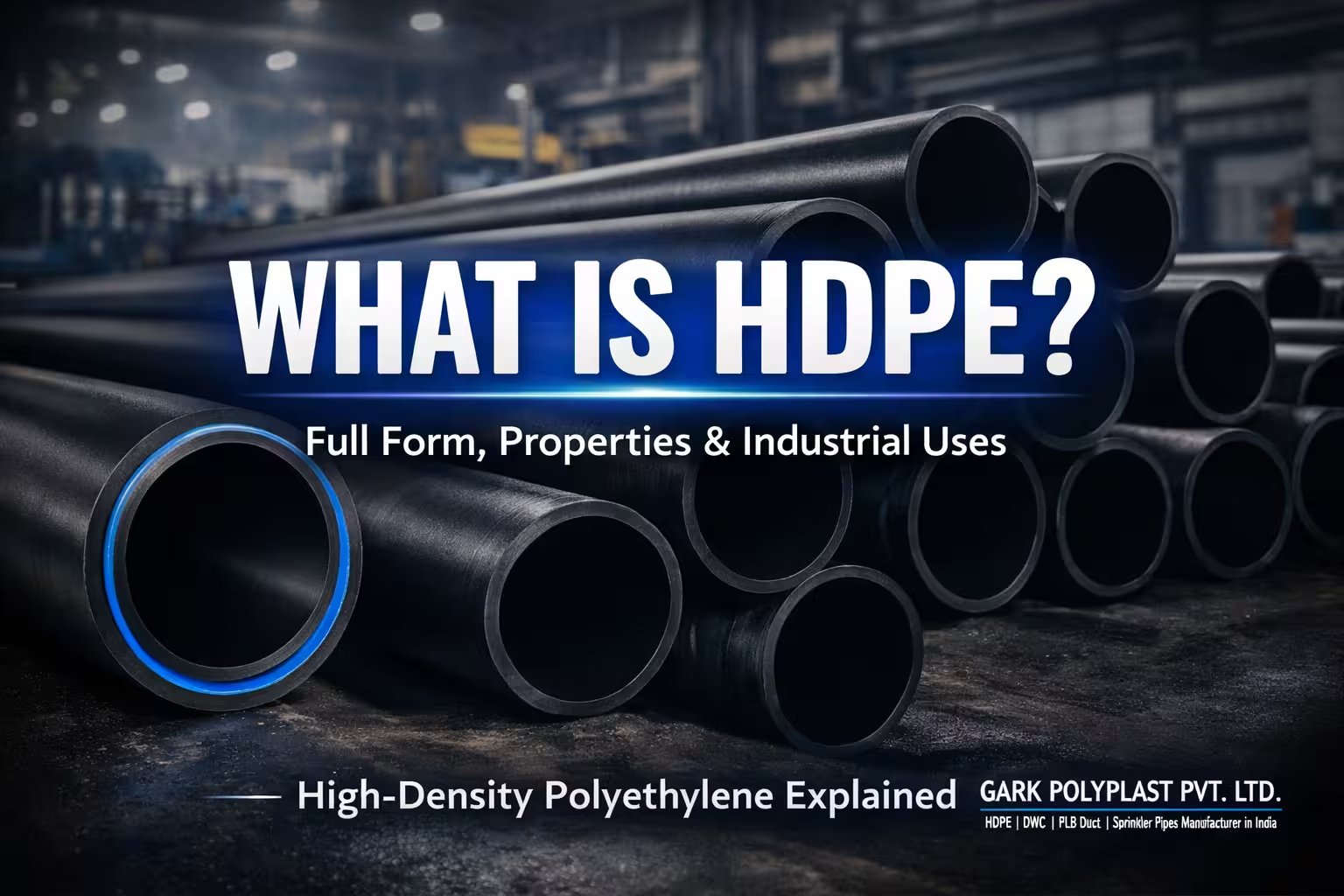
HDPE pipe stands for High-Density Polyethylene pipe — a thermoplastic piping solution manufactured from petroleum-derived polyethylene resin. HDPE is also sometimes referred to as PEHD (Polyethylene High Density) or colloquially as “alkathene” or “polythene pipe” in older usage across India.
What makes HDPE unique among piping materials is its exceptional strength-to-density ratio. It is simultaneously lightweight and extraordinarily tough — a combination that traditional materials like GI (galvanised iron), MS (mild steel), or even standard PVC simply cannot match.
At a molecular level, HDPE is produced by polymerising ethylene under specific temperature and pressure conditions, resulting in a long-chain polymer with very few branches. This tight molecular structure gives HDPE:
In India, HDPE pipes are classified and graded by BIS (Bureau of Indian Standards) under multiple quality grades — PE 63, PE 80, and PE 100 — with PE 100 being the highest-performance grade used in demanding pressure applications.
Understanding the grade of HDPE pipe is critical for specifying the right pipe for your project. The number after “PE” refers to the Minimum Required Strength (MRS) of the material expressed in bar.
| Grade | MRS (bar) | Typical Applications | Performance Level |
|---|---|---|---|
| PE 63 | 6.3 | Low-pressure water supply, irrigation | Entry-level |
| PE 80 | 8.0 | Gas distribution, water mains, general infrastructure | Mid-level |
| PE 100 | 10.0 | High-pressure water mains, potable water, sewerage, critical infra | Premium |
GARK POLYPLAST manufactures all three grades — PE 63, PE 80, and PE 100 — for HDPE pipes conforming to IS 4984, the primary Indian Standard for HDPE piping.
PE 100 pipes can be specified across the following SDR series:
| Pipe Series | SDR Value | Pressure Rating (PE 100) |
|---|---|---|
| SDR 26 | 26 | PN 6.3 |
| SDR 21 | 21 | PN 8 |
| SDR 17 | 17 | PN 10 |
| SDR 13.6 | 13.6 | PN 12.5 |
| SDR 11 | 11 | PN 16 |
Available pipe diameters range from 16 mm to 315 mm OD, supplied in tube (straight length) or coil form for smaller diameters.
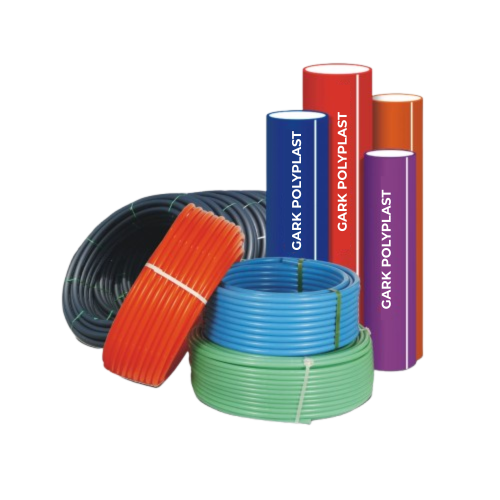
GARK POLYPLAST PVT. LTD. manufactures three primary HDPE-based piping product lines, each engineered for a specific infrastructure segment.
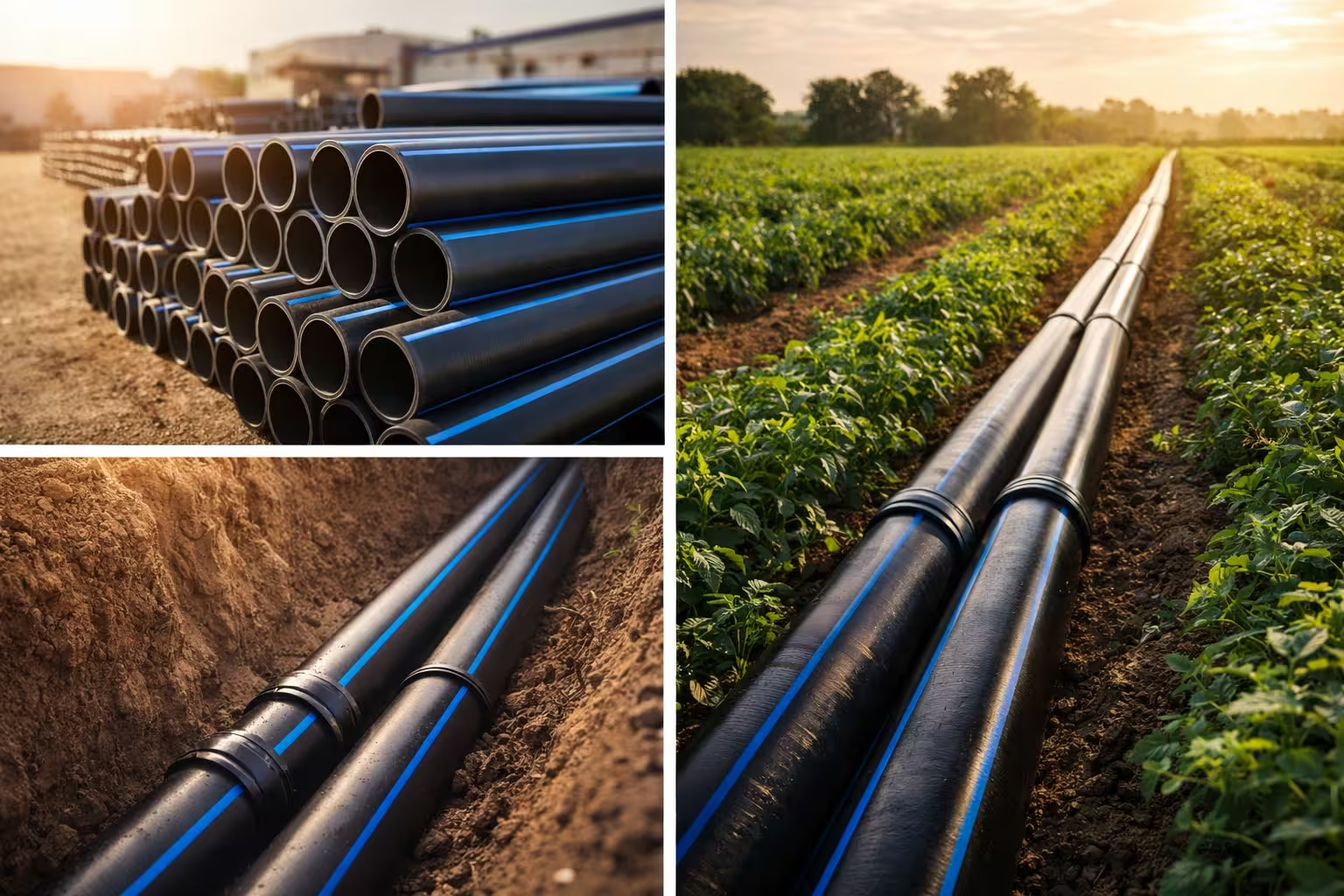
The most widely used HDPE pipe in India — for water distribution, gas networks, irrigation, industrial fluid transport, and electrical conduit applications.
Product specifications:
Applications:
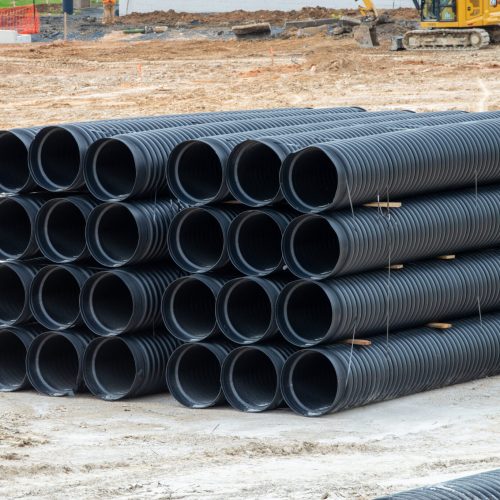
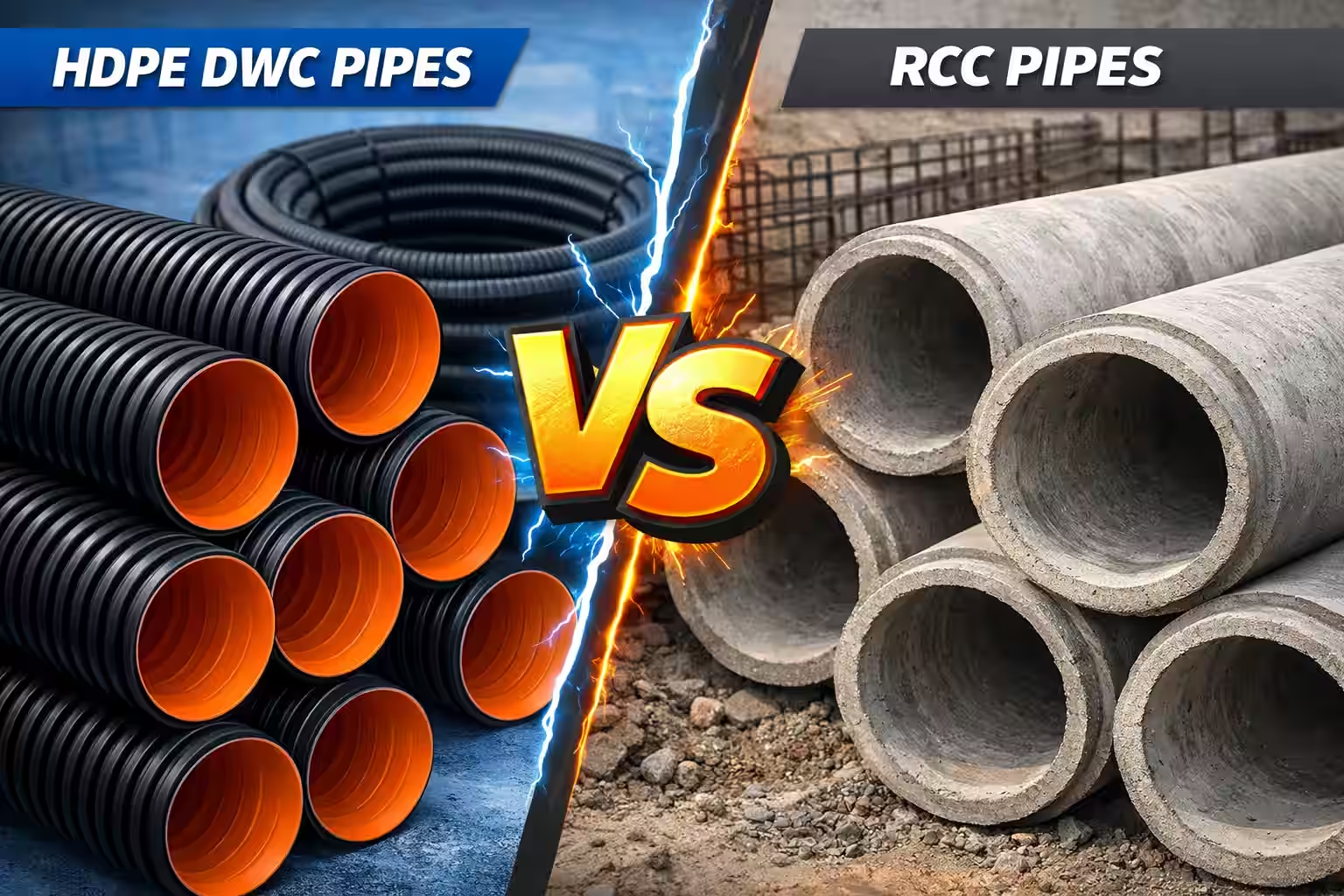
HDPE DWC pipes feature a profiled corrugated outer wall for structural rigidity under soil pressure and a smooth inner wall for optimal flow efficiency. They are the standard pipe for underground gravity systems across India.
Product specifications:
Available sizes (as per IS 16205: Part 24: 2017):
| Duct Size | Nominal OD (mm) | Nominal ID (mm) | Delivery Length |
|---|---|---|---|
| 40/33 | 40 | 33 | 100 m coil |
| 63/50 | 63 | 50 | 100 m coil |
| 110/92 | 110 | 92 | 100 m coil |
| 160/135 | 160 | 135 | 6 m tube |
| 200/175 | 200 | 175 | 6 m tube |
| 250/217 | 250 | 217 | 6 m tube |
| 315/275 | 315 | 275 | 6 m tube |
Applications:
GARK POLYPLAST’s PLB Duct Pipes are purpose-built for India’s telecom infrastructure. PLB stands for Permanently Lubricated Bore — the inner surface of these HDPE ducts is factory-coated with a permanent lubricant that dramatically reduces friction during optical fibre cable blowing, cutting installation time and labour costs significantly.
These pipes conform to TEC/GR/TX/CDS/008/03/March-2011 and comply with IS 4984.
Product specifications:
Size table (as per TEC/RDSO specification):
| Duct Size | Outer Diameter | Ovality | Wall Thickness | Standard Length |
|---|---|---|---|---|
| 25/20 mm | 25 ± 0.2 mm | 1 mm | 2.5 ± 0.2 mm | 500/1000 m |
| 32/26 mm | 32 ± 0.3 mm | 1.3 mm | 3.0 ± 0.2 mm | 500/1000 m |
| 40/33 mm | 40 ± 0.4 mm | 1.4 mm | 3.5 ± 0.2 mm | 500/1000 m |
| 50/42 mm | 50 ± 0.5 mm | 1.4 mm | 4.0 ± 0.3 mm | 500/1000 m |
| 63/50 mm | 63 ± 0.6 mm | 1.5 mm | 6.5 ± 0.4 mm | 6/12/50/500 m |
Applications:
This is where the real decision gets made on any project. Here is an honest, data-backed breakdown of why HDPE outperforms traditional alternatives in almost every measurable way.
HDPE pipes have a designed service life of 50 to 100 years under normal operating conditions. Compare that with:
According to the Plastics Pipe Institute (PPI), the lifecycle cost of HDPE piping is the lowest of any pipe material when factoring in reduced leakage, minimal maintenance, and almost zero replacement frequency over 50 years of service.
Unlike GI and MS pipes that rust from the inside out and concrete pipes that degrade with chemical exposure, HDPE does not corrode. It is completely immune to:
This is especially critical in India, where groundwater and soil chemistry varies dramatically across regions — from saline coastal soils in Gujarat to acidic red soils in South India to alkaline black cotton soils in Maharashtra.
HDPE pipes are joined using butt fusion or electrofusion welding — a process that melts the pipe ends together to create a joint that is as strong as the pipe itself. The result: near-zero leak rates at every joint.
This is a decisive advantage in India, where the Central Public Health and Environmental Engineering Organisation (CPHEEO) estimates that 30–40% of treated water is lost through leaky pipe joints in urban distribution networks. HDPE’s fusion-welded joints eliminate this loss at the source.
HDPE’s viscoelastic nature gives it the ability to flex and absorb ground movement without fracturing. This is critical for:
HDPE can withstand pressure surges up to 200 psi above its rated pressure, compared to PVC’s 100 psi surge tolerance — making HDPE significantly better for high-pressure mains with water hammer risk.
HDPE pipes weigh significantly less than concrete, ductile iron, or steel pipes of the same diameter. This means:
In coil form, small-diameter HDPE pipes can be laid in long continuous runs of 500 to 1000 metres without a single joint — dramatically reducing installation time and leak risk.
Standard black HDPE pipes are UV-stabilised through carbon black compounding and provide complete UV resistance throughout their service life — from storage in yards to above-ground outdoor applications in hot Indian conditions.
PVC pipes, by contrast, degrade with prolonged UV exposure and become brittle, requiring protective coatings or buried installation in most outdoor uses.
HDPE is non-toxic, tasteless, and odourless. It does not leach chemicals into the water it carries, making it safe for potable water supply even under sustained high-pressure use. This has been validated by BIS standards and international bodies including NSF International and the World Health Organization.
PE 100 grade HDPE pipes from GARK POLYPLAST are fully compliant with IS 4984 and are specified for use in India’s Jal Jeevan Mission and AMRUT water supply schemes.
HDPE is fully recyclable — at end of life, HDPE pipes can be recycled into secondary products. Their production consumes less energy than metal alternatives, and their near-zero leak rates directly contribute to water conservation — a national priority as India faces increasing water stress across its river basins.
Municipal IoT-enabled HDPE pipe deployments under the Smart Cities Mission in cities like Pune have reportedly reduced water losses by up to 25% through the combination of HDPE’s leak-free joints and modern pressure monitoring.
| Feature | HDPE Pipe | PVC Pipe | GI/MS Pipe |
|---|---|---|---|
| Lifespan | 50–100 years | 20–30 years | 15–25 years |
| Corrosion resistance | Excellent | Good | Poor (rusts) |
| UV resistance | Excellent (black) | Poor | Moderate |
| Flexibility | High | Low (brittle) | None |
| Joint integrity | Fusion-welded (near-zero leak) | Solvent/rubber ring (moderate) | Threaded/welded (high leak risk) |
| Weight | Very light | Light | Heavy |
| Pressure surge tolerance | 200 psi above rating | 100 psi above rating | Low |
| Safe for potable water | Yes | Yes (if certified) | Degrades over time |
| Recyclable | Yes (100%) | Partially | No |
| Installation cost | Low | Low | High |
| Maintenance cost | Minimal | Low | High |
| Ideal for trenchless | Yes | Limited | No |
India’s HDPE pipe market reached USD 689.70 million in 2024 and is projected to reach USD 990.15 million by 2033, growing at a CAGR of 4.10% (IMARC Group, 2025). This growth is driven across six primary sectors.
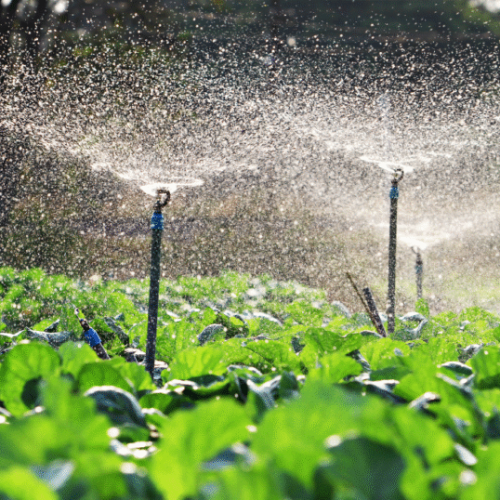
Agriculture accounts for approximately 70% of India’s total freshwater consumption. HDPE pipes are the backbone of drip and sprinkler irrigation systems being aggressively expanded under the Pradhan Mantri Krishi Sinchayee Yojana (PMKSY), for which the Union Budget 2025–26 allocated USD 970 million.
GARK POLYPLAST’s HDPE Sprinkler Pipes (IS 17425) in PE 100 grade — available from 63 mm to 140 mm — are purpose-built for micro-irrigation, drip irrigation, and large-scale farm water distribution in Gujarat, Rajasthan, Maharashtra, and across India’s semi-arid agricultural belt.
India is the world’s second-largest telecom market. The government’s BharatNet initiative (connecting 6 lakh villages with optical fibre) and commercial 5G rollout require millions of kilometres of OFC protection. GARK POLYPLAST’s PLB Duct Pipes, with permanently lubricated bores, are the TEC/RDSO-specified standard for this application — enabling faster, cheaper, and more reliable cable blowing across terrains ranging from the Indo-Gangetic plains to hilly Northeast India.
The Jal Jeevan Mission (JJM), which received a budget increase to USD 7.88 billion in February 2025 (having already benefitted 15 crore households since 2019), is the single largest driver of HDPE PE 100 pipe demand in India. Every rural household tap connection involves HDPE water supply pipelines.
The AMRUT 2.0 scheme funds urban water supply and sewerage network upgrades in 500 cities. Sewage projects in Mathura and Moradabad (Uttar Pradesh) alone involved a ₹7.9 billion investment in January 2024, with HDPE DWC pipes as the primary sewerage conduit.
HDPE DWC pipes (IS 16205 / IS 16098) are the standard solution for underground sewerage in India for good reason — their SN 8 stiffness rating handles soil overburden loads, their smooth inner wall ensures self-cleaning flow, and their HDPE construction guarantees 50+ years of chemical resistance in aggressive wastewater environments.
Applications include municipal sewer mains, storm water drains, culverts under national highways and railways, and industrial drainage at chemical processing plants.
India’s construction sector — driven by the PM Awas Yojana housing schemes, Smart Cities Mission, and commercial real estate expansion — is a fast-growing segment for HDPE. Applications include underground drainage, storm water management, electrical conduit, and infrastructure piping in new township and industrial park developments.
Between April and November 2025 alone, government departments released pipe procurement tenders worth ₹2,213 crore — a record high for any 8-month procurement cycle in India’s pipe market (Nexizo, December 2025).
HDPE pipes and PLB ducts are used in renewable energy infrastructure for water management piping in solar projects, cable protection in wind farm installations, and power cable conduit on national highways. HDPE’s UV stability, crush resistance, and chemical inertness make it ideal for the outdoor, high-exposure conditions typical of India’s expanding renewable energy sector.
Use this quick selection guide to match your application to the right product and standard:
| Application | Recommended Product | Standard | Grade |
|---|---|---|---|
| Potable water supply | HDPE Pipe, SDR 11/SDR 17 | IS 4984 | PE 100 |
| Agricultural irrigation | HDPE Sprinkler Pipe | IS 17425 | PE 100 |
| Underground sewer / drainage | HDPE DWC Pipe, SN 8 | IS 16205 / IS 16098 | HDPE Moulding |
| Optical fibre cable laying | PLB Duct Pipe | TEC/RDSO | HDPE |
| Storm water drainage | HDPE DWC Pipe | IS 16205 | HDPE Moulding |
| Electrical cable conduit | HDPE DWC or PLB Duct | IS 16205 / IS 4984 | HDPE |
| Gas distribution | HDPE Pipe, SDR 11 | IS 4984 | PE 80 / PE 100 |
| National highway cable ducts | PLB Duct Pipe | TEC/RDSO | HDPE |
Key selection factors: Operating pressure (PN rating), pipe diameter, installation method (trench or trenchless), fluid type (water, gas, effluent, or cable), and compliance standard required by the project tender.
| Scheme | Ministry | Relevance to HDPE Pipes | Budget (2025) |
|---|---|---|---|
| Jal Jeevan Mission | Jal Shakti | Rural household tap water connections | USD 7.88 billion |
| AMRUT 2.0 | Housing & Urban Affairs | Urban water supply and sewerage | Multi-billion |
| PMKSY | Agriculture | Drip & sprinkler irrigation | USD 970 million |
| Smart Cities Mission | Housing & Urban Affairs | Urban drainage, water, cable infra | ₹1.47 lakh crore total |
| BharatNet / Digital India | Telecom | OFC protection — PLB duct pipes | Multi-year mission |
| PM Awas Yojana | Housing | Construction drainage and plumbing | Ongoing |
HDPE stands for High-Density Polyethylene. In the context of pipes, it refers to piping manufactured from high-density polyethylene resin — a petroleum-derived thermoplastic known for its strength, flexibility, chemical resistance, and long service life of 50 to 100 years.
Under normal operating conditions in India’s climate, HDPE pipes have a designed service life of 50 to 100 years. This significantly exceeds GI pipes (15–25 years), standard PVC pipes (20–30 years), and concrete pipes.
Yes. HDPE is non-toxic and does not leach chemicals into the water it carries. PE 100 grade HDPE pipes are widely specified by BIS, CPHEEO, and government agencies for potable water supply under India’s Jal Jeevan Mission and AMRUT schemes. GARK POLYPLAST HDPE pipes carry BIS ISI certification under IS 4984.
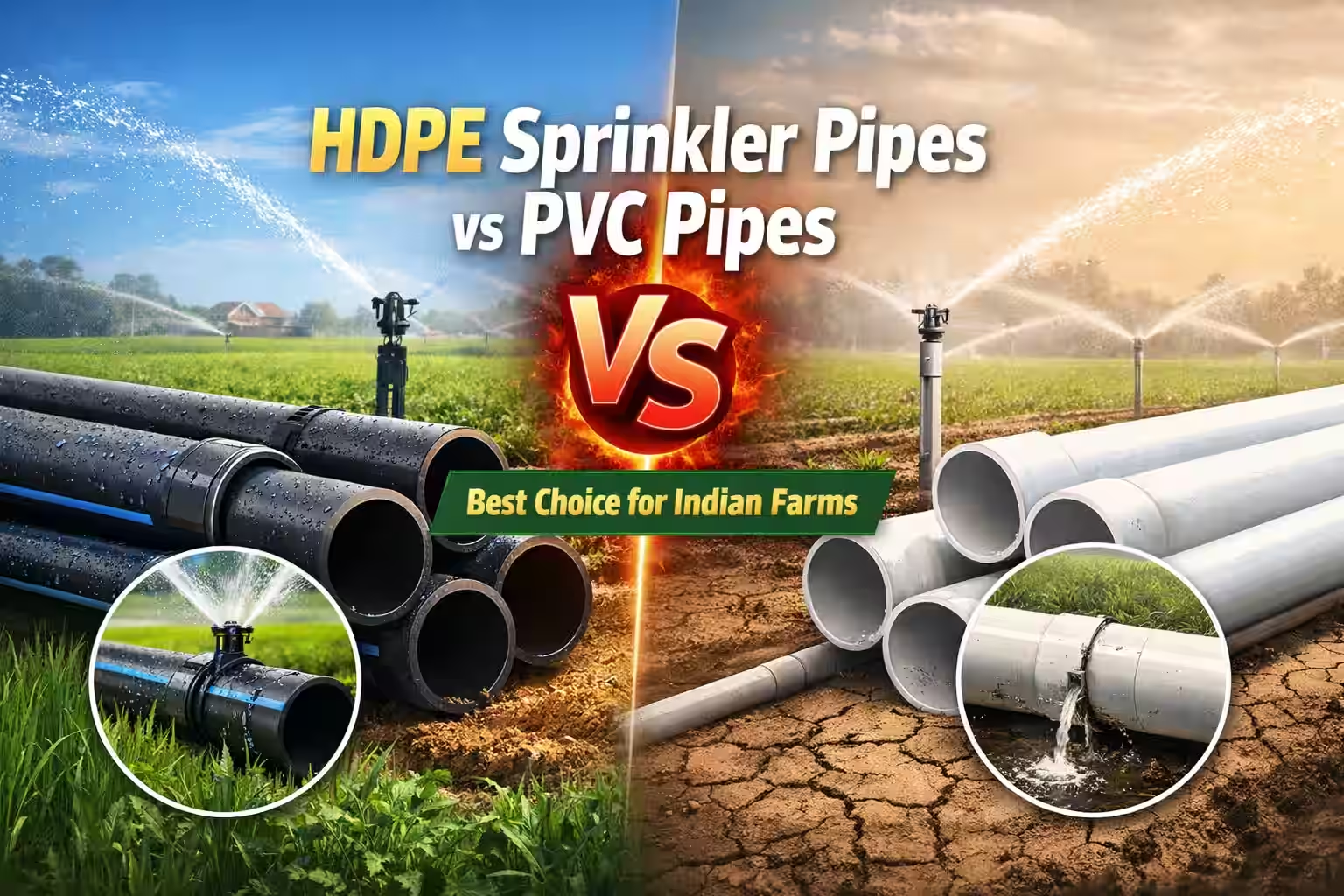
HDPE pipes are more flexible, have a longer lifespan (50–100 years vs 20–30 years), offer better UV resistance, and create stronger, near-zero-leak joints through heat fusion. PVC pipes are generally cheaper for small-diameter applications but are brittle, prone to cracking under pressure surge, and degrade under sustained UV exposure. For large infrastructure — water mains, sewerage, irrigation networks — HDPE is the preferred standard.
PLB (Permanently Lubricated Bore) duct pipes are HDPE ducts with a factory-applied permanent inner lubricant, manufactured specifically for the telecom sector. They enable fast, low-friction cable blowing for optical fibre cable (OFC) networks. GARK POLYPLAST manufactures PLB ducts to TEC/RDSO specification in sizes from 25/20 mm to 63/50 mm.
DWC stands for Double Wall Corrugated. HDPE DWC pipes have a corrugated outer wall for structural strength (SN 8 stiffness class) and a smooth inner wall for optimal flow. They conform to IS 16098 and IS 16205 and are the standard choice for underground sewerage, storm water drainage, culverts, and electrical cable laying in India, in sizes from 32 mm to 315 mm.
The primary BIS standards for HDPE pipes in India are:
GARK POLYPLAST PVT. LTD. manufactures HDPE pipes, DWC pipes, Sprinkler pipes, and PLB ducts at its facility in GARK INDUSTRIAL PARK, Kotda-Pirojpura Road, Palanpur, Gujarat — 385010. Established in 2015, the company holds ISO 9001:2015, ISO 14001:2015, and ISO 45001:2018 certifications and produces pipes with BIS ISI marks.
GARK POLYPLAST PVT. LTD. is a hi-tech HDPE pipe manufacturer based in Palanpur, Banaskantha, Gujarat — established in 2015 under the GARK GROUP umbrella. With over 9 years of manufacturing experience and a full suite of international quality certifications, GARK POLYPLAST delivers piping solutions for India’s agriculture, telecom, municipal water, sewerage, construction, and energy sectors.
Certifications: ISO 9001:2015 | ISO 14001:2015 | ISO 45001:2018 | BIS ISI Mark
Products: HDPE Pipes (IS 4984) | HDPE DWC Pipes (IS 16098/IS 16205) | HDPE Sprinkler Pipes (IS 17425) | PLB Duct Pipes (TEC/RDSO)
Contact:
 +91 9081300225 | +91 9081300226
 Sales@garkgroup.com | garkpolyplast@gmail.com
 www.garkgroup.com
 GARK INDUSTRIAL PARK, Kotda-Pirojpura Road, Palanpur, Gujarat 385010
“At GARK POLYPLAST, we don’t just manufacture pipes — we create lifelines for projects that demand resilience and performance.”