
Every HDPE pipe carries a number stamped on its outer wall. Sometimes it reads “SDR 11.” Sometimes “SDR 17.” Sometimes “SDR 26.” Most buyers see this number and either ask what it means or, more dangerously, ignore it entirely and assume all HDPE pipes are essentially the same product.
They are not. An HDPE pipe’s SDR value is not a secondary specification. It is the core parameter that determines everything consequential about how the pipe performs: how much internal pressure it can safely carry, how thick its wall is, how stiff it is under burial loads, how it behaves under surge pressure events, and — fundamentally — whether it is the right product for a given project or a potentially dangerous mismatch.
This guide explains SDR in HDPE pipes with the precision the topic deserves: what the term means mathematically, how it relates to the pipe’s pressure rating, how SDR values interact with HDPE material grades (PE63, PE80, PE100) and IS 4984 standards, which SDR is correct for which application, and what every project engineer, procurement manager, and contractor in India needs to understand before specifying or purchasing HDPE pipe.
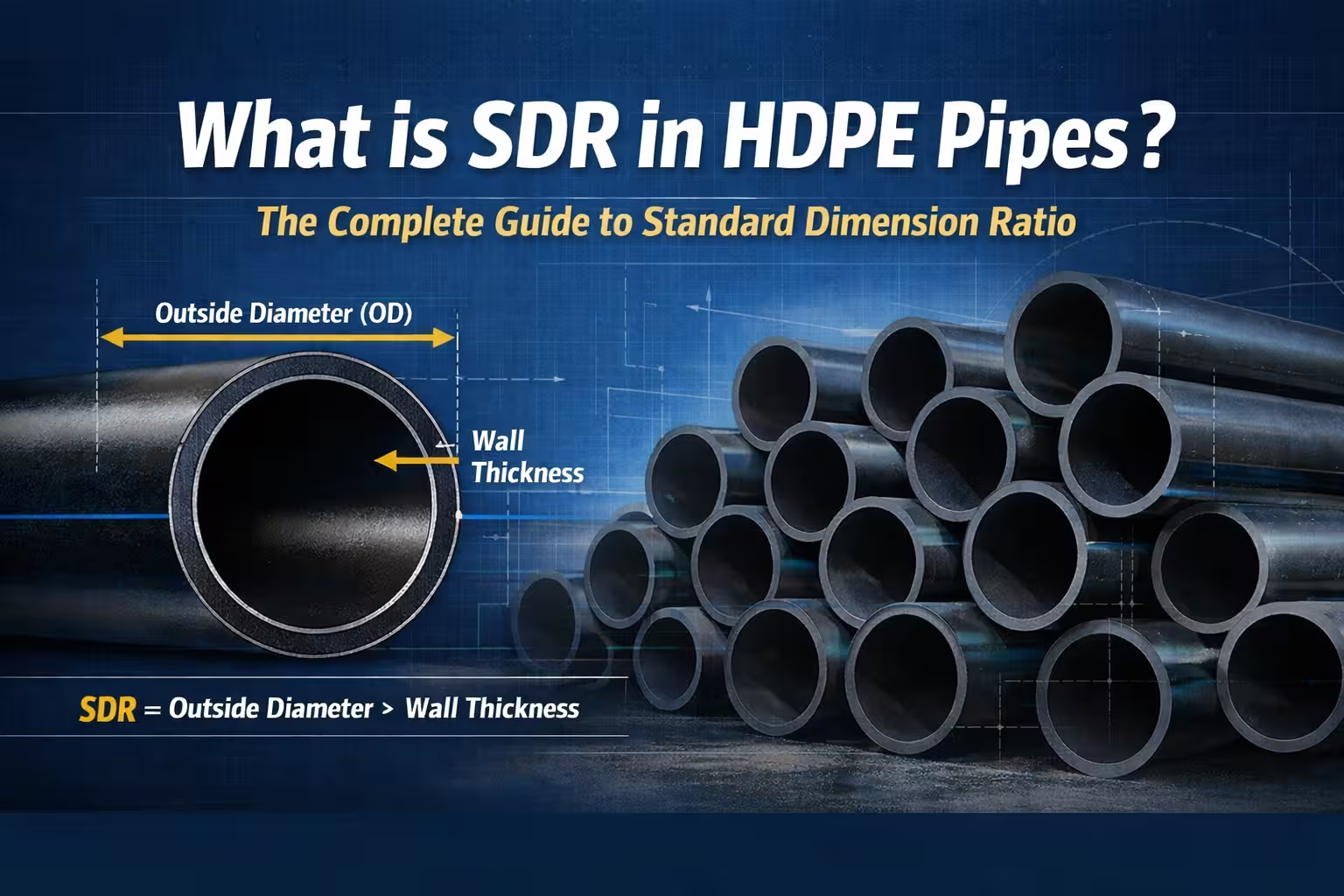
SDR stands for Standard Dimension Ratio. It is a dimensionless number that expresses the geometric relationship between an HDPE pipe’s nominal outside diameter and its nominal wall thickness.
The formula is straightforward:
SDR = Outer Diameter (OD) ÷ Wall Thickness (WT)
So an HDPE pipe with an outer diameter of 110mm and a wall thickness of 10mm has an SDR of 11. A pipe with an outer diameter of 110mm and a wall thickness of 6.47mm has an SDR of 17. The same outer diameter, but two entirely different pipes — different wall thicknesses, different weights per metre, different pressure ratings, different material costs, and different appropriate applications.
The “Standard” in Standard Dimension Ratio refers to the fact that SDR values follow the ANSI preferred number series — a recognised international series of dimensionless ratios that includes SDR 6, 9, 11, 13.6, 17, 21, 26, 33, 41. These are not arbitrary numbers. They are selected such that the same SDR value produces the same pressure rating regardless of pipe diameter — which is what makes the SDR system so powerful and universally used in HDPE piping engineering.
That last point bears repeating because it is one of the most useful properties of the SDR system: a 63mm SDR 11 HDPE pipe and a 315mm SDR 11 HDPE pipe, made from the same PE grade, carry exactly the same working pressure. This diameter-independent pressure rating is the direct consequence of the constant wall thickness-to-diameter ratio that SDR defines.
Before examining how SDR determines pressure, it helps to understand the physical picture clearly.
Imagine two HDPE pipes, both with an outer diameter of 200mm, both manufactured from PE100 HDPE:
The first pipe has an SDR of 11. Its wall thickness is 200 ÷ 11 = 18.2mm. Its bore (inner diameter) is 200 − (2 × 18.2) = 163.6mm. This is a heavy-walled pipe — substantial material content, significant structural stiffness, high pressure capacity.
The second pipe has an SDR of 26. Its wall thickness is 200 ÷ 26 = 7.7mm. Its bore is 200 − (2 × 7.7) = 184.6mm. This is a thin-walled pipe — less material, larger bore, lower pressure capacity, lower cost per metre.
Both pipes have the same outer diameter. Both can be jointed with the same fusion equipment and fittings at the same OD. But they are engineered for completely different operating conditions.
The rule that governs SDR:
A lower SDR number = thicker wall = higher pressure capacity = more material = higher cost per metre. A higher SDR number = thinner wall = lower pressure capacity = less material = lower cost per metre.
SDR 6 is a very heavy-walled pipe used in the most demanding high-pressure applications. SDR 41 is an extremely thin-walled pipe used only in gravity drainage or very low-pressure contexts. The engineer’s job is to select the SDR that correctly matches the operating pressure of the system with an appropriate safety margin — neither over-specifying (wasteful cost) nor under-specifying (unsafe failure risk).
The relationship between SDR and pressure rating is governed by a specific engineering equation. Under IS 4984 and ISO 4427, the nominal pressure (PN) rating of an HDPE pipe is calculated as:
PN = (20 × σ) ÷ (SDR − 1)
Where: σ is the maximum allowable hoop stress (hydrostatic design stress) for the PE material grade, which is calculated from the Minimum Required Strength (MRS) divided by the overall service design coefficient C (typically C = 1.25 per IS 4984).
For the three PE grades used under IS 4984:
PE63 — MRS = 6.3 MPa — σ = 5.0 MPa PE80 — MRS = 8.0 MPa — σ = 6.3 MPa PE100 — MRS = 10.0 MPa — σ = 8.0 MPa
Applying this formula produces the PN ratings for each SDR × PE grade combination. The most commonly specified combinations in India, relevant to IS 4984, are:
PE100 pipes (σ = 8.0 MPa): SDR 6 → PN 25 (very high pressure, industrial use) SDR 9 → PN 20 (high pressure) SDR 11 → PN 16 (high pressure municipal, gas distribution) SDR 13.6 → PN 12.5 (medium-high pressure) SDR 17 → PN 10 (standard municipal water supply) SDR 21 → PN 8 (medium pressure rural supply) SDR 26 → PN 6 (low-pressure distribution)
PE80 pipes (σ = 6.3 MPa): SDR 11 → PN 12.5 SDR 13.6 → PN 10 SDR 17 → PN 8 SDR 21 → PN 6 SDR 26 → PN 5
PE63 pipes (σ = 5.0 MPa): SDR 11 → PN 10 SDR 17 → PN 6 SDR 26 → PN 4
This table is the fundamental reference for HDPE pipe specification. Notice the pattern: for any given SDR, the higher the PE grade, the higher the PN rating — because the material is stronger. And for any given PE grade, the lower the SDR (thicker wall), the higher the PN rating.
This is why the correct way to describe an HDPE pipe fully is with all three parameters together: PE grade + SDR + nominal diameter. For example: PE100 SDR 11 DN 110mm. Without all three, the specification is incomplete.
IS 4984:2016 is the Bureau of Indian Standards specification that governs HDPE pipes for water supply in India. It specifies the material grades (PE63, PE80, PE100), the allowable SDR series, the minimum wall thickness for each diameter-SDR combination, and the testing requirements (hydrostatic pressure test, melt flow rate, tensile properties, ovality) that every BIS-licensed manufacturer must meet.
Under IS 4984:2016, the standard PN classes applicable to each PE grade are:
PE63: PN 2.5, PN 4, PN 6 PE80: PN 4, PN 6, PN 8, PN 10, PN 12.5 PE100: PN 4, PN 6, PN 8, PN 10, PN 12.5, PN 16
Each PN class corresponds to a specific SDR as per the formula above. Pipes must carry the BIS licence mark and the complete marking on the pipe outer surface: manufacturer name, brand, OD, SDR, PE grade, PN class, IS 4984, BIS mark, batch/date of manufacture.
When procuring HDPE pipes for any government project in India — Jal Jeevan Mission water supply, AMRUT distribution networks, industrial process pipelines — IS 4984:2016 compliance with BIS licence mark is the minimum procurement standard. Any pipe without this marking is not verified to meet the dimensional accuracy and material quality requirements of the standard.
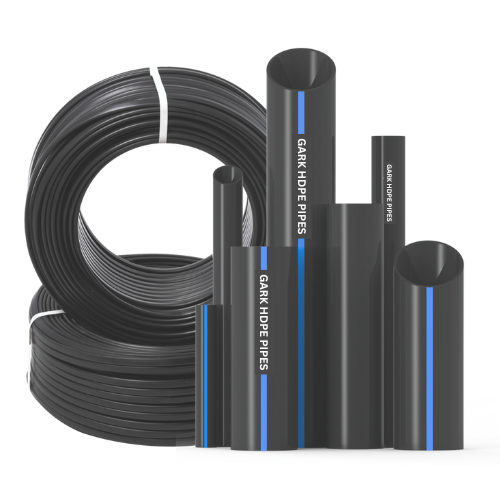
Gark Polyplast Pvt. Ltd. manufactures HDPE pipes under IS 4984:2016 with BIS/ISI mark certification in PE63, PE80, and PE100 grades. Full specifications, available SDR series, and dimensional tables are available in our product catalogue. For project-specific recommendations, contact our technical team.
Understanding how to read a complete HDPE pipe specification is a practical skill for anyone sourcing or specifying HDPE pressure pipes for Indian infrastructure projects. A correctly marked pipe will show something like:
GARK POLYPLAST — PE100 — SDR 17 — PN 10 — DN 110mm — IS 4984:2016 — BIS
Reading this marking, a specification engineer can immediately derive:
Wall thickness = 110 ÷ 17 = 6.47mm nominal Operating pressure at 20°C = 10 bar (1.0 MPa) Bore (inner diameter) = 110 − (2 × 6.47) = 97.1mm Material grade = PE100 (MRS 10.0 MPa, highest grade) Standard compliance = IS 4984:2016 with BIS mark Manufacturer = Gark Polyplast (traceable batch)
From this single line of information, a procurement engineer can verify the pipe against the project specification, calculate the flow area, and confirm the working pressure is appropriately matched to the system design pressure.
Conversely, a marking that says only “HDPE 110mm PN 10” without an SDR designation, PE grade, IS standard, and BIS mark should prompt immediate verification — because the PN 10 claim cannot be independently verified without knowing the material grade and confirming the wall thickness against the SDR formula.
The following is a practical guide to SDR selection for the most common HDPE pipe applications in India, referenced to IS 4984:2016 and the major government infrastructure programmes:
SDR 6 (PE100: PN 25) and SDR 9 (PE100: PN 20) are heavy-walled pipes specified for high-pressure industrial process lines, chemical transfer, compressed gas applications, and any system where operating pressures exceed 16 bar. These are specialist products for petrochemical plants, chemical processing facilities, and high-pressure water transmission mains. The thick wall provides not only pressure capacity but also exceptional mechanical strength for installations in aggressive soil conditions or high-impact environments.
SDR 11 is the standard specification for natural gas distribution networks in India, where safety factors are paramount and the consequences of pipe failure are severe. Under IS 4984, PE80 SDR 11 delivers PN 12.5 and PE100 SDR 11 delivers PN 16 — making it the appropriate choice for gas mains, high-pressure municipal water transmission mains, and industrial water service connections operating at elevated pressures. It is also the standard specification for horizontal directional drilling (HDD) installations, where the pipe must withstand significant tensile loading during the pull-through operation in addition to its operating pressure.
SDR 13.6 (PE100: PN 12.5; PE80: PN 10) bridges the gap between the very high pressure capacity of SDR 11 and the standard municipal specification of SDR 17. It is commonly specified for sub-transmission mains, elevated storage tank feed lines, and industrial cooling water circuits where operating pressure exceeds the PN 10 comfort threshold but SDR 11 would be over-specified.
SDR 17 is the most widely specified HDPE pipe in India today. PE100 SDR 17 delivers PN 10 — a pressure rating that covers the full range of municipal water distribution systems, including the Jal Jeevan Mission (JJM) water supply networks being deployed across rural India.
The Jal Jeevan Mission (Har Ghar Jal) has been one of the largest drivers of HDPE pipe demand in India’s recent infrastructure buildout. As of March 2026, over 15.80 crore rural households — representing 81.61% of the total rural households identified — have been provided with functional tap water connections. The mission has been extended to December 2028 under JJM 2.0, with an enhanced total outlay of ₹8.69 lakh crore. Every piped water supply scheme under JJM specifies IS 4984:2016 compliant HDPE pipe, and PE100 SDR 17 (PN 10) is the workhorse specification for distribution networks and rising mains across these schemes.
The SDR 17 pipe’s balance of adequate pressure capacity, good bore-to-diameter ratio (important for maintaining flow capacity in distribution mains), and cost efficiency — compared to the heavier SDR 11 or SDR 13.6 — makes it the engineering and economic default for India’s largest water infrastructure programme. For HDPE pipes in water supply applications, Gark Polyplast’s IS 4984:2016 certified HDPE pressure pipes in PE100 SDR 17 are available from our Palanpur manufacturing facility for pan-India delivery.
SDR 21 (PE100: PN 8) is specified for lower-pressure distribution mains, gravity-assisted service connections, and rural water supply networks in low-elevation terrain where system pressures are moderate. It offers a cost advantage over SDR 17 where the lower PN rating is genuinely adequate.
SDR 26 (PE100: PN 6; PE80: PN 5) is used in low-pressure drip and sprinkler irrigation networks, agricultural water distribution, and gravity-fed rural water supplies. The lower wall thickness maximises bore and minimises material cost in applications where pressure requirements are genuinely low. Gark Polyplast’s HDPE Sprinkler Pipes for agricultural irrigation are engineered for India’s irrigation infrastructure, complementing HDPE pressure pipes in farm-level water management.
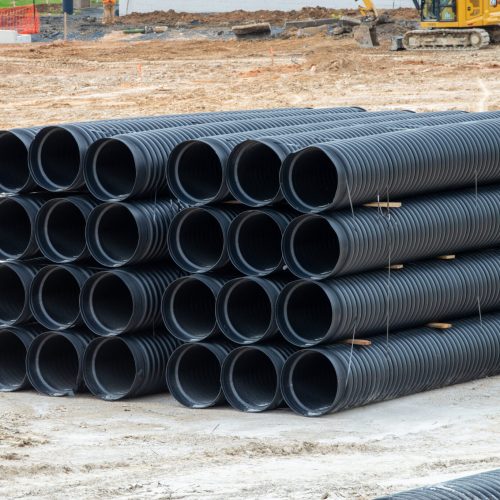
SDR 33 and SDR 41 are thin-walled pipe sections used in gravity sewer applications, non-pressure drainage systems, and conduit applications where the pipe carries no internal pressure. They are not appropriate for any pressurised water supply or process application. Their low wall thickness minimises material content and maximises bore area for gravity flow applications. These are typically complemented by HDPE DWC (Double Wall Corrugated) pipes for structural underground drainage — where the corrugated outer profile provides ring stiffness under burial loads that a thin-walled SDR 33/41 pipe cannot provide independently.
A question that often arises in procurement discussions is the difference between SDR and DR. DR stands for Dimension Ratio — the same mathematical formula (OD ÷ WT). The difference is that SDR refers specifically to dimension ratios that fall on the ANSI preferred number series (9, 11, 13.6, 17, 21, 26, 32.5). Any pipe whose dimension ratio exactly matches one of these standard values can be called an SDR pipe. DR refers to any dimensional ratio, whether it falls on a standard value or not.
In IS 4984 and in Indian infrastructure procurement practice, SDR is the correct and standard term. When you see “SDR 11” on an IS 4984 pipe, it means the ratio is precisely 11 — not approximately 11. The wall thickness is manufactured to the tolerance specified in the standard for exactly this ratio.
A critical but often overlooked aspect of SDR-based pressure rating is temperature. The PN ratings derived from the SDR formula are valid at 20°C — the standard reference temperature in IS 4984 and ISO 4427. As operating temperature increases above 20°C, the allowable working pressure of an HDPE pipe must be derated by factors published in the standard.
For HDPE in water supply applications in India, this matters in two primary contexts:
For above-ground installations in open sun — particularly in Gujarat, Rajasthan, and other high-temperature states where pipe surface temperatures can exceed 40°C during summer — the allowable working pressure is typically 80% of the rated PN value at temperatures approaching 40°C.
For solar park irrigation systems and industrial process lines carrying warm fluids, temperature derating becomes a formal design calculation. A PE100 SDR 17 pipe rated PN 10 at 20°C carries an effective PN of approximately 8 bar at 40°C. Engineers must account for this when selecting SDR for any application where operating temperatures will consistently exceed 20°C.
Gark Polyplast’s technical team can advise on appropriate SDR selection for specific temperature conditions as part of project consultation. Contact us with your project parameters.
One of HDPE pipe’s most significant advantages over PVC and Galvanised Iron (GI) alternatives is its surge pressure capacity. Water hammer — the pressure spike caused by sudden valve closure or pump start/stop — creates transient pressures that can substantially exceed the steady-state working pressure.
HDPE’s flexibility and viscoelastic behaviour allow it to absorb surge energy through controlled pipe wall deflection. Under IS 4984 and the relevant ISO standards, HDPE pipe is credited with the ability to handle surge pressures of up to 1.5 times the nominal pressure rating for recurring surge events and 2.0 times for occasional events. A PE100 SDR 17 pipe rated at PN 10 can safely handle recurring surge events at 15 bar and occasional surges at 20 bar.
PVC pipe does not have this surge allowance. A PVC pipe designed for PN 10 operation must have all anticipated surge pressures subtracted from its working pressure class — meaning a PN 10 PVC pipe in a system subject to 3 bar of surge pressure has an effective working capacity of only 7 bar. The same GI pipe system carries corrosion risk that progressively degrades burst pressure over its service life. HDPE’s surge capacity is a permanent material property that remains consistent throughout the pipe’s 50-year service life.
In India’s infrastructure procurement environment, three SDR-related specification errors occur frequently enough to warrant direct discussion:
Specifying PN class without specifying PE grade. A specification that says “PN 10 HDPE pipe” is incomplete. PE80 SDR 13.6 delivers PN 10. PE100 SDR 17 also delivers PN 10. PE63 SDR 11 also delivers PN 10. Three different pipes, different wall thicknesses, different material costs. The contractor is not required to supply the heavier specification if only the PN class is stated. Always specify PE grade + SDR + PN together.
Using SDR 26 or SDR 33 pipe in pressurised systems. This error occurs when procurement focuses on low unit cost without verifying the pressure adequacy. SDR 26 PE100 delivers only PN 6. A water distribution system operating at 8–10 bar that is fitted with SDR 26 pipe will experience premature failure — not immediately, but through progressive fatigue from sustained over-pressure. The cost of pipe replacement far exceeds the material cost saving at procurement.
Ignoring SDR when purchasing HDPE pipe for JJM projects. Jal Jeevan Mission tender documents specify IS 4984 compliant HDPE pipe with defined PN classes. Contractors who source HDPE pipe based solely on price without verifying SDR × PE grade against the tender PN specification risk rejection at quality inspection — or worse, network failures after commissioning that trigger penalty clauses.
India’s major infrastructure programmes create specific HDPE pipe demand across a clear SDR distribution:
Jal Jeevan Mission 2.0 (rural water supply, extended to December 2028, ₹8.69 lakh crore total outlay): Predominantly PE100 SDR 17 (PN 10) for distribution mains, PE100 SDR 11 or SDR 13.6 for rising mains in high-head zones.
AMRUT 2.0 (urban water supply renewal in 500+ towns): PE100 SDR 17 and SDR 13.6 for urban distribution networks with moderate operating pressures.
Agricultural irrigation networks under PMKSY: PE80 or PE100 SDR 21 to SDR 26 for low-pressure sprinkler and drip lateral supply mains. Gark Polyplast’s HDPE Sprinkler Pipes (IS 17425) serve the final distribution in these networks.
Industrial and chemical process piping: PE100 SDR 11 or SDR 9 for high-pressure and chemically aggressive process environments.
Gas distribution (natural gas networks): PE80 SDR 11 (PN 12.5) — the standard gas pipe specification under PNGRB guidelines.
Underground cable conduit and telecom OFC: SDR in this context is typically referenced through HDPE DWC pipes (IS 16098/IS 16205 for structural stiffness class, not PN class) and PLB duct pipes (TEC GR/TX/CDS-008/03 for telecom OFC). For these applications, the relevant specification is ring stiffness class (SN4/SN8) rather than SDR pressure rating. Gark Polyplast’s HDPE DWC Pipes and PLB Duct Pipes cover both these application categories.
Gark Polyplast Pvt. Ltd. manufactures IS 4984:2016 BIS/ISI certified HDPE pressure pipes in PE63, PE80, and PE100 grades across the full SDR series at its ISO 9001:2015, ISO 14001:2015, and ISO 45001:2018 certified facility in Palanpur, Gujarat.
Key product parameters:
Material grades: PE63, PE80, PE100 (virgin-grade compound) Available diameter range: 16mm to 315mm OD Available SDR series: SDR 6, SDR 9, SDR 11, SDR 13.6, SDR 17, SDR 21, SDR 26 (project-specific) PN classes: PN 2.5 to PN 16 (grade and SDR dependent) Standard compliance: IS 4984:2016 with BIS/ISI mark licence Testing: Hydrostatic pressure, MFR, tensile strength, ovality — in-house quality laboratory
Our full HDPE pipe dimensional data, wall thickness tables, and pressure rating charts by SDR and PE grade are available in the Gark Polyplast product catalogue. Factory-direct pricing with no intermediaries — contact our sales team for project quantities and latest ex-factory rates.
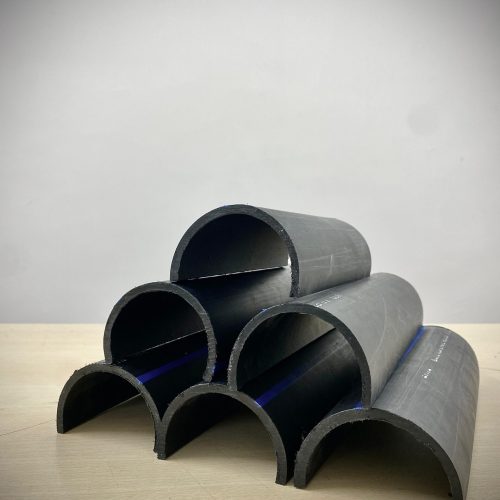
Our HDPE pressure pipe product complements the complete Gark Polyplast infrastructure piping range: HDPE DWC Pipes (IS 16098/IS 16205) for underground drainage, HDPE Half Round Pipes and DWC Half Round Pipes for cable protection and drainage channels, PLB Duct Pipes for telecom OFC infrastructure, and HDPE Sprinkler Pipes for agricultural irrigation — a complete piping portfolio from a single BIS-certified manufacturer.
For an understanding of HDPE as a material, our guide What is HDPE? Full Form, Properties and Industrial Uses covers the polymer science. For the full application landscape of HDPE pipes in India, What is an HDPE Pipe? Uses, Benefits and Applications in India provides the complete picture. For technical comparison with legacy materials, our published analyses of HDPE vs RCC Pipes — Detailed Comparison and What is an HDPE Half Round Pipe? Modern Alternative to RCC provide further technical context.
SDR stands for Standard Dimension Ratio. It is the ratio of an HDPE pipe’s nominal outside diameter to its nominal wall thickness, expressed as a single dimensionless number. For example, an HDPE pipe with an outer diameter of 110mm and a wall thickness of 10mm has an SDR of 11. The SDR is the primary parameter that determines an HDPE pipe’s pressure rating, wall thickness, and appropriate application — making it the most important single specification to verify when purchasing HDPE pipes.
The pressure rating (PN) of an HDPE pipe is calculated using the formula: PN = (20 × σ) ÷ (SDR − 1), where σ is the allowable hoop stress derived from the PE material grade’s Minimum Required Strength (MRS). For PE100 (MRS 10.0 MPa, σ = 8.0 MPa): SDR 17 gives PN 10; SDR 11 gives PN 16; SDR 26 gives PN 6. A lower SDR means a thicker wall, which means a higher pressure rating. The same SDR value produces the same PN rating for any diameter, which is what makes SDR the internationally recognised method for pressure pipe specification.
PE100 SDR 17 (PN 10) is the most widely specified HDPE pipe for Jal Jeevan Mission water distribution networks. It delivers 10 bar working pressure at 20°C, which is adequate for rural water supply distribution mains and service connections. For rising mains in high-head or high-elevation zones, PE100 SDR 13.6 (PN 12.5) or SDR 11 (PN 16) is specified. All JJM-supplied HDPE pipe must comply with IS 4984:2016 with BIS/ISI mark certification.
SDR 11 has a thicker wall (OD ÷ 11) than SDR 17 (OD ÷ 17) at the same outer diameter. For PE100 material: SDR 11 delivers PN 16 (16 bar working pressure) while SDR 17 delivers PN 10 (10 bar). SDR 11 is heavier, costs more per metre, and is used for high-pressure applications including gas distribution, high-pressure water transmission, and HDD installations. SDR 17 is lighter, more cost-effective, and is the standard for municipal water distribution, JJM water supply networks, and moderate-pressure infrastructure.
No — SDR and PN are related but distinct specifications. SDR is the geometric ratio (OD ÷ wall thickness) that defines the pipe’s physical dimensions. PN (Pressure Nominal) is the pressure rating that results from combining SDR with the PE material grade. The same SDR value gives different PN ratings for different PE grades: PE100 SDR 17 = PN 10, PE80 SDR 17 = PN 8, PE63 SDR 17 = PN 6. Correct HDPE pipe specification must state both SDR and PE grade — stating only PN class is ambiguous.
Natural gas distribution networks in India specify PE80 SDR 11 (PN 12.5) under PNGRB guidelines and relevant BIS standards. The high safety margins required for gas networks (due to the consequences of gas leakage versus water leakage) and the need for resistance to slow crack growth in soil environments make SDR 11 the standard gas pipe specification. PE100 SDR 11 (PN 16) is also used in larger-diameter gas transmission mains where higher operating pressures are required.
HDPE pipe fittings are sized by outer diameter (OD), not by SDR or wall thickness. This means that butt fusion and electrofusion fittings of the same OD can be used with pipes of different SDR values — the fusion joint is made at the outer diameter surface. However, mechanical fittings (compression joints, flanged connections) may require SDR-specific inserts or backup rings to accommodate the different wall thicknesses of SDR 11 versus SDR 17 pipe at the same OD. Always confirm fitting compatibility with the specific SDR being used. Gark Polyplast’s technical team can advise on fitting compatibility for your project. Contact us here.
Using a higher SDR pipe (thinner wall) in a pressurised system that requires a lower SDR (thicker wall) means the pipe’s PN rating is lower than the system’s operating pressure. At operating pressure, the pipe wall is subjected to hoop stress above its design limit. Over time — and sometimes immediately under surge conditions — this leads to pipe expansion, fatigue cracking, and ultimately burst failure. Using an incorrect (under-specified) SDR is a serious safety error in water supply and gas distribution projects. Always verify SDR × PE grade × PN against the system design pressure plus an appropriate safety margin before purchasing.
SDR in HDPE pipes is not a technicality for engineers to navigate in isolation from procurement decisions. It is the single most important number that determines whether an HDPE pipe is correctly specified for its application — or potentially dangerous.
The formula SDR = OD ÷ WT is simple. The consequences of misapplying it are not. Under-specifying SDR risks premature failure in pressurised infrastructure. Over-specifying SDR adds unnecessary cost to projects that already operate on tight margins. The correct SDR for each application is determined by system design pressure, PE material grade, operating temperature, and the specific standard (IS 4984:2016) that governs the product.
India’s infrastructure programmes — Jal Jeevan Mission 2.0 with its ₹8.69 lakh crore outlay extended to December 2028, AMRUT 2.0, PMKSY irrigation infrastructure, gas distribution network expansion — are creating demand for hundreds of millions of metres of correctly specified HDPE pressure pipe. The SDR system is the specification framework that ensures every metre of that pipe performs to its design intent over a 50-year service life.
Gark Polyplast Pvt. Ltd. is Gujarat’s BIS/ISI certified, ISO 9001:2015 certified manufacturer of IS 4984:2016 HDPE pressure pipes across PE63, PE80, and PE100 grades in the full SDR range — operating from Palanpur, Gujarat, with pan-India supply capability.
Explore our HDPE pipe range · Download our product catalogue · Contact us for project specifications and pricing · Become a distribution partner
Gark Polyplast Pvt. Ltd. is an ISI certified, BIS-marked manufacturer of HDPE DWC Pipes, HDPE Pipes, and PLB Ducts — operating from our state-of-the-art facility in Palanpur, Gujarat, since 2015.
 +91 9081300225 | +91 9081300226
 Sales@garkgroup.com | garkpolyplast@gmail.com
 www.garkgroup.com
 Gark Industrial Park, Kotda-Pirojpura Road, Palanpur, Gujarat 385010
Latest Post
Stay Updated With Insight
Subscribe to our social media channels, never miss the latest articles, expert blogs, your business effectively.
Related Post
Continue Reading
Table of Contents
×