
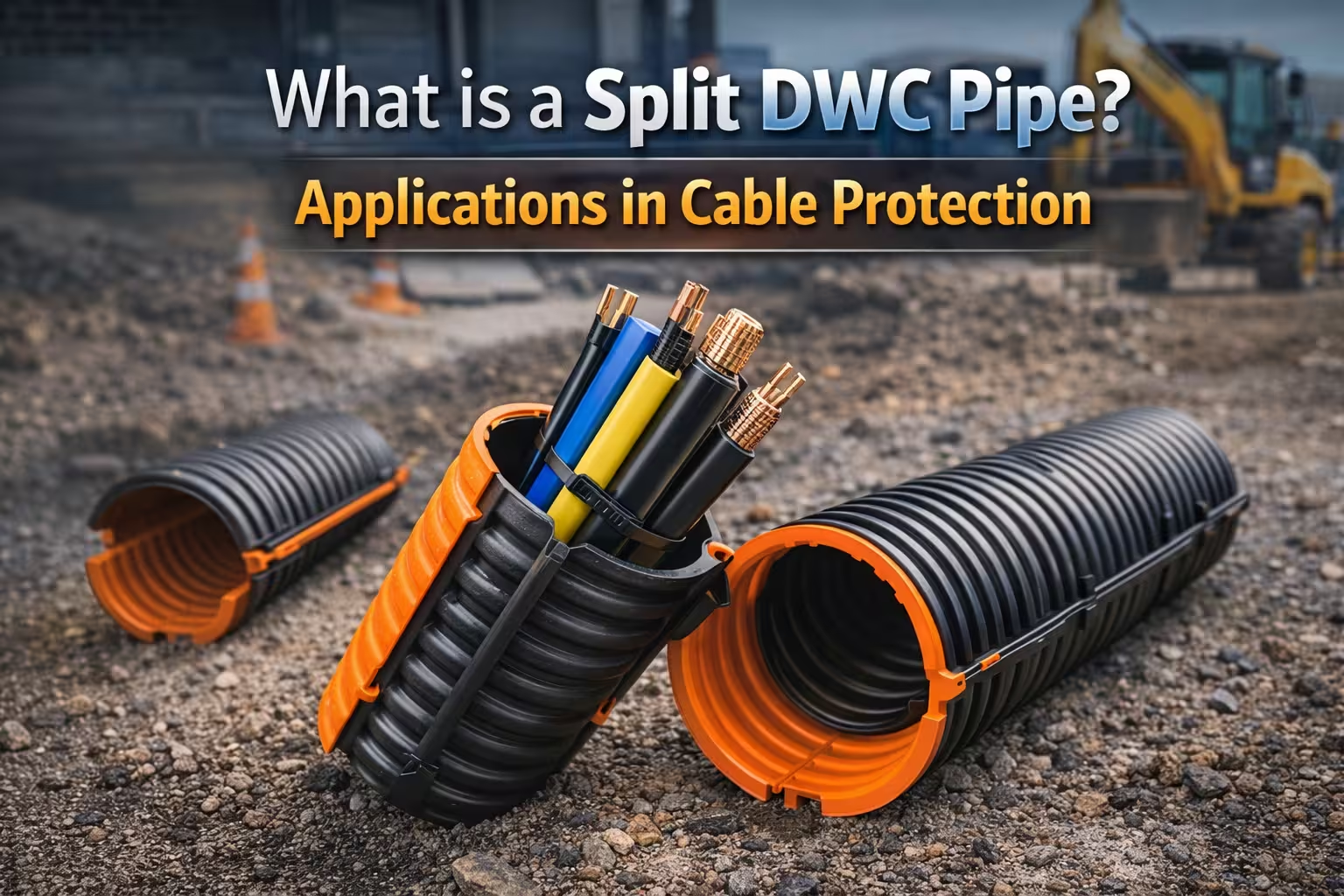
There is a problem every civil engineer, telecom project manager, and power utility contractor knows intimately — and rarely talks about publicly. You have an existing underground cable that needs protection. The cable is live. It is buried, operational, and you cannot disconnect it. Digging it up and rethreading it through a new full-round conduit would mean service disruption, costly excavation, and days of downtime that no project timeline or operations team can absorb.
What do you do?
The answer, increasingly across India’s infrastructure landscape, is a Split DWC Pipe — one of the most practical yet underappreciated innovations in the underground piping world. It solves the retrofitting problem completely, and it does so without cutting a single wire, without rewiring a single circuit, and without interrupting a single moment of service.
In this guide, we explore what a Split DWC Pipe actually is, how it differs from a standard DWC pipe, why India’s underground cable economy is growing at a pace that no one who builds infrastructure can afford to ignore, and every application sector where a Split DWC pipe delivers value that no other product can match.
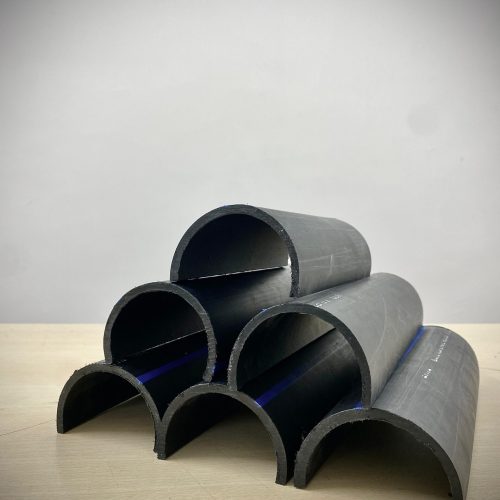
A Split DWC Pipe — also called a Half Round DWC Pipe, a split corrugated conduit, or a half-pipe cable protector — is a longitudinally cut version of a standard Double Wall Corrugated (DWC) pipe. Instead of presenting the cable with a complete circular bore that must be threaded from one end to the other, a Split DWC pipe is divided along its full length. The result is two mirrored corrugated halves that can be opened and clamped around an existing cable in situ, without removing, disconnecting, or even disturbing the cable itself.
In the simplest terms, imagine taking a full DWC pipe and slicing it cleanly along its length from one end to the other. You get two curved, corrugated half-shells. Position one half below the existing cable and one half above it, press or lock the two halves together, and the cable is now encased in a dual-wall corrugated HDPE shield. That shield offers virtually the same crush resistance, load distribution, UV protection, and mechanical impact resistance as a full-round conduit — all delivered around a cable that never stopped working.
The material is precisely the same as standard DWC pipes — virgin-grade High-Density Polyethylene (HDPE), the moulding-grade polymer that gives corrugated pipes their legendary combination of flexibility, chemical inertness, and structural longevity. Because HDPE does not corrode, does not degrade under soil chemicals, and resists the biological activity common in underground environments, a properly installed Split DWC pipe offers genuine long-term infrastructure protection, not a temporary workaround.
Key Insight: A Split DWC pipe does everything a full DWC pipe does in terms of cable protection — but it can be installed around a live, in-ground cable in a fraction of the time and at a fraction of the disruption cost. This is the defining advantage that no other conduit product can replicate.
The standard DWC pipe is a closed, continuous circular conduit. Its structural integrity derives from the complete ring formed by its cross-section — that closed ring is what generates the ring stiffness (SN class) that allows the pipe to resist soil overburden, vehicular load, and external crushing forces from every direction simultaneously.
A Split DWC pipe trades a portion of that radial closure for the far more critical advantage of retrofit capability. It is not a lesser product — it is a differently purposed one. While a standard DWC pipe is a new-installation product that goes into the trench before the cable is pulled through it, the Split DWC pipe is a protection, repair, and retrofit product that comes to the cable, wherever the cable already is.
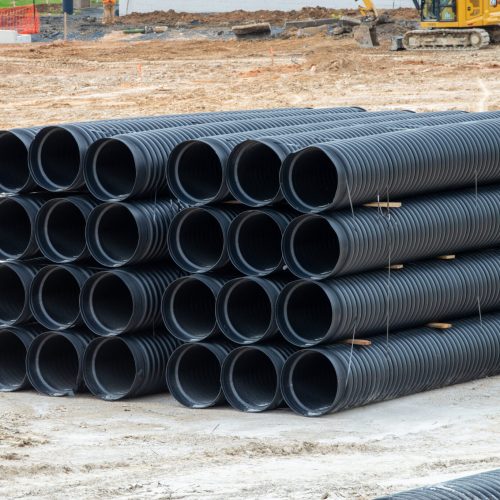
The corrugated outer profile of both products is identical in geometry. This matters because the corrugation on a Split DWC pipe — even in its half-round form — still distributes external loads across the corrugation ribs exactly as an arch distributes load in classical construction. A direct impact from a construction tool, a rock, or a vehicle load travelling through the soil above is intercepted by those corrugated ribs and spread laterally, dramatically reducing the peak stress that ever reaches the cable surface beneath.
When properly installed with compacted backfill surrounding both halves, the soil-pipe composite that forms around a Split DWC pipe comes very close to replicating the structural performance of a full-round conduit in service. It is this characteristic — reliable protection restored to an existing cable, with no excavation beyond what is minimally necessary — that makes the Split DWC pipe one of the most commercially and technically valuable tools in underground cable infrastructure management.
Understanding why a Split DWC pipe performs so well requires understanding a few principles of how flexible pipes behave underground.
When a standard DWC pipe is buried with properly compacted bedding and surround material, the pipe and the surrounding soil work together as a composite structural system. The pipe flexes slightly under load, which mobilises passive soil resistance on the pipe’s sides. It is this soil-pipe interaction that gives flexible HDPE pipes their remarkable load-carrying capacity at relatively low wall thicknesses. A properly compacted backfill around a flexible pipe contributes as much to its structural performance as the pipe material itself.
For a Split DWC pipe, the same principle applies. The two corrugated half-shells, once placed around the cable and surrounded by compacted granular backfill, function as the initiating structural element. They give the soil something to press against, and that soil pressure in turn locks the two halves together and creates the full protective envelope around the cable. The corrugated ribs keep the structural form rigid even as the HDPE material itself flexes under thermal and mechanical cycling.
The smooth inner wall of both halves means the cable sits against a friction-free, chemically inert HDPE surface that will not abrade the cable jacket over time. Unlike metal conduits, which can generate galvanic corrosion at the cable jacket interface, or concrete encasement, which can crack and create sharp edges that work against the cable during ground movement, HDPE is permanently gentle on everything it contacts.
The demand for cable protection solutions in India in 2025 is not a cyclical trend. It is a structural transformation of the country’s infrastructure, driven by multiple simultaneous government programmes and private sector investment waves that converge on the same requirement: more underground cable, better protected, deployed faster.
The India pipes market was valued at USD 14.40 billion in 2024 and is projected to reach USD 41.63 billion by 2034 at a CAGR of 11.20%. Within this market, the cable protection and underground conduit segment is identified as one of the fastest-growing verticals, driven by renewable energy infrastructure, telecom network expansion, and urban power distribution modernisation. HDPE conduits are already used in 41% of telecom projects for underground cable protection in India, and that share is climbing as fiber and 5G rollout accelerates.
The global cable conduit systems market was valued at USD 7.44 billion in 2024 and is growing at 8.6% CAGR. India accounts for USD 30.63 million of the global conduit pipe segment in 2025, expanding at 7.2% CAGR to 2034, and these figures cover only the formal, tracked market. The actual volume of HDPE conduit deployed in India — across government telecom projects, power sector schemes, highway corridors, and private developer works — is significantly larger than what formal market sizing captures.
The India wires and cables market, the industry that creates the demand for conduit protection, stood at USD 9.32 billion in 2024 and is growing at 7.94% CAGR toward USD 17.08 billion by 2032. Every new cable this market produces eventually needs protection underground, and a growing proportion of that protection requirement falls to HDPE corrugated conduits — full-round for new installations, split-round for the existing networks that were built without adequate protection.
The implication for Split DWC pipes specifically is this: India has built hundreds of thousands of kilometres of underground cable infrastructure across the past three decades, much of it without conduit protection or with inadequate conduit that has since degraded. As this infrastructure ages, as new construction activity threatens existing buried cables, and as government quality standards tighten, the demand for retroactive cable protection is climbing rapidly — and Split DWC pipes are the only product engineered specifically to meet it.
There was a time in India’s infrastructure history when underground cables were laid with minimal or no conduit protection. The logic was cost-driven: conduit added to the bill of materials, and budget constraints on government projects meant corners were cut. That approach is now generating consequences that are impossible to ignore.
Telecom networks are experiencing cable cuts from unrelated excavation work on roads above. According to industry data, accidental third-party excavation damage is one of the leading causes of fiber optic cable breaks in India, each incident capable of disrupting internet connectivity for thousands of users and costing lakhs of rupees in emergency repair and lost service revenue. Power distribution companies are dealing with cable faults from water ingress, soil chemical attack, and mechanical damage — problems that proper HDPE conduit protection would have prevented entirely.
The commercial calculus has shifted decisively. An underground cable without a conduit is one excavator strike away from a service failure. The cost of emergency repair, service restoration, customer claims, and the regulatory compliance burden of a forced outage far exceeds the cost of having installed proper conduit protection at the time of original cable laying — or of retrofitting it now with a Split DWC pipe.
Underground systems offer clear structural advantages over aerial cable runs: they are not vulnerable to cyclones, floods, storm damage, or the physical degradation from UV and thermal cycling that shortens the service life of overhead cable jackets. But those advantages are only realised if the cable is properly protected underground. A well-laid cable inside a properly installed HDPE conduit will serve for fifty years or more with zero maintenance. A poorly protected cable in aggressive soil can begin degrading within a decade.
India’s optical fiber revolution is the single largest driver of demand for Split DWC pipes in the country today. The BharatNet project — the world’s largest rural broadband connectivity programme — has already laid over 6.93 lakh kilometres of optical fiber cable, connecting 2,14,325 Gram Panchayats with broadband connectivity as of mid-2025. The total OFC network of PSUs including BSNL, BBNL, RailTel, and others has surpassed 42 lakh route kilometres.
A significant proportion of this fiber, particularly from early BharatNet phases executed under intense time pressure, was laid with minimal conduit protection. The priority was speed of deployment — getting fiber to every panchayat by the programme deadlines. Conduit systems were sometimes abbreviated or omitted, particularly on rural segments where construction supervision was less rigorous. Now, as this early-phase fiber ages and as maintenance teams begin encountering damage and degradation, the need to retrofit protection onto live, operational fiber runs has become a real and growing operational requirement.
The private telecom sector adds an equally urgent dimension. Jio, Airtel, and other private operators have laid hundreds of thousands of kilometres of their own fiber networks for 4G, 5G, and broadband FTTH services. Under India’s 5G rollout, fiber densification is required at scale — 5G small cells demand fiber backhaul to every base station, and much of that backhaul fiber must run underground through urban and semi-urban environments where surface traffic and construction activity create constant risk to buried cables.
In a typical telecom retrofit scenario, the fiber cable is already live and carrying traffic. Taking it down to install a full-round conduit is not a practical option. A Split DWC pipe — clamped around the existing duct or cable in the trench, with both halves locked in place and the trench backfilled — delivers complete mechanical protection without a single millisecond of service interruption. For a sector where uptime is measured in nine-nines and every outage has direct financial consequences, this is not just a convenient installation method. It is the only viable one.
India’s power sector is in the middle of one of the most ambitious underground cabling drives in its history. The Revamped Distribution Sector Scheme (RDSS), with a sanctioned outlay of approximately Rs 2,814 billion, is driving the conversion of overhead power lines to underground cable networks across hundreds of Indian cities and towns. Maharashtra leads in the extent of installed underground distribution networks, driven by RDSS and the Integrated Power Development Scheme (IPDS) implementations. Karnataka, Telangana, Delhi, Tamil Nadu, and Uttarakhand are all executing targeted underground cabling programmes.
In H1 2025-26 alone, one major EPC contractor reported completing 92 feeders for Uttar Gujarat Vij Company Ltd, installing over 700 km of underground cables as part of distribution network strengthening. At this scale — hundreds of kilometres of new underground cable being deployed every quarter across multiple states — the volume of conduit protection required is enormous. Full-round DWC pipes handle the new installations. Split DWC pipes handle the growing category of existing power cables that are already underground but were laid without conduit protection, in areas where RDSS or IPDS works are now upgrading the surrounding network.
The electrical insulation of a power cable degrades over time when directly exposed to soil moisture and the organic acids generated by soil bacteria. This degradation is slow but irreversible, and it leads to insulation faults that can cause outages, equipment damage, or safety incidents. A Split HDPE conduit installed around an existing direct-buried cable creates a chemically inert buffer zone around the cable jacket, halting this degradation process and substantially extending the operational life of the cable — often allowing the utility to defer expensive cable replacement by a decade or more.
Indian Railways and metro rail authorities represent a high-value and technically demanding market for cable protection solutions. The signalling systems that govern the safe movement of trains depend entirely on the physical integrity of underground signal cables running along track corridors. A single damaged signal cable can halt an entire train section, with cascading consequences across the rail network and severe safety implications.
Railway signalling cables face a protection challenge that goes beyond the soil pressure and moisture risks faced by static utility cables. They must also endure constant dynamic vibration from passing trains — repeated mechanical cycling that works differently from static soil loading and can, over time, cause cable jacket fatigue at points where the cable contacts hard surfaces. The corrugated profile of a Split DWC pipe addresses this by creating a flexible, slightly cushioned HDPE contact surface that absorbs vibratory energy through its rib geometry rather than transmitting it directly to the cable jacket.
Metro rail projects across Delhi, Mumbai, Bengaluru, Hyderabad, Chennai, Pune, and Ahmedabad require extensive underground cable networks for traction power, communication, SCADA systems, signalling, and fire and safety management. The service life expectation for metro rail infrastructure is fifty years and beyond. HDPE-based split conduits, with their fifty-year-plus service life, chemical inertness, and non-toxic material properties, align perfectly with these long-horizon infrastructure requirements. They will not corrode in the tunnel environment, will not emit toxic gases in fire scenarios, and will not require maintenance intervention across their operational life.
Every modern highway and expressway in India carries a significant volume of underground cable infrastructure alongside the carriageway — highway lighting power cables, CCTV camera feeds, emergency communication systems, toll management data cables, and increasingly, fiber optic backbone cables being deployed for 5G small cell coverage along highway corridors.
At road crossings — where cables must pass transversely beneath the carriageway — full-round DWC pipes are typically installed as part of the original civil works during road construction. But at the far greater number of points along a highway where cables run longitudinally in the verge or median, they are often laid with minimal protection and become vulnerable whenever maintenance work, drainage improvement, or vegetation management brings equipment close to the buried cable zone.
Split DWC pipes are ideal for protecting these longitudinal cable runs. They can be installed over existing cables with minimal excavation — often just enough depth to expose the cable, place the two halves around it, and backfill — without disturbing the road surface or requiring traffic management beyond what a basic maintenance operation would already involve. The result is a protected cable run capable of withstanding accidental contact from a maintenance excavator or grading machine without damage to the cable beneath.
The National Highways Authority of India (NHAI) is deploying fiber cable networks along 1,46,000 kilometres of national highways as part of its Integrated Multimodal Logistics strategy. Along these corridors, Split DWC pipes serve double duty: protecting newly laid cables at vulnerable points and retrofitting protection onto older cable runs that predate current conduit standards.
India’s renewable energy sector is growing at extraordinary speed. The country’s target of 500 GW of non-fossil fuel capacity by 2030 is driving the construction of large-scale solar parks, wind farms, and hybrid projects across Rajasthan, Gujarat, Tamil Nadu, Karnataka, and Andhra Pradesh. According to industry data, a 1 MW solar project requires approximately 50 km of solar cable. With India’s solar pipeline running into hundreds of gigawatts of planned capacity, the cumulative solar cable requirement alone runs into millions of kilometres — every metre of which eventually needs protection from soil pressure, UV, mechanical damage, and the constant thermal cycling that outdoor installations impose.
The demand for cable protection pipe in renewable energy infrastructure has risen by 54% globally over the past five years, driven specifically by solar and wind farm electrical cabling requirements. Within India, this growth is concentrated in the large solar parks under development, where cable infrastructure is laid in phases that create a specific problem: phase-one cables get buried and operational, and then phase-two or phase-three construction brings heavy vehicle traffic directly over them.
Split DWC pipes provide the solution to this phased-construction vulnerability. Phase-one cables that were direct-buried without conduit can be retroactively protected between construction phases — the cable is exposed with minimal excavation, the split halves are installed around it, and the trench is backfilled. The phase-one generation asset continues producing power uninterrupted while it receives the conduit protection it should have had from the beginning.
Wind farm cable infrastructure in coastal environments presents additional challenges beyond mechanical protection, because salt-laden soil is aggressively corrosive to both cable jackets and any metallic conduit system. HDPE is entirely immune to salt corrosion, making Split DWC pipes the unambiguous choice for wind farm cable protection in coastal Gujarat, Tamil Nadu, and Andhra Pradesh.
Large industrial facilities — manufacturing plants, chemical complexes, refineries, cement plants, steel mills, and food processing units — contain extensive underground cable networks supplying power to machinery, control systems, and instrumentation. These facilities are in a state of constant operational evolution: new equipment is installed, production lines are reconfigured, and civil works are undertaken on a continuous basis as part of operational improvement programmes.
In this environment, existing underground power and data cables are at perpetual risk of accidental damage during civil works carried out by contractors who may not have full awareness of cable routing. Even when cable routing drawings exist, they may not reflect the actual as-built positions of cables that were installed and modified over decades. Split DWC pipes give facilities infrastructure managers a fast way to add mechanical protection to critical cable runs identified as at-risk — without the operational disruption of a full cable replacement or rerouting.
In chemical plant environments, the soil chemistry around cable routes is often hostile, contaminated by process spills, chemical leaching, and industrial waste. HDPE is resistant to acids, alkalis, solvents, and a broad spectrum of industrial chemicals at the concentrations typically encountered in soil contamination. Metal conduit corrodes. PVC can be attacked by certain organic solvents. HDPE resists all of them across the temperature ranges encountered in industrial underground environments, making it the only material that delivers dependable long-term cable protection in these settings.
Perhaps the most urgently valuable application of Split DWC pipes is the repair of cable runs where the original conduit has failed. India has decades of underground infrastructure that was installed using materials that do not age gracefully — thin-walled PVC conduits that have cracked under soil pressure, concrete conduits that have fractured and collapsed, galvanised iron conduits that have corroded through. When an existing conduit fails but the cable inside is still functional, the practical challenge is to restore protection without replacing the cable itself.
Split DWC pipes solve this directly. The damaged conduit section is excavated to expose it, the failed conduit material is cleared, the cable is left undisturbed and operational, and the split halves are placed around it in the trench. The trench is backfilled and compacted. The repair is complete. The entire operation can typically be accomplished in a fraction of the time and cost that threading a new full-round conduit over the same cable would require — and with zero service interruption to whatever that cable is carrying.
For cables that have become fully exposed due to soil erosion, road resurfacing that cut deeper than expected, or construction work that removed overburden, Split DWC pipes also function as emergency protection that can be deployed rapidly — within hours of the exposure being discovered — while permanent reinstatement of the cable route is planned and scheduled.
When project teams evaluate cable protection options for retrofit scenarios, several alternatives come up for consideration. Understanding what they actually deliver — and where they fall short — clarifies why Split DWC pipes command the position they do.
Split PVC conduit is the most commonly proposed budget alternative. It is lighter and less expensive, but PVC conduit becomes progressively brittle with age, is vulnerable to point loading that causes cracking, and offers far lower structural stiffness than corrugated HDPE. More critically, PVC has limited chemical resistance in contaminated soil environments — precisely the environments where long-term cable protection is most needed. Split PVC conduit is a short-duration protective measure; Split DWC pipe is a permanent infrastructure solution.
Sand-cement encasement — pouring concrete around an exposed cable — provides decent crush resistance but is inflexible and cannot accommodate ground movement or cable thermal expansion. It is labour-intensive to apply, requires cure time before reinstatement, and when the cable eventually needs maintenance or replacement access, breaking out the concrete encasement becomes a major civil operation that risks damaging the cable in the process.
Metal clamshell conduits — split steel or cast iron half-pipes — provide mechanical strength but corrode over time in wet or chemically active soil. They are extremely heavy to handle and transport, particularly in the larger diameters used for power cable protection, and they present galvanic risk when in contact with copper or aluminium cable jackets. In coastal environments or industrial soil, their service life may be twenty years or less.
Leaving the cable unprotected remains — astonishingly — the most common outcome when project teams cannot find an easy answer. The consequences are the predictable ones: accidental cable damage during future works, service outages, emergency repair costs, safety incidents, and the regulatory and reputational burden that follows. The one-time cost of a Split DWC pipe installation is a fraction of a single emergency repair event, and the protection it provides is permanent.
HDPE Split DWC pipes combine corrugated structural strength, chemical inertness, EPDM-compatible flexibility, lightweight handling, rapid installation, and a service life that extends fifty years or more into a single product. No alternative delivers all of these properties together.
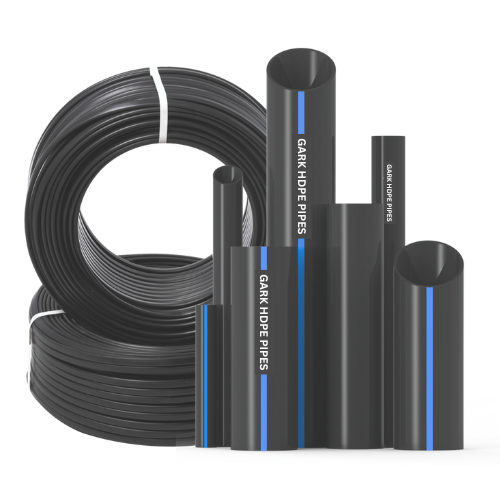
The quality of a Split DWC pipe is entirely determined by the quality of the HDPE compound from which it is manufactured. At Gark Polyplast, our HDPE Half Round Pipes are manufactured from the same virgin-grade HDPE moulding compound used across our full DWC pipe, HDPE pressure pipe, and PLB duct product ranges. No recycled or blended polymer enters our production process.
The compound is carbon black-stabilised to provide UV resistance during outdoor storage and handling. The corrugation profile is formed through precision extrusion and moulding processes that ensure dimensional consistency across every length produced. Every batch undergoes quality testing for dimensional accuracy, material consistency, and corrugation geometry before release for despatch.
Gark Polyplast holds ISO 9001:2015 certification for Quality Management Systems, ISO 14001:2015 for Environmental Management Systems, and ISO 45001:2018 for Occupational Health and Safety Management Systems. Our DWC pipe range carries BIS/ISI mark certification in compliance with IS 4984, IS 16098, and IS 16205. These certifications are not marketing claims — they are audited, third-party verified quality commitments that our customers can verify and rely on.
Our HDPE Half Round Pipes are available in sizes from 16 mm to 250 mm nominal diameter, covering the full range from small-diameter signal and communication cables through to large-diameter HT power cable protection requirements. We manufacture at our Gark Industrial Park facility in Palanpur, Gujarat, and supply across Gujarat, Rajasthan, Maharashtra, Madhya Pradesh, and beyond.
The installation of a Split DWC pipe is one of the most straightforward operations in underground cable management, which is one of the reasons contractors and utility maintenance teams favour it so strongly in retrofit scenarios.
The process begins with a site assessment and marking of the cable route, followed by a trench excavation that is typically narrower and shallower than what a new conduit installation would require — because the purpose is to expose the cable, not to create a full cable-laying trench from scratch. Once the cable is exposed, its jacket condition is inspected. Any existing jacket damage should be repaired with appropriate sealing tape or heat shrink sleeve before the conduit is placed — encasing a damaged jacket without repairing it simply defers a fault.
With the cable lying in the trench, one half of the Split DWC pipe is placed below it as a cradle, and the second half is positioned above as a cap. Where the split pipe incorporates a snap-fit or interlocking edge profile, the two halves are pressed together until they engage. For standard half-round configurations without integral locking, cable ties or banding tape are applied at regular intervals along the run to maintain alignment between halves until the backfill is placed.
At the junction between successive pipe lengths, a split coupler sleeve fits over the pipe ends to maintain the corrugated protection continuously across the joint without gaps or step changes in profile. Once the assembly is in position, selected granular backfill is placed and compacted in layers — the compaction process is what activates the soil-pipe composite behaviour that gives the installation its final structural performance. Warning marker tape is placed in the backfill above the pipe to alert any future excavators in the area. The installation record and as-built documentation are updated to reflect the new conduit.
For larger diameter cables or cables with significant longitudinal tension in the burial path, additional measures such as cable clamping to hold position during assembly, or the use of heavier wall thickness half-pipe sections with a higher SN-equivalent profile, may be specified. Our technical team works directly with project engineers on any application that requires specific guidance beyond the standard installation method.
At Gark Polyplast, our HDPE Half Round Pipes are manufactured as a dedicated product line within our broader corrugated pipe portfolio, alongside our standard HDPE DWC Pipes, PLB Ducts, HDPE Pressure Pipes, and HDPE Sprinkler Pipes. The Half Round Pipe is not a secondary or adapted product — it is a purpose-engineered product manufactured on the same equipment and to the same material specifications as our full-round DWC pipe range.
The corrugation geometry on our Half Round Pipes is identical to that of our full DWC range. The smooth inner surface finish meets the same specification. The HDPE compound is the same virgin-grade material. What differs is only the form — the pipe is cut longitudinally to provide the split configuration that makes retrofit installation possible.
Available in 16 mm to 250 mm nominal diameter, supplied in standard lengths suitable for infrastructure project quantities, and backed by our ISO-certified quality management systems, our HDPE Half Round Pipes are ready to specify into any cable protection retrofit project, emergency conduit repair programme, or new installation where split-pipe geometry is the design requirement.
A Split DWC pipe is known by several names — Half Round DWC Pipe, split corrugated conduit, split corrugated pipe, or half-pipe cable protector. At Gark Polyplast, it is manufactured and supplied as an HDPE Half Round Pipe. All of these names refer to the same product: a full DWC pipe cut longitudinally into two halves that can be clamped around an existing cable without disconnecting it.
Yes — and this is precisely its primary application. Because installation involves clamping the two halves around the cable mechanically from outside rather than threading the cable through a closed bore, there is no need to de-energise, disconnect, or splice the cable at any point. The installation process is entirely mechanical and does not contact the conductor of the cable. This makes it the only conduit solution that can protect a live power, fiber, or signal cable in the ground without any service interruption.
A standard DWC pipe is a closed circular conduit used for new cable installations — the cable is pulled through the pipe before it is buried. A Split DWC pipe is cut along its full length, allowing it to be opened and fitted around an existing cable in the ground. Both are made from the same HDPE material with the same corrugated outer profile, but they serve fundamentally different installation scenarios: one for new construction, one for retrofit and protection of existing infrastructure.
The two halves are held together through a combination of interlocking snap-fit edges where the pipe design includes them, cable ties or banding tape applied during installation, and ultimately the compacted backfill material that surrounds the pipe assembly in the trench. Properly compacted granular backfill provides the primary structural confinement in permanent underground installations, locking both halves in position and activating the soil-pipe composite behaviour that gives the installation its structural performance.
Gark Polyplast manufactures HDPE Half Round Pipes in nominal diameters from 16 mm to 250 mm, covering signal cables, communication cables, fiber optic ducts, LT power cables, and HT power cables. For specific size availability, current stock, and volume requirements, contact our sales team directly.
They can be. Split DWC pipes are effective for protecting cable runs along walls, beneath floor slabs, in cable trays, or at surface-level exposure points where mechanical protection is needed. In permanent above-ground outdoor use, the UV-stabilised HDPE resists sunlight degradation, and the split halves should be secured with appropriate clamps or cable ties at regular intervals since they cannot rely on backfill compaction to maintain their position. Our technical team can advise on above-ground fixing requirements for specific applications.
When installed correctly with appropriate bedding and backfill, HDPE Split DWC pipes have a service life equivalent to standard DWC pipes — 50 years or more under normal underground conditions. HDPE does not corrode, does not react with soil chemicals, resists biological degradation, and maintains its mechanical properties under the temperature and pressure conditions typical of underground installations across India’s diverse climatic and soil environments.
No. Split DWC pipes do not require adhesive, solvent cement, or any jointing compound. Successive pipe lengths are joined end-to-end using a mechanical split coupler sleeve that fits over the abutting ends. No bonding agents are needed. The installation process is clean, fast, and free from the cure-time delays that adhesive or bituminous jointing systems impose — an important practical advantage in time-sensitive infrastructure repair and retrofit scenarios.
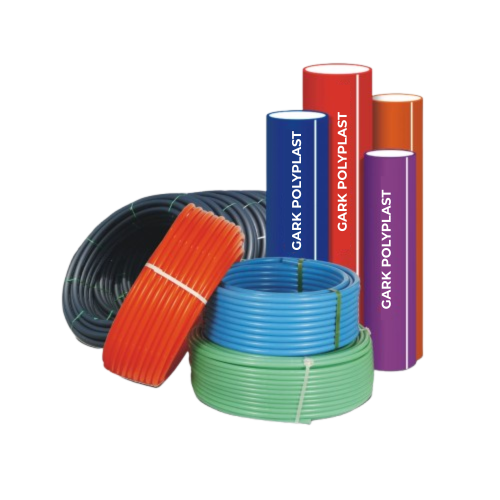
Gark Polyplast Pvt. Ltd. is an ISI certified, BIS-marked manufacturer of HDPE DWC Pipes, HDPE Pipes, and PLB Ducts — operating from our state-of-the-art facility in Palanpur, Gujarat, since 2015.
 +91 9081300225 | +91 9081300226
 Sales@garkgroup.com | garkpolyplast@gmail.com
 www.garkgroup.com
 Gark Industrial Park, Kotda-Pirojpura Road, Palanpur, Gujarat 385010